Disaster Management · TEE · papers
Q7A · Explain in detail Cause, Characteristics and Mitigation measures for “Topple” type of…
2026-02-12 · Semester V re-exam
Actual TEE paper · 100 marks · 3 hours · Q1 + any four of Q2–Q7
Q7A. Explain in detail Cause, Characteristics and Mitigation measures for “Topple” type of Landslide. [10 marks]
Answer
A topple is the forward rotation of a rock or soil mass out of a slope about a pivot near its base. It differs from a slide, in which a mass moves along a rupture surface.
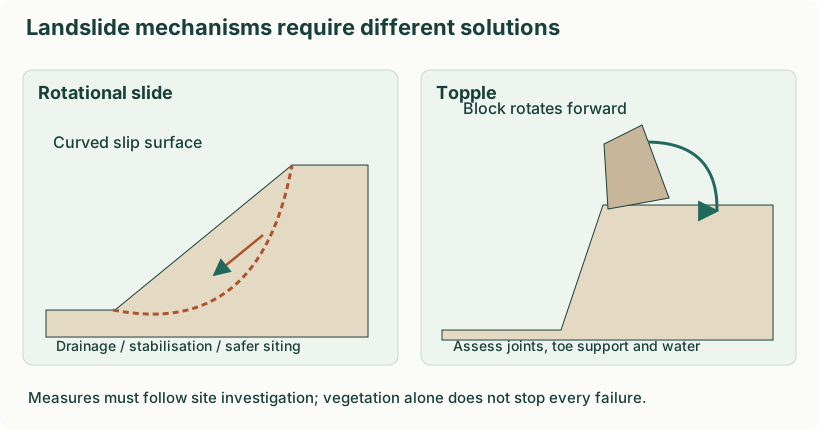
Diagram: Landslide mechanisms require different solutions. Labels: Landslide mechanisms require different solutions | Landslide mechanisms require different solutions | Rotational slide | Topple | Curved slip surface | Drainage / stabilisation / safer siting | Block rotates forward | Assess joints, toe support and water | Measures must follow site investigation; vegetation alone does not stop every failure.
Causes and characteristics
- Fractured structure. Steeply jointed or layered rock can form columns or blocks with limited lateral support.
- Loss of support. Erosion or excavation at the toe can remove resistance and allow forward rotation.
- External triggers. Water pressure, weathering, freeze-thaw where applicable or earthquake shaking can destabilise blocks.
- Visible behaviour. Leaning blocks, opening joints and detached fragments may indicate instability. Movement may involve individual blocks or a larger interacting mass.
Mitigation
- Investigate and restrict exposure. Map unstable rock and keep buildings, parking and people away from the potential fall/runout zone.
- Improve drainage. Control infiltration and pressure through professionally designed drainage.
- Stabilise or remove hazardous material. Suitable anchors, bolts, support or controlled scaling require specialist design and trained execution.
- Protect and monitor. Use designed catch structures where appropriate; monitor movement and close threatened routes when necessary.