Disaster Management · TEE · papers
Q2A · Illustrate and explain in detail with neat sketch 3 types of waves for earthquakes. A…
2026-05-15 · Semester VI final
Actual TEE paper · 100 marks · 3 hours · Q1 + any four of Q2–Q7
Q2A. Illustrate and explain in detail with neat sketch 3 types of waves for earthquakes. Also state the 2 types of earthquakes on earthquake on basis of plate boundaries [10 marks]
Answer
Definition. Seismic waves are disturbances carrying earthquake energy. Body waves travel through the Earth; surface waves propagate along its surface.
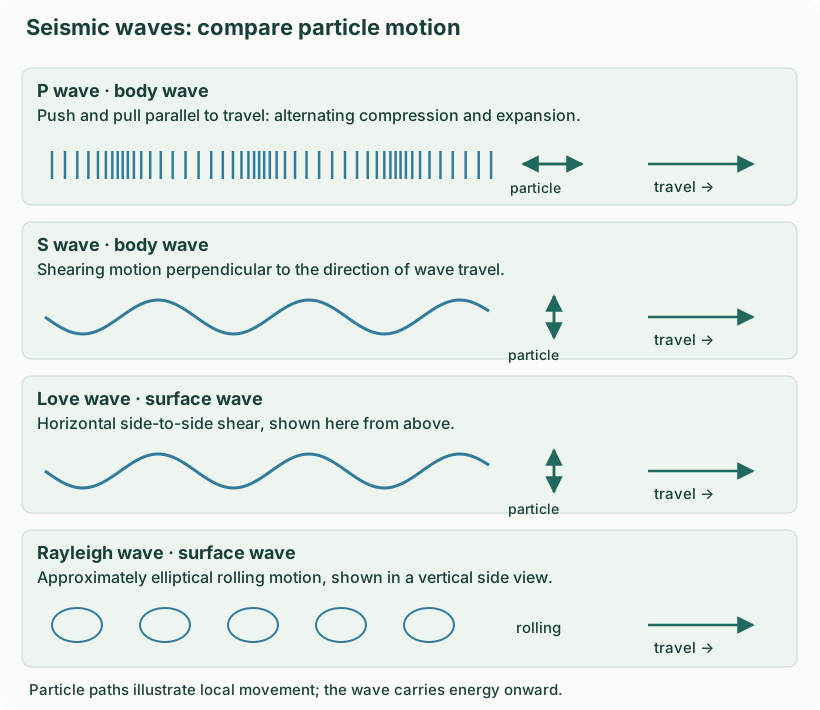
| Wave | Particle movement | Travel / key point |
|---|---|---|
| P: primary | Compression and expansion parallel to travel direction. | Fastest body wave; travels through solids and fluids. |
| S: secondary | Shearing perpendicular to travel direction. | Slower than P; cannot propagate through liquids as shear waves. |
| Love | Horizontal side-to-side surface motion. | Surface wave; produces strong lateral shaking. |
| Rayleigh | Rolling, approximately elliptical motion in a vertical plane. | Surface wave with vertical and horizontal ground movement. |
“Direction of travel” means where wave energy moves. “Particle movement” means how a small part of the ground moves locally. A particle need not travel all the way from the fault to your city. Do not list Love waves as body waves.
How shaking is recorded
A seismometer senses ground movement. A seismograph is the sensing-and-recording system; a seismogram is its record. A classical instrument uses inertia: the supporting ground moves relative to a suspended mass. Modern electronic instruments record a time series. Sensor, recorder and timing reference are the three basic components.
Why P–S arrival separation is useful
P waves arrive first because they travel faster. The P–S time gap generally increases with source distance. Records from several stations constrain earthquake location. One station alone does not uniquely locate an epicentre; real location calculations use travel-time models.
Interplate and intraplate earthquakes
Interplate earthquakes occur at plate boundaries. Intraplate earthquakes occur within a plate, commonly on reactivated faults. Boundary setting is different from classification by depth or by tectonic/volcanic origin.