Disaster Management · TEE · papers
Q2A · Describe in detail with neat sketch 3 types of boundaries for earthquakes. Also state…
2026-07-10 · Semester VI re-exam
Actual TEE paper · 100 marks · 3 hours · Q1 + any four of Q2–Q7
Q2A. Describe in detail with neat sketch 3 types of boundaries for earthquakes. Also state the causes of earthquake [10 marks]
Answer
Definition. Earthquakes can be classified by their cause, position relative to plates and focal depth. These are different classification bases, so one event can belong to several categories at once.
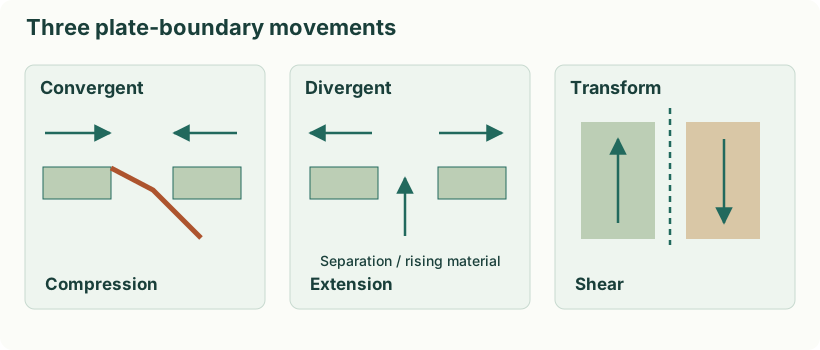
Diagram: Three plate-boundary movements. Labels: Three plate-boundary movements | Three plate-boundary movements | Convergent | Divergent | Transform | Separation / rising material | Compression | Extension | Shear
| Boundary | Movement | Typical process |
|---|---|---|
| Convergent | Plates move towards one another. | Subduction or continental collision builds compressive stress. |
| Divergent | Plates move apart. | Extension and faulting occur as new crust forms at spreading boundaries. |
| Transform | Plates slide horizontally past one another. | Shear stress is released along strike-slip faults. |
| Classification | Types and meaning |
|---|---|
| By plate position | Interplate: at a plate boundary. Intraplate: within a plate away from its boundary; old faults can reactivate. |
| By cause | Tectonic movement; volcanic activity; collapse in cavities; induced events associated with activities such as mining or reservoir loading. |
| By focal depth | Common seismological grouping: shallow 0–70 km, intermediate 70–300 km, deep 300–700 km. Boundary conventions may be inclusive on either side. |
A shallow event can produce severe local shaking because its source is close to the surface, but depth alone does not determine damage. Magnitude, distance, soil, construction and preparedness also matter. Intraplate does not mean harmless: Kutch and the peninsular region have experienced damaging earthquakes.