Disaster Management · TEE · papers
Q5A · An area faces River Floods frequently. Suggest any 4 mitigation measures that can be …
2026-07-10 · Semester VI re-exam
Actual TEE paper · 100 marks · 3 hours · Q1 + any four of Q2–Q7
Q5A. An area faces River Floods frequently. Suggest any 4 mitigation measures that can be adopted for the same. Describe and Justify your suggestion in detail with sketches. [10 marks]
Answer
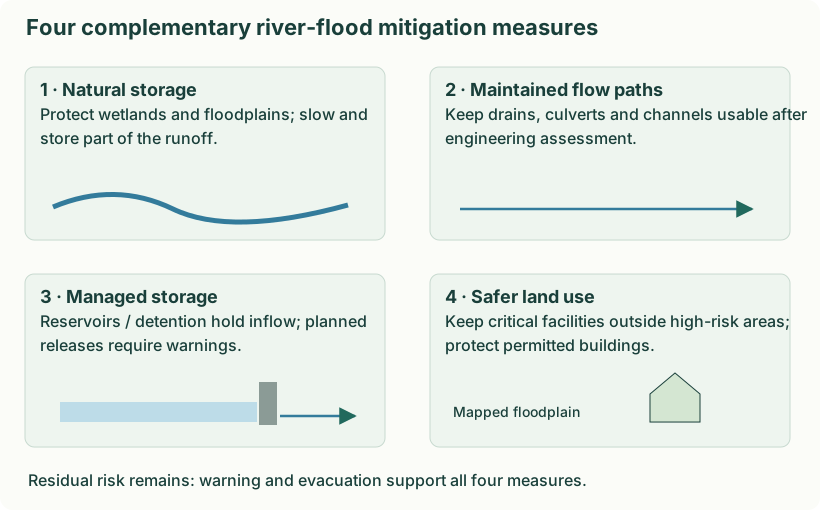
Diagram: Four complementary river-flood mitigation measures. Labels: Four complementary river-flood mitigation measures | Four complementary river-flood mitigation measures | 1 · Natural storage | Protect wetlands and floodplains; slow and | store part of the runoff. | 2 · Maintained flow paths | Keep drains, culverts and channels usable after | engineering assessment. | 3 · Managed storage | Reservoirs / detention hold inflow; planned | releases require warnings. | 4 · Safer land use | Keep critical facilities outside high-risk areas; | protect permitted buildings. | Mapped floodplain | Residual risk remains: warning and evacuation support all four measures.
- Maintain the catchment and natural storage. Protect wetlands and floodplains and restore suitable vegetation. These measures slow runoff and store part of the floodwater, although they cannot eliminate extreme floods.
- Manage channels and drainage. Remove blockages and maintain bridges, culverts and drains. Engineering surveys should guide selective desilting; indiscriminate excavation can damage banks and ecosystems.
- Use storage and coordinated reservoir operation. Detention basins and reservoirs can hold water and release it more slowly. Forecasts, operating rules and downstream warnings are essential because storage and outlet capacity are finite.
- Apply floodplain zoning and resilient construction. Keep new critical facilities outside high-risk zones. Where occupation is permitted, use suitable raised floors, protected utilities and evacuation access to reduce losses.
All structural measures retain residual risk, so forecasting, warning and evacuation remain necessary.