Disaster Management · TEE · practice
Channel discharge — optional lecture-formula practice
Optional calculation practice
Supplementary worked examples · no numerical question found in the available 12 TEE sittings
Definition. Discharge is the volume of water passing a cross-section per unit time. For a known flowing cross-sectional area and average velocity, Q = Av.
Simple meaning. Cross-section mein kitna area hai × paani kitni speed se jaa raha hai.
 LaTeX:
Q=A_{flow}\,vAflow is the wet cross-sectional area in m²; v is average velocity in m/s. Multiplying m² by m/s gives m³/s. This A is different from the catchment area used in the rational method.
Illustrative calculation (not a PYQ). Water flows through a rectangular drain 2 m wide and 1.5 m deep at an average velocity of 0.8 m/s. Find discharge.
Answer
Given
Width=2 m; flowing depth=1.5 m; v=0.8 m/s.
To find
Q.
Formula and why
 LaTeX:
A_{flow}=\text{width}\times\text{depth},\quad Q=A_{flow}vThe cross-section is rectangular, so width times flowing depth gives wet area.
Step-by-step solution
Step 1. Find area
 LaTeX:
A_{flow}=2\times1.5=3\text{ m}^2Step 2. Find discharge
 LaTeX:
Q=3\times0.8=2.4\text{ m}^3/\text{s}Final answer: 2.4 m³/s.
Illustrative calculation (not a PYQ). Silt reduces the same drain’s flowing depth from 1.5 m to 1 m. Assume the average velocity remains 0.8 m/s. Find the reduction in discharge.
Answer
Given
Width=2 m; new depth=1 m; v=0.8 m/s; old Q=2.4 m³/s.
To find
New Q and reduction.
Formula and why
 LaTeX:
Q=A_{flow}vThe fixed-velocity assumption isolates the effect of reduced cross-sectional area.
Step-by-step solution
Step 1. Find reduced area
 LaTeX:
A_{flow}=2\times1=2\text{ m}^2Step 2. Find reduced discharge
 LaTeX:
Q=2\times0.8=1.6\text{ m}^3/\text{s}Step 3. Calculate loss
 LaTeX:
2.4-1.6=0.8\text{ m}^3/\text{s}Step 4. Express as percentage
 LaTeX:
(0.8/2.4)\times100=33.333\%Final answer: Reduction =0.8 m³/s, or 33.3% under the assumption.
Illustrative calculation (not a PYQ). A channel must carry 6 m³/s at an average velocity of 1.5 m/s. Find the required flowing cross-sectional area.
Answer
Given
Q=6 m³/s; v=1.5 m/s.
To find
Aflow.
Formula and why
 LaTeX:
Q=A_{flow}v\quad\Rightarrow\quad A_{flow}=Q/vDivide both sides by velocity to isolate area.
Step-by-step solution
Step 1. Substitute the known values
 LaTeX:
A_{flow}=6/1.5Step 2. Calculate and write units
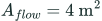 LaTeX:
A_{flow}=4\text{ m}^2Final answer: Required flowing area =4 m², under the stated average velocity.
Desilting may restore lost capacity, but actual velocity, downstream water level and channel stability also change. A calculation holding velocity fixed is a teaching comparison, not proof that desilting alone will prevent floods.
Yaad rakho: Catchment area receives rain; channel area carries flow.