Disaster Management · TEE · practice
Magnitude comparisons — optional authored practice
Optional calculation practice
Supplementary worked examples · no numerical question found in the available 12 TEE sittings
Definition. A logarithmic scale expresses multiplicative changes as differences. A base-10 logarithm asks: “10 raised to what power gives this number?”
Simple meaning. Log bas ulta sawaal hai: 10 ki kaunsi power?
For example, 10² = 100, so log₁₀(100) = 2. On a compatible amplitude-based magnitude scale, a difference of 1 corresponds to a factor of 10 in measured amplitude after the required corrections. Earthquake energy follows the approximate relationship below; energy and amplitude are different quantities.
 LaTeX:
\Delta M=M_2-M_1,\qquad \frac{A_2}{A_1}=10^{\Delta M}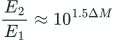 LaTeX:
\frac{E_2}{E_1}\approx10^{1.5\Delta M}A is wave amplitude; E is released energy; Δ means “change in”. Amplitude comparisons assume the relevant scale and comparable/corrected recording conditions. Do not turn an energy ratio into a claim about building damage.
Illustrative calculation (not a PYQ). Compare the amplitude and approximate energy of earthquakes of magnitude 6 and 5.
Answer
Given
M₂ = 6; M₁ = 5.
To find
A₂/A₁ and E₂/E₁.
Formula and why
 LaTeX:
A_2/A_1=10^{\Delta M};\quad E_2/E_1\approx10^{1.5\Delta M}The magnitude difference is the exponent in the respective logarithmic relationship.
Step-by-step solution
Step 1. Find the difference
 LaTeX:
\Delta M=6-5=1Step 2. Find amplitude ratio
 LaTeX:
A_2/A_1=10^1=10Step 3. Find energy ratio
 LaTeX:
E_2/E_1\approx10^{1.5}=31.6228Final answer: 10 times the amplitude and approximately 31.6 times the energy.
Illustrative calculation (not a PYQ). Compare magnitude 7 with magnitude 5 using amplitude and energy ratios.
Answer
Given
M₂ = 7; M₁ = 5.
To find
The two ratios.
Formula and why
LaTeX: A_2/A_1=10^{\Delta M};\quad E_2/E_1\approx10^{1.5\Delta M}There are two magnitude units between the events, so multiply factors through the exponent.
Step-by-step solution
Step 1. Subtract magnitudes
 LaTeX:
\Delta M=7-5=2Step 2. Calculate amplitude
 LaTeX:
10^2=100Step 3. Calculate energy
 LaTeX:
10^{1.5\times2}=10^3=1000Final answer: 100 times the amplitude; approximately 1,000 times the energy.
Illustrative calculation (not a PYQ). A corrected amplitude ratio is 100. Find the magnitude difference. If the smaller event has magnitude 4.3, estimate the larger event’s magnitude.
Answer
Given
A₂/A₁ = 100; M₁ = 4.3.
To find
ΔM and M₂.
Formula and why
 LaTeX:
\Delta M=\log_{10}(A_2/A_1),\quad M_2=M_1+\Delta MThe logarithm reverses exponentiation: 10² is 100.
Step-by-step solution
Step 1. Take the base-10 logarithm
 LaTeX:
\Delta M=\log_{10}(100)=2Step 2. Add the difference
 LaTeX:
M_2=4.3+2=6.3Final answer: Magnitude difference 2; larger magnitude 6.3.
Calculator: use the log key for base 10, not ln. For 101.5, use the calculator’s 10ˣ function with exponent 1.5. Keep brackets around a multiplied exponent.
Yaad rakho: +1 magnitude: ×10 amplitude, about ×32 energy.