Intelligent Systems II · M2 · formulas
Fuzzy formulas, with meanings and worked-example links
All M2 formulas
One place for the formulas, meanings, conditions and links to full worked examples.
Fuzzy formulas
Triangular membership
 LaTeX:
\mu(x)=\max\left(0,\min\left(\frac{x-a}{b-a},\frac{c-x}{c-b}\right)\right)a=left zero, b=peak, c=right zero, with a<b<c. Locate x before choosing the rising/falling branch.
Read the explanation and worked sums →
Union and intersection
 LaTeX:
\mu_{A\cup B}=\max(\mu_A,\mu_B)\quad\mu_{A\cap B}=\min(\mu_A,\mu_B)Compare memberships at the same element. These formulas use standard max–min operations.
Read the explanation and worked sums →
Complement and difference
 LaTeX:
\mu_{A^c}=1-\mu_A\quad\mu_{A\setminus B}=\min(\mu_A,1-\mu_B)A difference means A AND NOT B; it is not ordinary subtraction.
Read the explanation and worked sums →
Rule strength, clipping and aggregation
 LaTeX:
\alpha_r=\min(a_r,b_r)\quad\mu_r(z)=\min(\alpha_r,\mu_{C_r}(z))\quad\mu_{out}(z)=\max_r\mu_r(z)a,b are input degrees; α is the strength; z is a candidate output value. OR conditions use max instead.
Read the explanation and worked sums →
Mean of maxima
 LaTeX:
z^*=\frac{\sum_{z_i\in M}z_i}{|M|}\quad\text{one plateau }[a,b]:\ z^*=(a+b)/2M is the set of discrete output locations attaining maximum membership. The plateau shortcut is for one continuous maximum interval.
Read the explanation and worked sums →
Discrete / continuous centroid
 LaTeX:
z^*=\frac{\sum_i z_i\mu_i}{\sum_i\mu_i}\qquad z^*=\frac{\int z\mu(z)\,dz}{\int\mu(z)\,dz}Use actual discrete memberships or the full continuous aggregate. Denominator must be positive.
Read the explanation and worked sums →
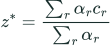
Specified representative-weighted output
 LaTeX:
z^*=\frac{\sum_r\alpha_r c_r}{\sum_r\alpha_r}c is a supplied representative such as a peak. Do not call this the exact area centroid of a clipped Mamdani aggregate without justification.
Read the explanation and worked sums →
Cartesian product and max–min composition
 LaTeX:
R_{ij}=\min(A_i,B_j)\quad T_{ik}=\max_j\min(R_{ij},S_{jk})Relations must have a common middle domain in the same order. Min along a path, max across paths.
Read the explanation and worked sums →
Other membership formulas from the reading lessons
Trapezoid with distinct breakpoints
 LaTeX:
\mu(x)=\max\left(0,\min\left(\frac{x-a}{b-a},1,\frac{d-x}{d-c}\right)\right)For a<b≤c<d: a is the left zero, b the start of the height-1 plateau, c its end and d the right zero. Vertical shoulder edges need the specified piecewise definition. Branch examples →
Gaussian membership
 LaTeX:
\mu(x)=e^{-(x-c)^2/(2\sigma^2)}c is the centre and σ>0 sets the width. At x=c the exponent is zero and membership is 1. Worked exponential calculations →
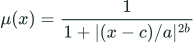
Generalised bell membership
 LaTeX:
\mu(x)=\frac{1}{1+|(x-c)/a|^{2b}}a>0 controls width; b>0 controls steepness; c is the centre. First subtract c, divide by a, take absolute value, apply the power, add 1, then take its reciprocal.
Alpha-cut
 LaTeX:
A_\alpha=\{x:\mu_A(x)\ge\alpha\}α is the chosen membership threshold. For 0<α≤1 keep inputs meeting or exceeding it, including threshold-equality endpoints. Discrete and triangular examples →