Intelligent Systems II · M2 · papers
Q3(b) Fuzzy relations and composition [10]
Re-examination · 31 Jan 2026
Longer past-paper practice restricted to Fuzzy, GA and PSO.
Question. A = {0.6/small + 0.4/medium + 0.1/large}, B = {0.4/slow + 0.8/moderate + 0.3/fast}, C = {0.5/small + 0.2/medium + 0.4/large}. Find R = A × B, S = C × B and the max–min composition S ∘ R. [10 marks]
Answer
Given
The fuzzy sets or relation matrices and their listed row/column order.
To find
The relation matrix/matrices and the composition specified in the question.
Formula and why it applies
For Cartesian products take min of row and column membership. For the ordered matrix composition shown here:
 LaTeX:
T_{ik}=\max_j\min(S_{ij},R_{jk})Solution
Step 1. R and S
 LaTeX:
R=\begin{bmatrix}0.4&0.6&0.3\\0.4&0.4&0.3\\0.1&0.1&0.1\end{bmatrix},\qquad S=\begin{bmatrix}0.4&0.5&0.3\\0.2&0.2&0.2\\0.4&0.4&0.3\end{bmatrix}Step 2. S ∘ R
 LaTeX:
(1,1)=\max[\min(.4,.4),\min(.5,.4),\min(.3,.1)]=\max(.4,.4,.1)=0.4 LaTeX:
(1,2)=\max[\min(.4,.6),\min(.5,.4),\min(.3,.1)]=\max(.4,.4,.1)=0.4 LaTeX:
(1,3)=\max[\min(.4,.3),\min(.5,.3),\min(.3,.1)]=0.3 LaTeX:
\text{row 2 (all 0.2)}=(0.2,0.2,0.2);\quad(3,1)=\max(.4,.4,.1)=0.4,\;(3,2)=\max(.4,.4,.1)=0.4,\;(3,3)=0.3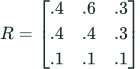 LaTeX:
R=\begin{bmatrix}.4&.6&.3\\.4&.4&.3\\.1&.1&.1\end{bmatrix}, 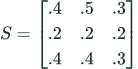 LaTeX:
S=\begin{bmatrix}.4&.5&.3\\.2&.2&.2\\.4&.4&.3\end{bmatrix}, 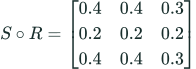 LaTeX:
S\circ R=\begin{bmatrix}0.4&0.4&0.3\\0.2&0.2&0.2\\0.4&0.4&0.3\end{bmatrix}. (The key gives R and S only.)Every cell without the row shortcuts
Both printed relations run from size to speed; their middle labels do not match for genuine relation composition. The numerical working below follows the question’s intended row-of-S with column-of-R operation using explicitly assumed positional alignment of the three middle entries.
R: Cartesian-product cells
| Cell | Row degree | Column degree | min result |
|---|---|---|---|
| R11 | 0.6 | 0.4 | 0.4 |
| R12 | 0.6 | 0.8 | 0.6 |
| R13 | 0.6 | 0.3 | 0.3 |
| R21 | 0.4 | 0.4 | 0.4 |
| R22 | 0.4 | 0.8 | 0.4 |
| R23 | 0.4 | 0.3 | 0.3 |
| R31 | 0.1 | 0.4 | 0.1 |
| R32 | 0.1 | 0.8 | 0.1 |
| R33 | 0.1 | 0.3 | 0.1 |
S: Cartesian-product cells
| Cell | Row degree | Column degree | min result |
|---|---|---|---|
| S11 | 0.5 | 0.4 | 0.4 |
| S12 | 0.5 | 0.8 | 0.5 |
| S13 | 0.5 | 0.3 | 0.3 |
| S21 | 0.2 | 0.4 | 0.2 |
| S22 | 0.2 | 0.8 | 0.2 |
| S23 | 0.2 | 0.3 | 0.2 |
| S31 | 0.4 | 0.4 | 0.4 |
| S32 | 0.4 | 0.8 | 0.4 |
| S33 | 0.4 | 0.3 | 0.3 |
Result cell (1,1)
 LaTeX:
\max\{\min(0.4,0.4),\min(0.5,0.4),\min(0.3,0.1)\} LaTeX:
=\max\{0.4,0.4,0.1\}=0.4Result cell (1,2)
 LaTeX:
\max\{\min(0.4,0.6),\min(0.5,0.4),\min(0.3,0.1)\}LaTeX: =\max\{0.4,0.4,0.1\}=0.4Result cell (1,3)
 LaTeX:
\max\{\min(0.4,0.3),\min(0.5,0.3),\min(0.3,0.1)\} LaTeX:
=\max\{0.3,0.3,0.1\}=0.3Result cell (2,1)
 LaTeX:
\max\{\min(0.2,0.4),\min(0.2,0.4),\min(0.2,0.1)\} LaTeX:
=\max\{0.2,0.2,0.1\}=0.2Result cell (2,2)
 LaTeX:
\max\{\min(0.2,0.6),\min(0.2,0.4),\min(0.2,0.1)\}LaTeX: =\max\{0.2,0.2,0.1\}=0.2Result cell (2,3)
 LaTeX:
\max\{\min(0.2,0.3),\min(0.2,0.3),\min(0.2,0.1)\}LaTeX: =\max\{0.2,0.2,0.1\}=0.2Result cell (3,1)
 LaTeX:
\max\{\min(0.4,0.4),\min(0.4,0.4),\min(0.3,0.1)\}LaTeX: =\max\{0.4,0.4,0.1\}=0.4Result cell (3,2)
 LaTeX:
\max\{\min(0.4,0.6),\min(0.4,0.4),\min(0.3,0.1)\}LaTeX: =\max\{0.4,0.4,0.1\}=0.4Result cell (3,3)
 LaTeX:
\max\{\min(0.4,0.3),\min(0.4,0.3),\min(0.3,0.1)\}LaTeX: =\max\{0.3,0.3,0.1\}=0.3