Intelligent Systems II · TEE · mocks
Q3(a) Bayesian network: fever given no flu [10]
Re-examination · 31 Jan 2026
100-mark timed practice using the actual Re-exam 2026 paper. Q1 compulsory; any four of Q2–Q7. Worked solutions are below the questions.
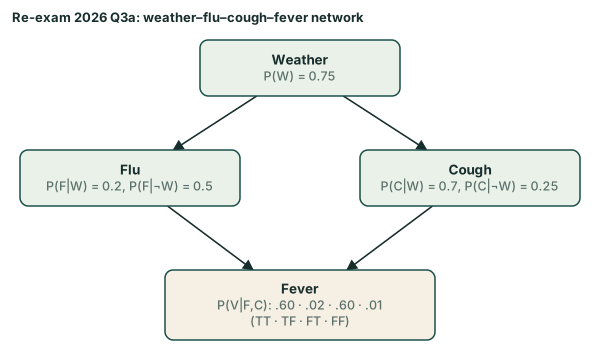
Question. Weather → Flu, Weather → Cough, Flu and Cough → Fever. P(Weather) = 0.75; P(Flu | W) = 0.2, P(Flu | ¬W) = 0.5; P(Cough | W) = 0.70, P(Cough | ¬W) = 0.25; P(Fever | Flu, Cough) = 0.60, P(Fever | Flu, ¬Cough) = 0.02, P(Fever | ¬Flu, Cough) = 0.60, P(Fever | ¬Flu, ¬Cough) = 0.01. Calculate the probability of a person having fever given he doesn't have flu. [10 marks]
Answer
The following table enumerates the values of Weather and Cough that were not fixed by the question. Two Boolean choices give four rows: true/true, true/false, false/true, false/false. Each row is one mutually exclusive complete case. Read the CPT entry using that row’s parent values, multiply its factors, and add the resulting row weights. The denominator must include all cases matching the evidence, including both possible values of the queried outcome.
Given
W→F, W→C, (F,C)→V. The complete probabilities are in the question. Evidence F=false.
To find
P(V=true | F=false), summing hidden W and C.
Formula and why it applies
Use the network joint and normalise by the no-Flu evidence.
 LaTeX:
P(V\mid\neg F)=\frac{\sum_{w,c}P(w)P(\neg F\mid w)P(c\mid w)P(V\mid\neg F,c)}{\sum_wP(w)P(\neg F\mid w)}Solution
Step 1. Chain rule
 LaTeX:
P(W,F,C,V)=P(W)\,P(F\mid W)\,P(C\mid W)\,P(V\mid F,C)Step 2. Sum over W and C with F = false, V = true
| W | C | P(W) | P(¬F|W) | P(C|W) | P(V|¬F,C) | Product |
|---|---|---|---|---|---|---|
| T | T | 0.75 | 0.8 | 0.70 | 0.60 | 0.252 |
| T | F | 0.75 | 0.8 | 0.30 | 0.01 | 0.0018 |
| F | T | 0.25 | 0.5 | 0.25 | 0.60 | 0.01875 |
| F | F | 0.25 | 0.5 | 0.75 | 0.01 | 0.0009375 |
| P(V, ¬F) | 0.2734875 | |||||
Step 3. Evidence
 LaTeX:
P(\lnot F)=0.75(0.8)+0.25(0.5)=0.6+0.125=0.725Step 4. Divide
 LaTeX:
P(V\mid\lnot F)=\frac{0.2734875}{0.725}=0.3772