Intelligent Systems II · TEE · mocks
Q4(a) PSO, one iteration [10]
Re-examination · 31 Jan 2026
100-mark timed practice using the actual Re-exam 2026 paper. Q1 compulsory; any four of Q2–Q7. Worked solutions are below the questions.
Question. Maximize  LaTeX:
F(x)=x_1^2-x_1x_2+x_2^2+3x_1+4x_2+5 using Particle Swarm Optimization.  LaTeX:
X=\begin{bmatrix}3.1472&-4.0246\\4.0579&-2.2150\end{bmatrix},\;V=\begin{bmatrix}0.2194&0.2449\\0.1908&0.2228\end{bmatrix}. Take  LaTeX:
W=0.9,\;c_1=c_2=1.5,\;r_1=0.5949,\;r_2=0.0855. Optimize and give the solution after 1 iteration showing the step-by-step process. [10 marks]
Answer
Given
P1:  LaTeX:
x=(3.1472,\,-4.0246),  LaTeX:
v=(0.2194,\,0.2449). P2:  LaTeX:
x=(4.0579,\,-2.2150),  LaTeX:
v=(0.1908,\,0.2228).  LaTeX:
c_1r_1=0.89235,  LaTeX:
c_2r_2=0.12825.
To find
Updated velocities, positions, pbest and gbest after one iteration.
Formula and why it applies
 LaTeX:
v^{new}=wv+c_1r_1(pbest-x)+c_2r_2(gbest-x),\quad x^{new}=x+v^{new}Initial personal bests equal the starting positions. Use one frozen global best for all particles. This question maximises fitness, so keep a memory only when its score is larger.
Solution
Step 1. Fitness of P1 (term by term)
 LaTeX:
x_1^2=9.904868,\;-x_1x_2=+12.666221,\;x_2^2=16.197405,\;3x_1=9.4416,\;4x_2=-16.0984 LaTeX:
F_1=9.904868+12.666221+16.197405+9.4416-16.0984+5=37.1117Step 2. Fitness of P2
 LaTeX:
F_2=16.466552+8.988249+4.906225+12.1737-8.86+5=38.6747Step 3. pbest and gbest
pbest = current positions.  LaTeX:
38.6747>37.1117, so gbest = P2 = (4.0579, −2.2150).
Step 4. Particle 1 updates
 LaTeX:
v_{11}=0.9(0.2194)+0+0.12825(4.0579-3.1472)=0.19746+0.116797=0.314257 LaTeX:
x_{11}=3.1472+0.314257=3.461457 LaTeX:
v_{12}=0.9(0.2449)+0+0.12825(-2.2150+4.0246)=0.22041+0.232081=0.452491 LaTeX:
x_{12}=-4.0246+0.452491=-3.572109Step 5. Particle 2 updates (gbest particle: only inertia acts)
 LaTeX:
v_{21}=0.9(0.1908)=0.17172,\quad x_{21}=4.22962;\qquad v_{22}=0.9(0.2228)=0.20052,\quad x_{22}=-2.01448Step 6. New fitness and bests
Use the same objective at each new position. Keep full precision internally; displayed coordinates are rounded.
 LaTeX:
F(3.461457275,-3.5721088)=(3.461457275)^2-(3.461457275)(-3.5721088)+(-3.5721088)^2+3(3.461457275)+4(-3.5721088)+5 LaTeX:
=11.981686467+12.364701993+12.759961279+10.384371825+(-14.2884352)+5\approx38.202286364 LaTeX:
F(4.22962,-2.01448)=(4.22962)^2-(4.22962)(-2.01448)+(-2.01448)^2+3(4.22962)+4(-2.01448)+5 LaTeX:
=17.889685344+8.520484898+4.05812967+12.68886+(-8.05792)+5\approx40.099239912| Particle | New position | New F | Old F | pbest |
|---|---|---|---|---|
| 1 | (3.461457, −3.572109) | 38.2023 | 37.1117 | updated |
| 2 | (4.22962, −2.01448) | 40.0992 | 38.6747 | updated |
The best pbest is now P2's with F = 40.0992, so gbest moves to (4.22962, −2.01448).
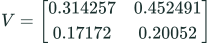 LaTeX:
V=\begin{bmatrix}0.314257&0.452491\\0.17172&0.20052\end{bmatrix},  LaTeX:
X=\begin{bmatrix}3.461457&-3.572109\\4.22962&-2.01448\end{bmatrix}. Both particles improved; new gbest = (4.22962, −2.01448) with F = 40.0992.This X and V are particles 1 and 2 of your lecture's five-particle example; only the function differs (+3x₁ and +5 here instead of +2x₁ and +3).