Intelligent Systems II · TEE · mocks
Q6(a) ACO for TSP [10]
Re-examination · 31 Jan 2026
100-mark timed practice using the actual Re-exam 2026 paper. Q1 compulsory; any four of Q2–Q7. Worked solutions are below the questions.
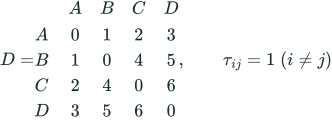
Question. For the four-city travelling salesman problem the distance matrix and pheromone matrix are given (all pheromones 1). Apply Ant Colony Optimization. Calculate the path travelled by 2 ants starting from city A; random numbers for Ant 1 are 0.3, 0.8 and for Ant 2 are 0.5, 0.7. Also update the pheromone matrix after 1 iteration. [10 marks]
Answer
Given
 LaTeX:
D=\begin{array}{c|cccc}&A&B&C&D\\\hline A&0&1&2&3\\B&1&0&4&5\\C&2&4&0&6\\D&3&5&6&0\end{array},\qquad\tau_{ij}=1\;(i\ne j)Assume  LaTeX:
\alpha=\beta=1,\;\rho=0.5,\;Q=1.
To find
Both tours, their lengths and the pheromone matrix after one iteration.
Formula and why it applies
 LaTeX:
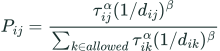
P_{ij}=\frac{\tau_{ij}^{\alpha}(1/d_{ij})^\beta}{\sum_{k\in allowed}\tau_{ik}^{\alpha}(1/d_{ik})^\beta} LaTeX:
\tau_{ij}^{new}=(1-\rho)\tau_{ij}+\sum_{k:\,ij\in tour_k}\frac{Q}{L_k}Use unvisited cities in alphabetical order for cumulative selection. Every ant completes its tour using old pheromones; then evaporate and deposit on each undirected edge, including the return edge.
Solution
Step 1. From A
 LaTeX:
\eta:\;B=1,\;C=0.5,\;D=0.3333;\;\text{sum}=1.8333\Rightarrow P=0.5455,\;0.2727,\;0.1818Cumulative: B 0–0.5455, C 0.5455–0.8182, D 0.8182–1. Ant 1 (0.3) → B; Ant 2 (0.5) → B.
Step 2. From B (C and D left)
 LaTeX:
\eta:\;C=0.25,\;D=0.2;\;\text{sum}=0.45\Rightarrow P_{BC}=0.5556,\;P_{BD}=0.4444Cumulative: C 0–0.5556, D 0.5556–1. Ant 1 (0.8) → D; Ant 2 (0.7) → D.
Step 3. Complete the tours
 LaTeX:
A\to B\to D\to C\to A,\qquad L=1+5+6+2=14\;\text{(both ants)}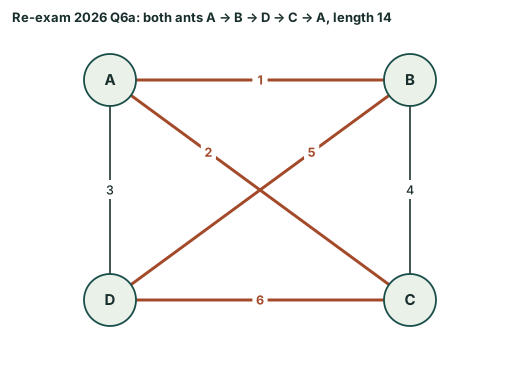
Step 4. Pheromone update
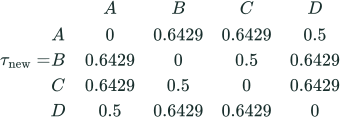
Used edges AB, BD, DC, CA get  LaTeX:
0.5(1)+2\times\frac1{14}=0.6429; unused edges AD and BC become  LaTeX:
0.5.
 LaTeX:
\tau_{\text{new}}=\begin{array}{c|cccc}&A&B&C&D\\\hline A&0&0.6429&0.6429&0.5\\B&0.6429&0&0.5&0.6429\\C&0.6429&0.5&0&0.6429\\D&0.5&0.6429&0.6429&0\end{array} LaTeX:
1+0.1428=1.1428) and its matrix is inconsistent: it increases the unused edge A–D, leaves the used return edge C–A at 1, and gives B–D and D–B different values. If your examiner follows the no-evaporation idea, the consistent version is 1.1429 on AB, BD, CD, AC and 1 on AD, BC. The paper does not specify ρ. State the convention you use; the resulting matrix depends on it. Grading depends on the examiner’s intended convention.