Intelligent Systems II · TEE · papers
Q1(b) Membership function and age sketch [5]
Final examination · 17 Apr 2024
Actual historical paper ·100 marks attempted /140 offered · Q1 compulsory + any four of Q2–Q7. Source defects and solution assumptions are explicitly identified.
Define a membership function in the context of fuzzy logic. Using your intuition, sketch fuzzy membership functions for the “age of people”.
Answer
A membership function assigns each element x of a universe X a degree μA(x) between 0 and 1, indicating compatibility with a linguistic concept A.
 LaTeX:
\mu_A:X\rightarrow[0,1]A value of 0 means no membership, 1 means full membership, and intermediate values represent partial membership. This is a degree of a vague property, not automatically a probability of a random event.
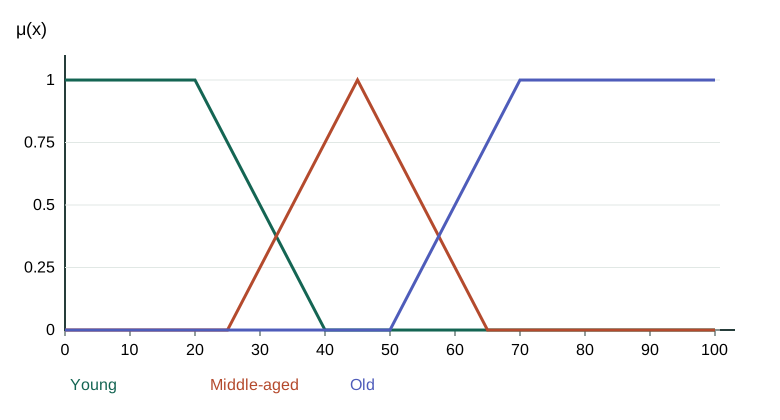
| Term | One explicit assumed shape |
|---|---|
| Young | 1 until age 20; then decreases linearly to 0 at age 40. |
| Middle-aged | 0 up to 25; rises to 1 at 45; falls to 0 at 65. |
| Old | 0 up to 50; rises to 1 at 70; then remains 1. |
For age 35, μYoung=(40−35)/(40−20)=0.25 and μMiddle=(35−25)/(45−25)=0.5. The person is partly young and partly middle-aged. Overlap permits smooth decisions; a crisp boundary would abruptly change the label at one exact birthday.
Remember: membership = “kitna fit hota hai is label mein”. State the axis labels and the assumed age breakpoints when sketching.