Intelligent Systems II · TEE · papers
Q1(d) Markov chain diagram and path probability [5]
Final examination · 17 Apr 2024
Actual historical paper ·100 marks attempted /140 offered · Q1 compulsory + any four of Q2–Q7. Source defects and solution assumptions are explicitly identified.
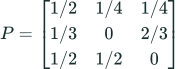
Consider the Markov chain with S={1,2,3} and transition matrix below. (a) Draw the state transition diagram. (b) The scan prints “P(X₁=1)=(X₂=2)=1/4”; calculate P(X₁=3, X₂=2, X₃=1).
 LaTeX:
P=\begin{bmatrix}1/2&1/4&1/4\\1/3&0&2/3\\1/2&1/2&0\end{bmatrix}Answer
Given
The printed matrix; ambiguous condition reproduced above.
To find
All nonzero transitions and the joint probability of the path 3→2→1.
Formula and why it applies
Rows are current states and columns are next states. A specified path probability is initial-state probability multiplied by each transition along that path.
 LaTeX:
P(X_1=3,X_2=2,X_3=1)=P(X_1=3)P_{32}P_{21}Solution
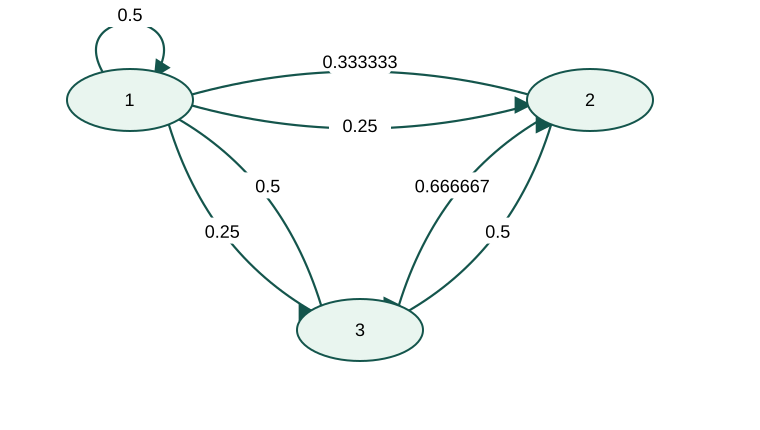
Step 1. Draw the matrix as arrows
| From | Outgoing destinations |
|---|---|
| 1 | 1 with 1/2; 2 with 1/4; 3 with 1/4 |
| 2 | 1 with 1/3; 3 with 2/3 |
| 3 | 1 with 1/2; 2 with 1/2 |
Step 2. Solve the literal reading
Let p₁=P(X₁=1)=1/4 and p₃=P(X₁=3). To be in state 2 at time 2, arrive from state 1 or state 3; transition 2→2 is zero.
 LaTeX:
\frac14=p_1P_{12}+p_2P_{22}+p_3P_{32}=\frac14\frac14+0+\frac12p_3 LaTeX:
\frac12p_3=\frac14-\frac1{16}=\frac3{16}\quad\Rightarrow\quad p_3=\frac38 LaTeX:
P(3,2,1)=\frac38\cdot\frac12\cdot\frac13=\frac1{16}=0.0625Step 3. Show the alternative if the second subscript was a typo
If the intended statement was P(X₁=1)=P(X₁=2)=1/4, then P(X₁=3)=1−1/4−1/4=1/2.
 LaTeX:
P(3,2,1)=\frac12\cdot\frac12\cdot\frac13=\frac1{12}\approx0.0833333