Intelligent Systems II · TEE · papers
Q2(a) Bayesian network joint probabilities [10]
Final examination · 17 Apr 2024
Actual historical paper ·100 marks attempted /140 offered · Q1 compulsory + any four of Q2–Q7. Source defects and solution assumptions are explicitly identified.
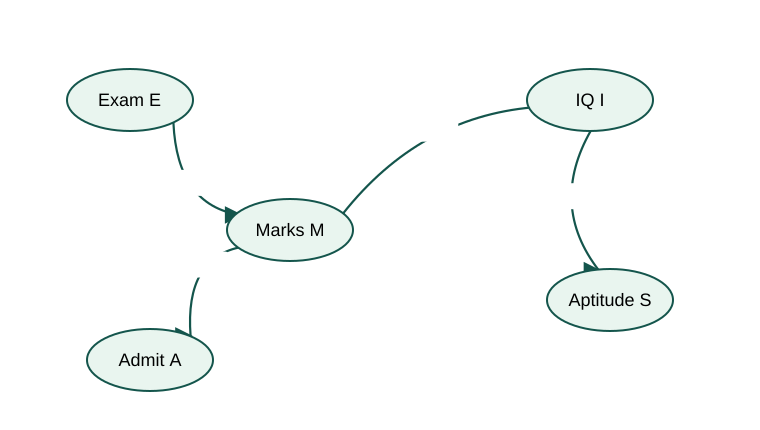
Given the task of modelling a student’s marks for an exam, use the Bayesian network and conditional probability tables below. Exam E: 0 easy, 1 difficult. IQ I: 0 low, 1 high. Aptitude S: 0 low, 1 high. (a) Calculate the probability of a difficult exam, low IQ, low aptitude, passing and securing admission. (b) Calculate the probability of high IQ and aptitude, an easy exam, failing and no admission.
| Root | P(0) | P(1) |
|---|---|---|
| E | 0.7 | 0.3 |
| I | 0.8 | 0.2 |
| I | E | P(M=0) | P(M=1) |
|---|---|---|---|
| 0 | 0 | 0.6 | 0.4 |
| 0 | 1 | 0.9 | 0.1 |
| 1 | 0 | 0.5 | 0.5 |
| 1 | 1 | 0.8 | 0.2 |
| I | P(S=0) | P(S=1) |
|---|---|---|
| 0 | 0.75 | 0.25 |
| 1 | 0.4 | 0.6 |
| M | P(A=0) | P(A=1) |
|---|---|---|
| 0 | 0.6 | 0.4 |
| 1 | 0.9 | 0.1 |
Answer
Given
All five variables and their CPTs are reproduced above.
To find
The two complete joint-event probabilities.
Formula and why it applies
For a Bayesian network, multiply each node’s probability conditional on its parents. Roots have no parents. Do not multiply an extra marginal for a node whose conditional factor is already present.
 LaTeX:
P(E,I,M,S,A)=P(E)P(I)P(M\mid E,I)P(S\mid I)P(A\mid M)Solution
Step 1. Write event (a) in symbols
 LaTeX:
(E,I,M,S,A)=(1,0,1,0,1)Step 2. Select one CPT entry for each node
| Factor | Why this entry | Value |
|---|---|---|
| P(E=1) | Difficult | 0.3 |
| P(I=0) | Low IQ | 0.8 |
| P(M=1|E=1, I=0) | Pass, difficult, low IQ | 0.1 |
| P(S=0|I=0) | Low aptitude given low IQ | 0.75 |
| P(A=1|M=1) | Admission given pass | 0.1 |
Step 3. Multiply without dropping root probabilities
 LaTeX:
0.3\times0.8=0.24\quad;\quad0.24\times0.1=0.024 LaTeX:
0.024\times0.75=0.018\quad;\quad0.018\times0.1=0.0018Step 4. Write and solve event (b)
 LaTeX:
(E,I,M,S,A)=(0,1,0,1,0) LaTeX:
0.7\times0.2\times0.5\times0.6\times0.6=0.0252Intermediate products: 0.7×0.2=0.14; ×0.5=0.07; ×0.6=0.042; ×0.6=0.0252. These are joint probabilities of the whole described event. If E/I/S were explicitly conditioned on, their factors would cancel; the conditional answers would be 0.1×0.1=0.01 and 0.5×0.6=0.30.