Intelligent Systems II · TEE · papers
Q2(b) Fuzzy Cartesian product and composition [10]
Final examination · 17 Apr 2024
Actual historical paper ·100 marks attempted /140 offered · Q1 compulsory + any four of Q2–Q7. Source defects and solution assumptions are explicitly identified.
A={1/low + 0.2/medium + 0.6/high}; B={0.9/positive + 0.3/zero + 0.8/negative}. (1) Find R=A×B. (2) With C={0.3/low + 0.4/medium + 0.6/high}, find S=C×B. (3) Find S∘R using max–min composition.
Answer
Given
A, B, C memberships as printed. Rows of R/S: low, medium, high; columns: positive, zero, negative.
To find
Both Cartesian-product matrices and a carefully stated interpretation of the requested composition.
Formula and why it applies
The usual fuzzy Cartesian product uses minimum, not ordinary multiplication. Max–min composition combines a row with a column: take each matching minimum, then the maximum.
 LaTeX:
R_{ij}=\min(A_i,B_j),\quad S_{ij}=\min(C_i,B_j),\quad T_{ij}=\max_k\min(R_{ik},S_{kj})Solution
Step 1. Build R one row at a time
| A row | Min with 0.9 | Min with 0.3 | Min with 0.8 |
|---|---|---|---|
| 1 | min(1,0.9)=0.9 | min(1,0.3)=0.3 | min(1,0.8)=0.8 |
| 0.2 | min(0.2,0.9)=0.2 | min(0.2,0.3)=0.2 | min(0.2,0.8)=0.2 |
| 0.6 | min(0.6,0.9)=0.6 | min(0.6,0.3)=0.3 | min(0.6,0.8)=0.6 |
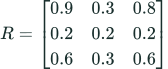 LaTeX:
R=\begin{bmatrix}0.9&0.3&0.8\\0.2&0.2&0.2\\0.6&0.3&0.6\end{bmatrix}Step 2. Build S the same way
| C row | Min with 0.9 | Min with 0.3 | Min with 0.8 |
|---|---|---|---|
| 0.3 | min(0.3,0.9)=0.3 | min(0.3,0.3)=0.3 | min(0.3,0.8)=0.3 |
| 0.4 | min(0.4,0.9)=0.4 | min(0.4,0.3)=0.3 | min(0.4,0.8)=0.4 |
| 0.6 | min(0.6,0.9)=0.6 | min(0.6,0.3)=0.3 | min(0.6,0.8)=0.6 |
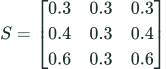 LaTeX:
S=\begin{bmatrix}0.3&0.3&0.3\\0.4&0.3&0.4\\0.6&0.3&0.6\end{bmatrix}Step 3. State the R-then-S index convention and calculate all nine cells
Here S∘R means apply R first, then S, so use row R and column S.
| Output cell | Compare every matching middle index | Take the largest result |
|---|---|---|
| (1, 1) | min(0.9, 0.3) = 0.3, min(0.3, 0.4) = 0.3, min(0.8, 0.6) = 0.6 | max(0.3, 0.3, 0.6) = 0.6 |
| (1, 2) | min(0.9, 0.3) = 0.3, min(0.3, 0.3) = 0.3, min(0.8, 0.3) = 0.3 | max(0.3, 0.3, 0.3) = 0.3 |
| (1, 3) | min(0.9, 0.3) = 0.3, min(0.3, 0.4) = 0.3, min(0.8, 0.6) = 0.6 | max(0.3, 0.3, 0.6) = 0.6 |
| (2, 1) | min(0.2, 0.3) = 0.2, min(0.2, 0.4) = 0.2, min(0.2, 0.6) = 0.2 | max(0.2, 0.2, 0.2) = 0.2 |
| (2, 2) | min(0.2, 0.3) = 0.2, min(0.2, 0.3) = 0.2, min(0.2, 0.3) = 0.2 | max(0.2, 0.2, 0.2) = 0.2 |
| (2, 3) | min(0.2, 0.3) = 0.2, min(0.2, 0.4) = 0.2, min(0.2, 0.6) = 0.2 | max(0.2, 0.2, 0.2) = 0.2 |
| (3, 1) | min(0.6, 0.3) = 0.3, min(0.3, 0.4) = 0.3, min(0.6, 0.6) = 0.6 | max(0.3, 0.3, 0.6) = 0.6 |
| (3, 2) | min(0.6, 0.3) = 0.3, min(0.3, 0.3) = 0.3, min(0.6, 0.3) = 0.3 | max(0.3, 0.3, 0.3) = 0.3 |
| (3, 3) | min(0.6, 0.3) = 0.3, min(0.3, 0.4) = 0.3, min(0.6, 0.6) = 0.6 | max(0.3, 0.3, 0.6) = 0.6 |
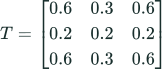 LaTeX:
T=\begin{bmatrix}0.6&0.3&0.6\\0.2&0.2&0.2\\0.6&0.3&0.6\end{bmatrix}Step 4. Distinguish the other common notation convention
If your course writes S∘R as the matrix product with S on the left, the index result is instead:
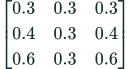 LaTeX:
\begin{bmatrix}0.3&0.3&0.3\\0.4&0.3&0.4\\0.6&0.3&0.6\end{bmatrix}For a correctly typed relation between the input universes, compose R with the inverse relation Sᵀ; the row/column labels then match:
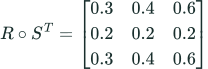 LaTeX:
R\circ S^T=\begin{bmatrix}0.3&0.4&0.6\\0.2&0.2&0.2\\0.3&0.4&0.6\end{bmatrix}