Intelligent Systems II · TEE · papers
Q6(b) Markov property and weather path [10]
Final examination · 17 Apr 2024
Actual historical paper ·100 marks attempted /140 offered · Q1 compulsory + any four of Q2–Q7. Source defects and solution assumptions are explicitly identified.
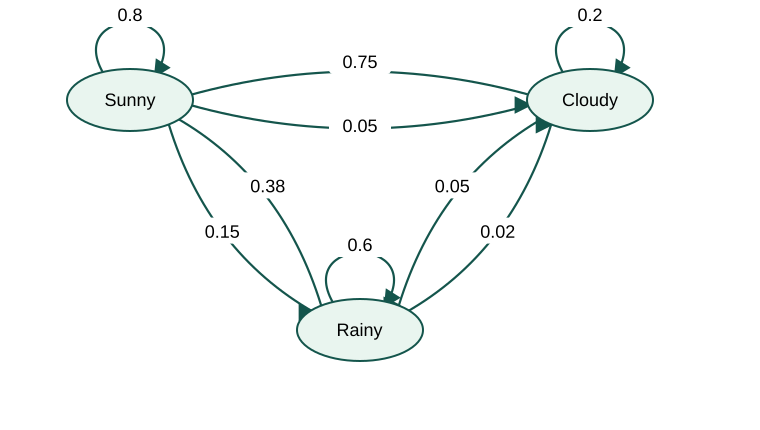
Describe the concept of a Markov process and its use in probabilistic systems. For the given state diagram S, C, R: (a) today is sunny; find probability tomorrow is sunny and the next day rainy. (b) today is cloudy and yesterday rainy; find probability tomorrow is sunny.
Answer
Given
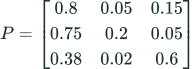
State order Sunny, Cloudy, Rainy. The diagram gives P=[[.8,.05,.15],[.75,.2,.05],[.38,.02,.6]].
To find
Definition and both requested conditional probabilities.
Formula and why it applies
A Markov process has the memoryless property: after the current state is known, earlier states do not change the next-state probabilities. It models time evolution through a state distribution and transition law.
 LaTeX:
P(X_{t+1}\mid X_t,X_{t-1},\ldots)=P(X_{t+1}\mid X_t)Solution
Step 1. Read origin row and destination column
 LaTeX:
P=\begin{bmatrix}0.8&0.05&0.15\\0.75&0.2&0.05\\0.38&0.02&0.6\end{bmatrix}For example P(Sunny→Rainy)=0.15 while P(Rainy→Sunny)=0.38; arrow directions cannot be interchanged. Each row sums to 1.
Step 2. Multiply along the specified S→S→R path
 LaTeX:
P(X_{t+1}=S,X_{t+2}=R\mid X_t=S)=P_{SS}P_{SR}=0.8\times0.15=0.12Do not sum all two-day routes ending in rain: tomorrow is specifically required to be sunny.
Step 3. Use the current cloudy state in part (b)
 LaTeX:
P(X_{t+1}=S\mid X_t=C,X_{t-1}=R)=P_{CS}=0.75Yesterday’s rain adds no further information under the stated Markov model. Such models are used for weather regimes, brand switching, queue states and reliability; the chosen state must capture the relevant predictive information.