Intelligent Systems II · TEE · papers
Q1(d) Irreducibility and stationary distribution [5]
Re-examination · 25 Jun 2024
Actual historical paper ·100 marks attempted /140 offered · Q1 compulsory + any four of Q2–Q7. Source defects and solution assumptions are explicitly identified.
For a two-state Markov chain with P=[[0.8,0.2],[0.3,0.7]], (a) is the chain irreducible? (b) find its stationary distribution.
Answer
Given
Two states, row-stochastic matrix [[.8,.2],[.3,.7]].
To find
Mutual reachability and a probability row vector π with πP=π.
Formula and why it applies
Irreducible means every state can reach every other with positive probability in some number of steps. Stationary means one transition leaves the distribution unchanged.
 LaTeX:
\pi=\pi P,\quad\pi_1+\pi_2=1Solution
Step 1. Check both directions
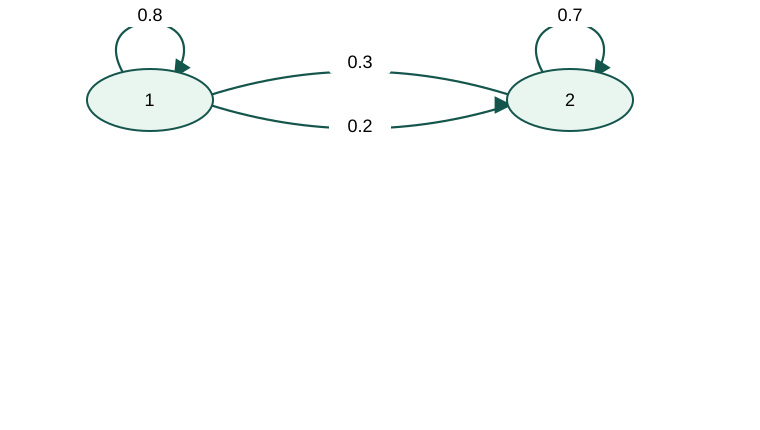
1→2 has probability .2>0 and 2→1 has probability .3>0. Each state reaches the other in one step; the chain is irreducible. Self-loops also make it aperiodic.
Step 2. Balance probability entering state 1
 LaTeX:
\pi_1=0.8\pi_1+0.3\pi_2\Rightarrow0.2\pi_1=0.3\pi_2\Rightarrow\pi_1=1.5\pi_2Step 3. Normalize
 LaTeX:
1.5\pi_2+\pi_2=1\Rightarrow\pi_2=0.4,\quad\pi_1=0.6Step 4. Verify both columns
 LaTeX:
[0.6,0.4]P=[0.48+0.12,\;0.12+0.28]=[0.6,0.4]