Intelligent Systems II · TEE · papers
Q2(b) Fuzzy washing-machine controller [10]
Re-examination · 25 Jun 2024
Actual historical paper ·100 marks attempted /140 offered · Q1 compulsory + any four of Q2–Q7. Source defects and solution assumptions are explicitly identified.
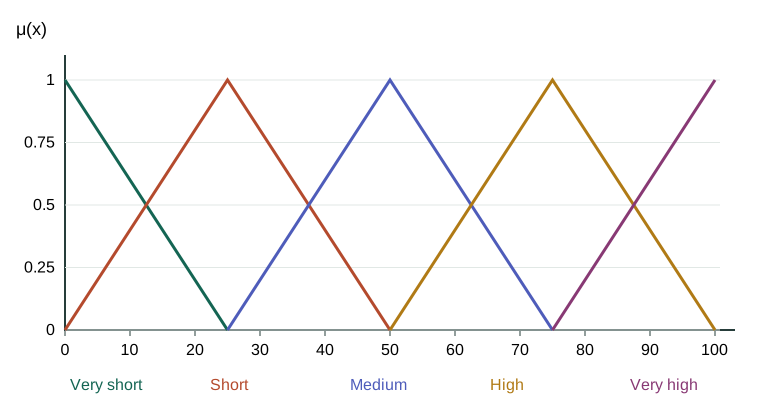
Design a domestic washing-machine controller with Dirt and Grease inputs, both 0–100, and Wash time output 0–100. Use low/medium/high input terms and very short/short/medium/high/very high output terms. Derive rules, support the design with graphs and show that larger dirt gives longer wash time. Defuzzify for Dirt=60% and Grease=70%.
Answer
Given
Dirt=60, Grease=70; ranges 0–100; three input terms and five output terms.
To find
A complete controller: membership graphs, rules, inference and crisp output.
Formula and why it applies
Fuzzification translates measured values into degrees. Min implements AND, max combines rules, and centroid converts the fuzzy output to one numerical command.
 LaTeX:
\alpha_r=\min(\mu_{A_r}(x),\mu_{B_r}(y)),\quad z^*=\frac{\int z\mu_{out}(z)\,dz}{\int\mu_{out}(z)\,dz}Solution
Step 1. Specify the inputs and output
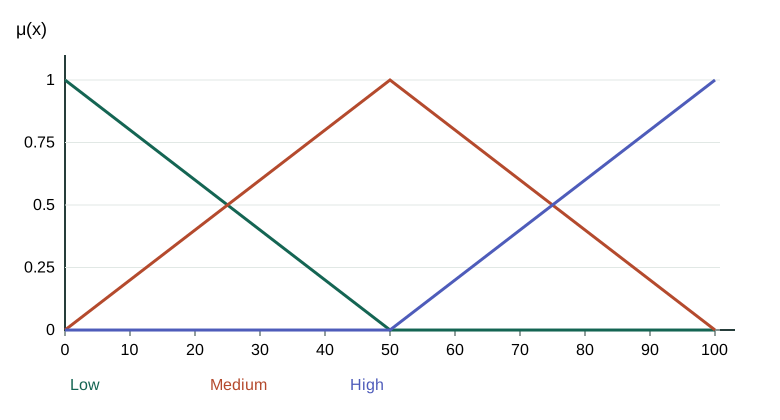
Dirt and Grease each span 0–100. Use low=left shoulder (0,0,50), medium=triangle (0,50,100), high=right shoulder (50,100,100). Output is wash-time index on 0–100; larger means longer washing. The question gives no physical time unit, so do not invent minutes.
Step 2. Define all nine IF–THEN rules
| Dirt / Grease | Low | Medium | High |
|---|---|---|---|
| Low | Very short | Short | Medium |
| Medium | Short | Medium | High |
| High | Medium | High | Very high |
Greater dirt or grease never reduces the rule consequent. This implements the requested monotonic relationship.
Step 3. Fuzzify the two crisp readings
| Input | Low membership | Medium membership | High membership |
|---|---|---|---|
| Dirt=60 | 0 | 4/5 | 1/5 |
| Grease=70 | 0 | 3/5 | 2/5 |
For Dirt=60: low=max(0,(50−60)/50)=0; medium=(100−60)/50=0.8; high=max(0,(60−50)/50)=0.2. For Grease=70: low=0, medium=(100−70)/50=0.6, high=(70−50)/50=0.4.
Step 4. Fire every active rule with minimum
| Dirt | Grease | AND strength | Output descriptor |
|---|---|---|---|
| Medium | Medium | min(0.8, 0.6) = 0.6 | Medium |
| Medium | High | min(0.8, 0.4) = 0.4 | High |
| High | Medium | min(0.2, 0.6) = 0.2 | High |
| High | High | min(0.2, 0.4) = 0.2 | Very high |
The other rules have a zero antecedent membership and therefore fire at zero.
Step 5. Aggregate rules and clip each output membership
| Descriptor | Maximum firing strength |
|---|---|
| Very short | 0.0 |
| Short | 0.0 |
| Medium | 0.6 |
| High | 0.4 |
| Very high | 0.2 |
 LaTeX:
\mu_{out}(z)=\max_r\min(\alpha_r,\mu_{B_r}(z))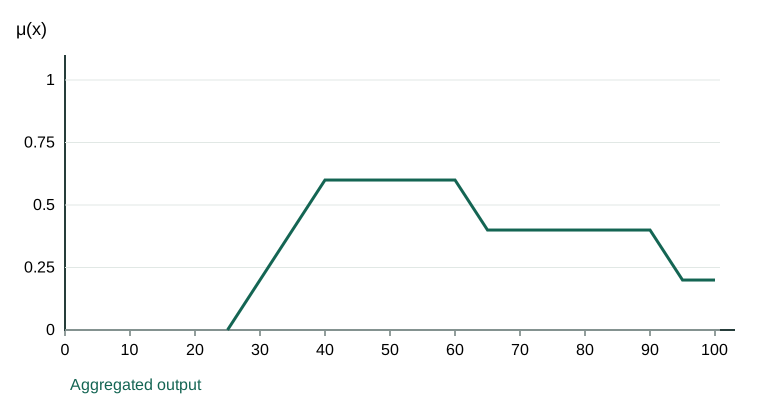
Step 6. Calculate centroid area and first moment
Split the upper outline at every corner and intersection. On a segment [a, b] with endpoint heights u and v, integrate the straight line. This counts overlap once.
 LaTeX:
A=(b-a)\frac{u+v}{2},\qquad M=aA+\frac{(b-a)^2(u+2v)}6,\qquad z^*=\frac{\sum M}{\sum A}| Segment [a, b] | Heights [u, v] | Area A | Moment M |
|---|---|---|---|
| [25, 40] | [0, 0.6] | 4.500000 | 157.500000 |
| [40, 50] | [0.6, 0.6] | 6.000000 | 270.000000 |
| [50, 60] | [0.6, 0.6] | 6.000000 | 330.000000 |
| [60, 65] | [0.6, 0.4] | 2.500000 | 155.833333 |
| [65, 75] | [0.4, 0.4] | 4.000000 | 280.000000 |
| [75, 80] | [0.4, 0.4] | 2.000000 | 155.000000 |
| [80, 90] | [0.4, 0.4] | 4.000000 | 340.000000 |
| [90, 95] | [0.4, 0.2] | 1.500000 | 138.333333 |
| [95, 100] | [0.2, 0.2] | 1.000000 | 97.500000 |
 LaTeX:
z^*=\frac{1924.166667}{31.500000}\approx 61.084656Step 7. Demonstrate the longer-wash response
Hold grease fixed at 70 and repeat the same minimum, maximum and centroid steps for three dirt readings. This compares outputs without changing the rules or membership graphs.
| Dirt | Grease | Exact centroid | Wash-time index |
|---|---|---|---|
| 20 | 70 | 1925/41 | 46.951220 |
| 60 | 70 | 11545/189 | 61.084656 |
| 80 | 70 | 6580/99 | 66.464646 |
The calculated wash-time index increases from 46.951220 to 61.084656 to 66.464646 as dirt rises from 20 to 60 to 80. These comparisons demonstrate the requested behavior for the stated test inputs. At the target reading (60,70), only medium, high and very-high consequents fire.