Intelligent Systems II · TEE · papers
Q4(a) Naive Bayes and Laplace smoothing [10]
Re-examination · 25 Jun 2024
Actual historical paper ·100 marks attempted /140 offered · Q1 compulsory + any four of Q2–Q7. Source defects and solution assumptions are explicitly identified.
(1) Use Naive Bayes on the dataset to predict whether a person buys a computer for Age=Old, Income=Medium, Freelancer=Yes. (2) Explain Laplacian smoothing, whether it is required here and its impact.
| ID | Age | Income | Freelancer | Buys computer |
|---|---|---|---|---|
| 1 | Young | High | No | No |
| 2 | Young | High | No | No |
| 3 | Middle Age | High | No | Yes |
| 4 | Old | Medium | No | Yes |
| 5 | Old | Low | Yes | Yes |
| 6 | Old | Low | Yes | No |
| 7 | Middle Age | Low | Yes | Yes |
| 8 | Young | Medium | No | No |
| 9 | Young | Low | Yes | Yes |
| 10 | Young | Medium | Yes | Yes |
Answer
Given
Ten records; query (Old, Medium, Yes). Class counts Yes 6, No 4.
To find
Class scores, normalized comparison and smoothing impact.
Formula and why it applies
Naive Bayes multiplies the class prior and feature likelihoods, assuming features are conditionally independent given the class. The same evidence denominator cancels when comparing classes.
 LaTeX:
s(c)=P(c)\prod_j P(x_j\mid c),\qquad P(c\mid x)=\frac{s(c)}{\sum_{k}s(k)}Solution
Step 1. Count query-feature matches within each class
| Class | N | Old | Medium income | FreelancerYes |
|---|---|---|---|---|
| Yes | 6 | 2 | 2 | 4 |
| No | 4 | 1 | 1 | 1 |
Yes records are 3,4,5,7,9,10; No records 1,2,6,8. Count within the chosen class, not among all ten records.
Step 2. Compute unsmoothed Yes score
 LaTeX:
s(Y)=\frac6{10}\frac26\frac26\frac46=\frac2{45}\approx0.0444444Step 3. Compute unsmoothed No score
 LaTeX:
s(N)=\frac4{10}\frac14\frac14\frac14=\frac1{160}=0.00625Step 4. Normalize and classify
 LaTeX:
P(Y\mid x)=\frac{2/45}{2/45+1/160}=\frac{64}{73}\approx0.876712 LaTeX:
P(N\mid x)=\frac9{73}\approx0.123288Predict Yes because its score is larger.
Step 5. Explain add-one smoothing
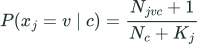
A zero likelihood would make the whole class product zero, even if other features favor the class. Add-one smoothing prevents that by adding one to each category count and adding the number of possible categories to the denominator. No query likelihood is zero here, so smoothing is not needed to rescue a zero score; it still changes the estimates.
 LaTeX:
P(x_j=v\mid c)=\frac{N_{jvc}+1}{N_c+K_j}There are 3 age categories,3 income categories and 2 freelancer categories. Retaining empirical priors:
 LaTeX:
s_{+1}(Y)=\frac6{10}\frac{2+1}{6+3}\frac{2+1}{6+3}\frac{4+1}{6+2}=\frac1{24}\approx0.0416667 LaTeX:
s_{+1}(N)=\frac4{10}\frac{1+1}{4+3}\frac{1+1}{4+3}\frac{1+1}{4+2}=\frac8{735}\approx0.0108844Step 6. Compare the smoothed result
 LaTeX:
P_{+1}(Y\mid x)=\frac{1/24}{1/24+8/735}=\frac{245}{309}\approx0.792880The predicted class remains Yes, while certainty decreases. Stating whether priors are smoothed matters; here only feature likelihoods were add-one smoothed.