Intelligent Systems II · TEE · papers
Q4(b) Transition matrix properties and two-step probabilities [10]
Re-examination · 25 Jun 2024
Actual historical paper ·100 marks attempted /140 offered · Q1 compulsory + any four of Q2–Q7. Source defects and solution assumptions are explicitly identified.
(1) Discuss how state transitions are represented by a transition matrix. (2) Cite and illustrate any 3 properties. (3) Given P=[[1/2,1/2],[3/4,1/4]] and initial row distribution p⁽⁰⁾=[1/4,3/4], define and find (a) P₂₁⁽²⁾, (b) P₁₂⁽²⁾, (c) P⁽²⁾, (d) p₁⁽²⁾.
Answer
Given
P and p⁽⁰⁾ as printed; row-vector convention.
To find
Two-step conditional transition probabilities, the full two-step matrix and unconditional state 1 probability at time 2.
Formula and why it applies
Pᵢⱼ is next-state j probability given current-state i. Entries lie in[0,1], rows sum to 1, and the n-step matrix is Pⁿ for a time-homogeneous chain. Row sums need not equal column sums; a transition matrix need not be symmetric.
 LaTeX:
(P^2)_{ij}=\sum_kP_{ik}P_{kj},\qquad p^{(2)}=p^{(0)}P^2Solution
Step 1. Sum every possible two-step path
| Entry | Via state 1 | Via state 2 | Sum |
|---|---|---|---|
| (P²)11 | (1/2)(1/2)=1/4 | (1/2)(3/4)=3/8 | 5/8 |
| (P²)12 | (1/2)(1/2)=1/4 | (1/2)(1/4)=1/8 | 3/8 |
| (P²)21 | (3/4)(1/2)=3/8 | (1/4)(3/4)=3/16 | 9/16 |
| (P²)22 | (3/4)(1/2)=3/8 | (1/4)(1/4)=1/16 | 7/16 |
Step 2. Write the transition matrix and requested entries
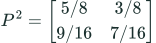 LaTeX:
P^2=\begin{bmatrix}5/8&3/8\\9/16&7/16\end{bmatrix}Therefore (a) P₂₁⁽²⁾=9/16 and (b) P₁₂⁽²⁾=3/8. Each entry conditions on a specific starting state.
Step 3. Mix over the supplied initial distribution
 LaTeX:
p_1^{(2)}=\frac14\frac58+\frac34\frac9{16}=\frac{10+27}{64}=\frac{37}{64}=0.578125 LaTeX:
p_2^{(2)}=1-37/64=27/64=0.421875Step 4. Keep matrix and distribution notation separate
P² is 2×2 and gives two-step probabilities for either starting state. p⁽²⁾ is one row of two probabilities after averaging those starting states using p⁽⁰⁾. If part (c) was intended as the distribution rather than capital-P matrix, the supplied distribution is [37/64,27/64]. Both objects are shown.