Intelligent Systems II · TEE · papers
Q6(b) Markov process and homework transition paths [10]
Re-examination · 25 Jun 2024
Actual historical paper ·100 marks attempted /140 offered · Q1 compulsory + any four of Q2–Q7. Source defects and solution assumptions are explicitly identified.
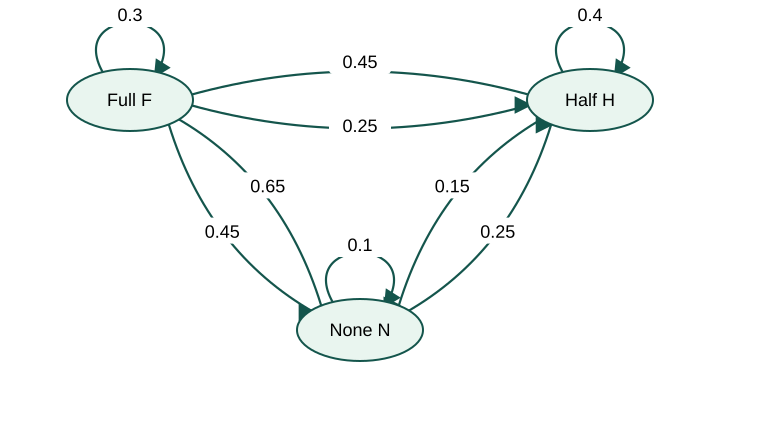
(I) Define the Markov process and list applications. (II) A professor assigns full-credit F, half-credit H and no-credit N homework according to the transition diagram. (a) Construct the TPM; (b) find P(X₃=F|X₂=N); (c) P(X₂=N|X₁=H); (d) P(X₄=H|X₂=F).
Answer
Given
The labeled arrows in the original diagram; state orderF, H, N.
To find
The transition matrix and one-step/two-step probabilities.
Formula and why it applies
A Markov process predicts the next state using the current state, conditionally independent of earlier history. Applications include weather regimes, brand switching, reliability, queueing and movement among locations. Here a state records the homework-credit category.
 LaTeX:
P(X_{t+n}=j\mid X_t=i)=(P^n)_{ij}Solution
Step 1. Read all outgoing arrows into rows
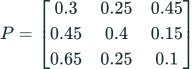 LaTeX:
P=\begin{bmatrix}0.3&0.25&0.45\\0.45&0.4&0.15\\0.65&0.25&0.1\end{bmatrix}| Row | Sum |
|---|---|
| F | .30+.25+.45=1 |
| H | .45+.40+.15=1 |
| N | .65+.25+.10=1 |
Step 2. Part (b): one transition N→F
 LaTeX:
P(X_3=F\mid X_2=N)=P_{NF}=0.65Step 3. Part (c): one transition H→N
 LaTeX:
P(X_2=N\mid X_1=H)=P_{HN}=0.15Step 4. Part (d): two transitions F→?→H
The time difference is 4−2=2. Sum three mutually exclusive intermediate-state routes.
| Intermediate state | Path product |
|---|---|
| F | .30×.25=.075 |
| H | .25×.40=.100 |
| N | .45×.25=.1125 |
 LaTeX:
(P^2)_{FH}=.075+.100+.1125=.2875