Intelligent Systems II · TEE · papers
Q2(b) GMM versus k-means, log likelihood and parameter count [10]
Final / re-examination · 28 Apr 2025
Actual historical paper ·100 marks attempted /140 offered · Q1 compulsory + any four of Q2–Q7. Source defects and solution assumptions are explicitly identified.
With reference to Gaussian Mixture model (GMM), answer the following
- Compare GMM with K-means algorithm
- Derive the equation for Log likelihood function.
- What will be the no of parameters to be computed if K=5
Answer
Gaussian mixture model: a probability density formed by a weighted sum of K Gaussian components. Each observation has a latent component label; its membership is generally represented by responsibilities rather than a single compulsory hard assignment.
| Aspect | K-means | GMM |
|---|---|---|
| Assignment | Hard: choose one closest centroid | Soft: a posterior responsibility for each component |
| Parameters | K centroid vectors | Mixture weights, mean vectors and covariance matrices |
| Objective | Minimize within-cluster squared Euclidean distances | Maximize data likelihood or log likelihood |
| Shape | Nearest-centroid partitions suit roughly spherical/equal-scale groups | Full covariance allows tilted ellipsoids; restricted covariance gives simpler shapes |
| Updates | Alternate assignment and centroid averaging | EM: responsibility calculation and weighted parameter updates |
| Uncertainty | No probability from basic assignment alone | Responsibilities quantify ambiguity under the fitted model |
Log-likelihood derivation
Step 1. Write one observation's density
 LaTeX:
p(x_i\mid\theta)=\sum_{k=1}^K\pi_k\,\mathcal N(x_i\mid\mu_k,\Sigma_k),\quad \pi_k\ge0,\quad\sum_k\pi_k=1 LaTeX:
\mathcal N(x\mid\mu,\Sigma)=\frac{\exp[-\frac12(x-\mu)^T\Sigma^{-1}(x-\mu)]}{(2\pi)^{d/2}|\Sigma|^{1/2}}πk is the probability of component k; µk is its centre; Σk describes spread and correlation. Assume positive-definite full covariances for this density.
Step 2. Multiply independent observations
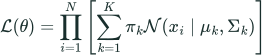 LaTeX:
\mathcal L(\theta)=\prod_{i=1}^{N}\left[\sum_{k=1}^{K}\pi_k\mathcal N(x_i\mid\mu_k,\Sigma_k)\right]The product follows from the usual independent, identically distributed training-sample assumption. The sum inside handles the unobserved component choice.
Step 3. Take the natural logarithm
 LaTeX:
\ell(\theta)=\log\mathcal L(\theta)=\sum_{i=1}^{N}\log\left[\sum_{k=1}^{K}\pi_k\mathcal N(x_i\mid\mu_k,\Sigma_k)\right]Log turns the product across samples into a sum. It does not turn the mixture sum inside each logarithm into a sum of logarithms. The coupled terms motivate iterative optimization such as EM.
Step 4. Count parameters and state the missing assumption
The question gives K=5 but does not give dimension d or covariance structure, so one universal integer cannot be determined.
| Component | Independent parameters |
|---|---|
| Means | Kd |
| Full symmetric covariances | K d (d+1)/2 |
| Mixture weights | K−1, because their sum is 1 |
 LaTeX:
n_{free}=Kd+K\frac{d(d+1)}2+(K-1) LaTeX:
K=5:\quad n_{free}=5d+\frac{5d(d+1)}2+4If one-dimensional data are intended: five means+five variances+four independent weights=14 free parameters. One implementation stores 15 numbers (including all five weights), but the sum-to-one constraint removes one independent degree of freedom. For d-dimensional diagonal covariances the count is 10d+4; state the selected covariance assumption.