Intelligent Systems II · TEE · papers
Q3(a) Bayesian-network conditional cough probability [10]
Final / re-examination · 28 Apr 2025
Actual historical paper ·100 marks attempted /140 offered · Q1 compulsory + any four of Q2–Q7. Source defects and solution assumptions are explicitly identified.
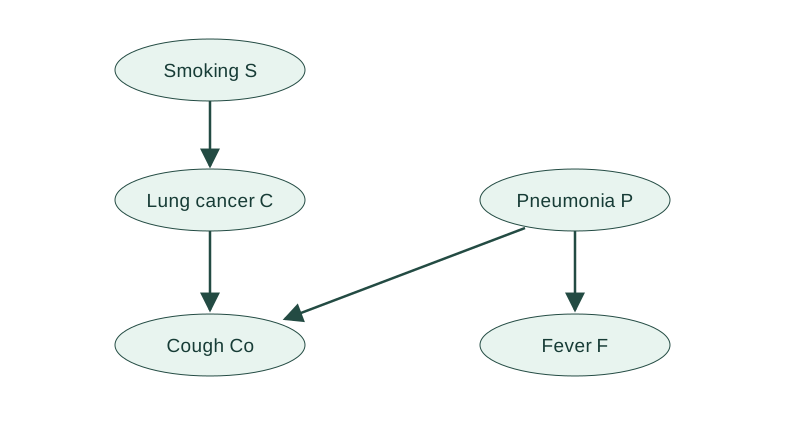
| Smoking S | P(S) |
|---|---|
| T | 0.3 |
| F | 0.7 |
| Smoking S | P(C=T|S) | P(C=F|S) |
|---|---|---|
| T | 0.1 | 0.9 |
| F | 0.01 | 0.99 |
| Pneumonia P | P(P) |
|---|---|
| T | 0.3 |
| F | 0.7 |
| C | P | P(Co=T|C, P) | P(Co=F|C, P) |
|---|---|---|---|
| T | T | 0.95 | 0.05 |
| T | F | 0.8 | 0.2 |
| F | T | 0.7 | 0.3 |
| F | F | 0.1 | 0.9 |
| P | P(Fever=T|P) | P(Fever=F|P) |
|---|---|---|
| T | 0.9 | 0.1 |
| F | 0.01 | 0.99 |
Given the above tables for the Bayesian network, calculate Probability of a person having cough given he doesn’t have lung cancer but Smokes.
Answer
Given
Evidence: C=F (no lung cancer), S=T (smokes). Query: Co=T. Pneumonia is not observed; sum over its two states.
To find
P(Co=T | C=F, S=T).
Formula and why
 LaTeX:
P(Co\mid\neg C,S)=\sum_{p\in\{T,F\}}P(Co\mid\neg C,S,P=p)P(P=p\mid\neg C,S)The network says cough depends on its parents C and P. Once they are known, smoking provides no additional direct information about cough. The pneumonia root is independent of S and C in this network when no descendant evidence such as cough/fever is conditioned on.
Step 1. Write the network factorization
 LaTeX:
P(S,C,P,Co,F)=P(S)P(C\mid S)P(P)P(Co\mid C,P)P(F\mid P)This factorization expresses the model, not a general medical truth. Fever is unobserved and its two conditional probabilities sum to 1.
Step 2. Select the correct cough rows
| Hidden pneumonia state | Cough probability with C=F | Pneumonia weight |
|---|---|---|
| P=T | P(Co=T|C=F, P=T)=0.70 | 0.30 |
| P=F | P(Co=T|C=F, P=F)=0.10 | 0.70 |
Do not use 0.95 or 0.80: those rows assume lung cancer is present, which contradicts the given evidence.
Step 3. Multiply each conditional probability by its weight
 LaTeX:
0.70\times0.30=0.21,\qquad0.10\times0.70=0.07Step 4. Add the mutually exclusive pneumonia cases
 LaTeX:
P(Co=T\mid C=F,S=T)=0.21+0.07=\boxed{0.28}Final answer:28%. We do not multiply the final answer byP(smoking)=0.3: smoking is already a condition, not an additional joint event.
Step 5. Verify using joint-over-evidence
 LaTeX:
P(\neg C,S)=0.9\times0.3=0.27 LaTeX:
P(Co,\neg C,S)=0.27\times0.28=0.0756 LaTeX:
P(Co\mid\neg C,S)=0.0756/0.27=0.28