Intelligent Systems II · TEE · papers
Q3(b) Fuzzy Cartesian relations and composition-domain ambiguity [10]
Final / re-examination · 28 Apr 2025
Actual historical paper ·100 marks attempted /140 offered · Q1 compulsory + any four of Q2–Q7. Source defects and solution assumptions are explicitly identified.
Consider 2 fuzzy sets
A={0.8/small+0.5/medium+0.2/large}
B={0.6/slow+0.9/moderate+0.4/fast}
- Find the fuzzy relation R=A×B (Cartesian Product)
- Given another fuzzy set C={0.7/small+0.3/medium+0.5/large}. Find the fuzzy relation S=C×B
- Calculate the max-min composition S∘R
Answer
Given
A and C use size universe X={small, medium, large}; B uses speed universe Y={slow, moderate, fast}. Use the listed orders for rows and columns.
To find
R and S; then explain and resolve the composition convention explicitly.
Formula and why
 LaTeX:
\mu_{A\times B}(x,y)=\min(\mu_A(x),\mu_B(y)),\quad T_{ij}=\max_k\min(U_{ik},V_{kj})Fuzzy Cartesian product uses minimum here, not multiplication. A relation composition additionally needs the first relation's output universe to match the second's input universe.
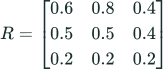
Step 1. Calculate all entries of R
| Size / speed | slow 0.6 | moderate 0.9 | fast 0.4 |
|---|---|---|---|
| small 0.8 | min(0.8,0.6)=0.6 | min(0.8,0.9)=0.8 | min(0.8,0.4)=0.4 |
| medium 0.5 | min(0.5,0.6)=0.5 | min(0.5,0.9)=0.5 | min(0.5,0.4)=0.4 |
| large 0.2 | min(0.2,0.6)=0.2 | min(0.2,0.9)=0.2 | min(0.2,0.4)=0.2 |
 LaTeX:
R=\begin{bmatrix}0.6&0.8&0.4\\0.5&0.5&0.4\\0.2&0.2&0.2\end{bmatrix}Step 2. Calculate all entries of S
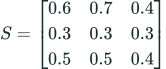
| Size / speed | slow 0.6 | moderate 0.9 | fast 0.4 |
|---|---|---|---|
| small 0.7 | min(0.7,0.6)=0.6 | min(0.7,0.9)=0.7 | min(0.7,0.4)=0.4 |
| medium 0.3 | min(0.3,0.6)=0.3 | min(0.3,0.9)=0.3 | min(0.3,0.4)=0.3 |
| large 0.5 | min(0.5,0.6)=0.5 | min(0.5,0.9)=0.5 | min(0.5,0.4)=0.4 |
 LaTeX:
S=\begin{bmatrix}0.6&0.7&0.4\\0.3&0.3&0.3\\0.5&0.5&0.4\end{bmatrix}Step 3. State the source-domain problem
As typed relations, both R and S map X→Y. S cannot directly follow R because S expects a size while R ends in a speed. Equal matrix dimensions do not make the universes equal. Thus the requested composition has no unique meaningful typed interpretation as written.
Step 4. If the examiner intends an indexed matrix operation, state it first
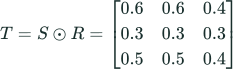
Conditional classroom calculation: temporarily identify intermediate labels by position 1,2,3 and define the requested notation here as T=S⊙R, where⊙ is max–min matrix multiplication. This is an index convention, not a claim that “slow” equals “small”.
| Entry | Three minimum terms | Maximum |
|---|---|---|
| T11 | min(0.6,0.6)=0.6, min(0.7,0.5)=0.5, min(0.4,0.2)=0.2 | 0.6 |
| T12 | min(0.6,0.8)=0.6, min(0.7,0.5)=0.5, min(0.4,0.2)=0.2 | 0.6 |
| T13 | min(0.6,0.4)=0.4, min(0.7,0.4)=0.4, min(0.4,0.2)=0.2 | 0.4 |
| T21 | min(0.3,0.6)=0.3, min(0.3,0.5)=0.3, min(0.3,0.2)=0.2 | 0.3 |
| T22 | min(0.3,0.8)=0.3, min(0.3,0.5)=0.3, min(0.3,0.2)=0.2 | 0.3 |
| T23 | min(0.3,0.4)=0.3, min(0.3,0.4)=0.3, min(0.3,0.2)=0.2 | 0.3 |
| T31 | min(0.5,0.6)=0.5, min(0.5,0.5)=0.5, min(0.4,0.2)=0.2 | 0.5 |
| T32 | min(0.5,0.8)=0.5, min(0.5,0.5)=0.5, min(0.4,0.2)=0.2 | 0.5 |
| T33 | min(0.5,0.4)=0.4, min(0.5,0.4)=0.4, min(0.4,0.2)=0.2 | 0.4 |
 LaTeX:
T=S\odot R=\begin{bmatrix}0.6&0.6&0.4\\0.3&0.3&0.3\\0.5&0.5&0.4\end{bmatrix}If the course instead writes S∘R to mean first R then S, its untyped matrix computation is R⊙S, which yields rows(0.6,0.6,0.4), (0.5,0.5,0.4), (0.2,0.2,0.2) for these values. The convention must be declared; silently reversing the factors changes the answer.
Step 5. Show a mathematically valid typed repair
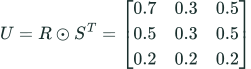
One possible corrected task is to compose R:X→Y with the inverse relation Sᵀ:Y→X. Then compare size elements through a common speed:
 LaTeX:
U=R\odot S^T=\begin{bmatrix}0.7&0.3&0.5\\0.5&0.3&0.5\\0.2&0.2&0.2\end{bmatrix} LaTeX:
U_{11}=\max\{\min(0.6,0.6),\min(0.8,0.7),\min(0.4,0.4)\}=0.7This last matrix answers the explicitly repaired task, not an unannounced correction to the printed question.