Intelligent Systems II · TEE · papers
Q7(a) Fuzzy logic applications and complete controller example [10]
Final / re-examination · 28 Apr 2025
Actual historical paper ·100 marks attempted /140 offered · Q1 compulsory + any four of Q2–Q7. Source defects and solution assumptions are explicitly identified.
List the applications of Fuzzy logic. Explain one in detail.
Answer
Fuzzy logic represents gradual membership in linguistic categories and reasons with graded rules. A temperature can partly belong to both “warm” and “hot”; this is degree of membership, not a probability that a hidden label is true.
- Air-conditioning and automatic fan-speed control.
- Washing-machine adjustment of wash time, agitation or water use.
- Camera autofocus/exposure control.
- Vehicle and industrial process control.
- Decision support and multicriteria scoring when judgments are linguistic.
- Pattern recognition and fuzzy clustering.
Detailed example: room-temperature fan controller
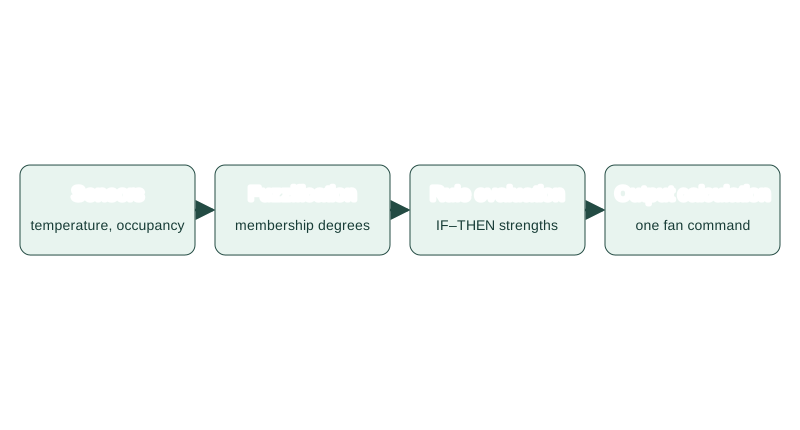
| Block | Role in this example |
|---|---|
| Sensors / crisp input | Measure room temperature and occupancy |
| Fuzzifier | Convert each measurement to memberships such asCool, Warm, Hot andLow, High occupancy |
| Knowledge base | Store membership-function definitions and IF–THEN rules |
| Inference engine | Evaluate each rule's antecedent strength using the stated AND/OR operations |
| Defuzzifier / output computation | Convert the activated outputs to one fan command |
| Actuator | Apply the bounded fan-speed command; sensors provide fresh input for the next cycle |
Illustrative rules and a transparent calculation
For a simple single-input numerical illustration, hold occupancy fixed. On 20≤T≤40°C chooseµWarm=(40−T)/20 andµHot=(T−20)/20. AtT=30°C both memberships are 0.5.
- IF temperature isWarm THEN fan command=50%.
- IF temperature isHot THEN fan command=90%.
Use a zero-order Sugeno design with these constant consequents, so its weighted output is:
 LaTeX:
fan=\frac{0.5(50)+0.5(90)}{0.5+0.5}=\frac{25+45}{1}=70\%Here 50% and 90% are explicit illustrative output constants, not discovered from a source dataset. A Mamdani controller instead defines fuzzy output shapes and may use their aggregated centroid; the two procedures must not be mixed without saying which design is used.
Advantages and limitations
- Smooth transitions avoid an abrupt full-speed jump at one fixed threshold.
- Rules are interpretable and can incorporate expert knowledge without requiring an exact plant equation.
- Membership functions and rules still require validation; poor design can create unsuitable or unstable behavior.
- More inputs and linguistic sets can make the rule base large. Safety limits and fallback behavior must be engineered separately.
Yaad rakho: measured number→kitnaWarm/Hot→rules→one usable fan command.