Intelligent Systems II · TEE · read
Graph axes, intervals and the fractions inside membership functions
1. The maths these three topics use
Short prerequisites, with worked examples. Read once before Fuzzy → GA → PSO.
Read a graph one input at a time
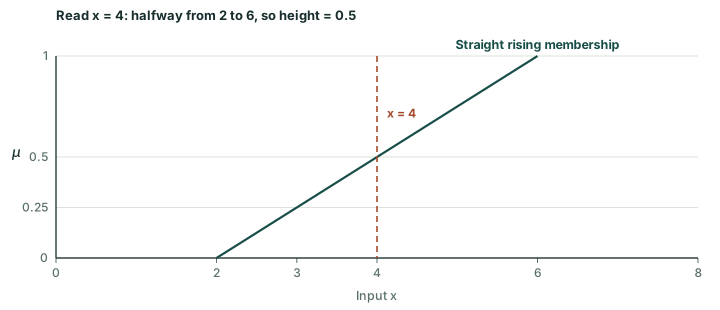
The horizontal axis runs left to right and shows input x. The vertical axis runs bottom to top and shows the output. A point (3,0.4) means: input 3 gives output 0.4. In a membership graph, the vertical output is a degree between 0 and 1.
To read the graph at x=3, start at 3 on the bottom axis, move vertically until you reach the line, then move horizontally to the vertical axis. The height you read is the membership.
| Read this | Meaning | Concrete example |
|---|---|---|
| x < 5 | Strictly less than 5 | 4.9 qualifies; 5 does not |
| x ≤ 5 | Less than or equal to 5 | Both 4.9 and 5 qualify |
| 2 ≤ x ≤ 8 | x is between 2 and 8 including both ends | The interval is [2,8] |
| [2,8) | Include 2; exclude 8 | Useful for roulette interval boundaries |
| Piecewise formula | Choose one calculation according to where x lies | Rising branch, falling branch or outside |
A straight membership line rises from (2,0) to (6,1). Find its height at x=3. [2 marks · Worked example]
Given
Left input=2; peak input=6; required input=3.
To find
Membership height.
Formula and why it applies
 LaTeX:
\text{height}=\frac{\text{distance from left}}{\text{total rising width}}A straight line changes by the same proportion of its height as the proportion travelled along its width.
Solution
Step 1. Find distance travelled
 LaTeX:
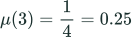
3-2=1Step 2. Find total width
 LaTeX:
6-2=4Step 3. Divide distance by width
 LaTeX:
\mu(3)=\frac{1}{4}=0.25A straight membership line rises from (2,0) to (6,1). Find its height at x=4. [2 marks · Worked example]
Given
Left input=2; peak input=6; required input=4.
To find
Membership height.
Formula and why it applies
LaTeX: \text{height}=\frac{\text{distance from left}}{\text{total rising width}}A straight line changes by the same proportion of its height as the proportion travelled along its width.
Solution
Step 1. Find distance travelled
 LaTeX:
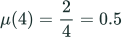
4-2=2Step 2. Find total width
LaTeX: 6-2=4Step 3. Divide distance by width
 LaTeX:
\mu(4)=\frac{2}{4}=0.5A straight membership line rises from (10,0) to (30,1). Find its height at x=25. [2 marks · Worked example]
Given
Left input=10; peak input=30; required input=25.
To find
Membership height.
Formula and why it applies
LaTeX: \text{height}=\frac{\text{distance from left}}{\text{total rising width}}A straight line changes by the same proportion of its height as the proportion travelled along its width.
Solution
Step 1. Find distance travelled
 LaTeX:
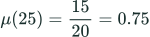
25-10=15Step 2. Find total width
 LaTeX:
30-10=20Step 3. Divide distance by width
 LaTeX:
\mu(25)=\frac{15}{20}=0.75A membership line falls from (5,1) to (8,0). Find its height at x=7. [2 marks · Worked example]
Given
Peak=5; right zero=8; x=7.
To find
Membership.
Formula and why it applies
 LaTeX:
\mu(x)=\frac{\text{distance still remaining to right zero}}{\text{total falling width}}Solution
Step 1. Remaining distance
 LaTeX:
8-7=1Step 2. Total falling width
 LaTeX:
8-5=3Step 3. Divide
 LaTeX:
\mu(7)=1/3\approx0.333333Yaad rakho: Chadhti line: left se kitna aage? Utarti line: right tak kitna baaki? Dono mein poori width se divide.