Intelligent Systems II · TEE · read
Triangular membership: choose the side, then calculate
2. Fuzzy logic, from meaning to full solutions
Definitions → membership graphs → operations → rules → defuzzification → complete controller.
Why the triangle has two different fractions
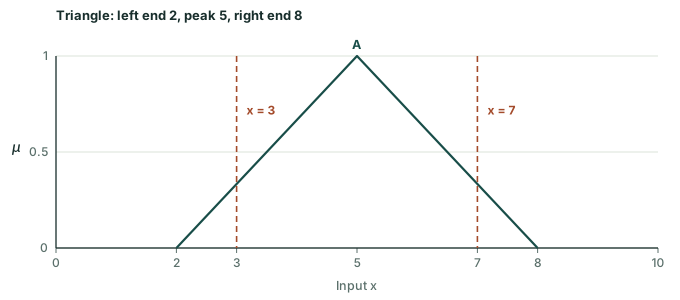
Tri(2,5,8) means membership starts at zero at x=2, rises to 1 at x=5, then falls to zero at x=8. The first three numbers are input positions, not three membership degrees.
| Where is x? | Meaning | Calculation |
|---|---|---|
| x≤2 or x≥8 | Outside, or at a zero-height endpoint | 0 |
| 2<x<5 | Part-way up the rising edge | (x−2)/(5−2) |
| x=5 | At the peak | 1 |
| 5<x<8 | Part-way down the falling edge | (8−x)/(8−5) |
For x=3: distance travelled is 3−2=1; total rising width is 5−2=3; the height is 1÷3. For x=7: distance still remaining is 8−7=1; total falling width is 8−5=3; again the height is 1÷3. Use the branch containing the input before doing any division.
Yaad rakho: a = start, b = peak, c = end. x kahan pada hai, wahi fraction decide karega.
A graph is a rule for assigning membership
The horizontal axis gives the input x. The vertical axis gives membership μ. To read μ at an input, go vertically up from that x to the line, then horizontally to the membership axis.
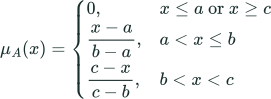
A triangle has three parameters: a is the left zero, b is the peak with membership 1, and c is the right zero. We assume a < b < c.
 LaTeX:
\mu_A(x)=\begin{cases}0,&x\le a\text{ or }x\ge c\\\dfrac{x-a}{b-a},&a<x\le b\\\dfrac{c-x}{c-b},&b<x<c\end{cases}Why the two fractions have these forms
On the rising side, x − a is how far you have climbed across the horizontal base; b − a is the full rising width. Their ratio goes from 0 to 1. On the falling side, c − x is the remaining horizontal distance to the right zero; c − b is the full falling width. That ratio goes from 1 to 0.
A fuzzy set A has triangular membership Tri(2, 5, 8). Find membership at x = 3. [2 marks · Practice]
Given
Left endpoint a = 2; peak b = 5; right endpoint c = 8; input x = 3.
To find
The membership degree μA(x), a number from 0 to 1.
Formula and why it applies
Locate x relative to a, b, c before choosing the branch.
LaTeX: \mu_A(x)=\begin{cases}0,&x\le a\text{ or }x\ge c\\\dfrac{x-a}{b-a},&a<x\le b\\\dfrac{c-x}{c-b},&b<x<c\end{cases}Solution
Step 1. Locate the input
2 < 3 ≤ 5, so membership increases as x moves toward the peak.
Step 2. Choose the correct expression
Rising side
 LaTeX:
\mu_A(3)=\frac{3-2}{5-2}=\frac{1}{3}=0.333333333Step 3. Interpret the value
The degree of belonging to A is 0.333333333. It is a membership degree, not a probability.
A fuzzy set A has triangular membership Tri(2, 5, 8). Find membership at x = 7. [2 marks · Practice]
Given
Left endpoint a = 2; peak b = 5; right endpoint c = 8; input x = 7.
To find
The membership degree μA(x), a number from 0 to 1.
Formula and why it applies
Locate x relative to a, b, c before choosing the branch.
LaTeX: \mu_A(x)=\begin{cases}0,&x\le a\text{ or }x\ge c\\\dfrac{x-a}{b-a},&a<x\le b\\\dfrac{c-x}{c-b},&b<x<c\end{cases}Solution
Step 1. Locate the input
5 < 7 < 8, so membership decreases as x moves away from the peak.
Step 2. Choose the correct expression
Falling side
 LaTeX:
\mu_A(7)=\frac{8-7}{8-5}=\frac{1}{3}=0.333333333Step 3. Interpret the value
The degree of belonging to A is 0.333333333. It is a membership degree, not a probability.
A fuzzy set A has triangular membership Tri(2, 5, 8). Find membership at x = 5. [2 marks · Practice]
Given
Left endpoint a = 2; peak b = 5; right endpoint c = 8; input x = 5.
To find
The membership degree μA(x), a number from 0 to 1.
Formula and why it applies
Locate x relative to a, b, c before choosing the branch.
LaTeX: \mu_A(x)=\begin{cases}0,&x\le a\text{ or }x\ge c\\\dfrac{x-a}{b-a},&a<x\le b\\\dfrac{c-x}{c-b},&b<x<c\end{cases}Solution
Step 1. Locate the input
2 < 5 ≤ 5, so membership increases as x moves toward the peak.
Step 2. Choose the correct expression
Rising side
 LaTeX:
\mu_A(5)=\frac{5-2}{5-2}=\frac{3}{3}=1Step 3. Interpret the value
The degree of belonging to A is 1. This is full membership at the peak.
A fuzzy set A has triangular membership Tri(2, 5, 8). Find membership at x = 9. [2 marks · Practice]
Given
Left endpoint a = 2; peak b = 5; right endpoint c = 8; input x = 9.
To find
The membership degree μA(x), a number from 0 to 1.
Formula and why it applies
Locate x relative to a, b, c before choosing the branch.
LaTeX: \mu_A(x)=\begin{cases}0,&x\le a\text{ or }x\ge c\\\dfrac{x-a}{b-a},&a<x\le b\\\dfrac{c-x}{c-b},&b<x<c\end{cases}Solution
Step 1. Locate the input
9 is outside the open support (2, 8) or at an endpoint.
Step 2. Choose the correct expression
Outside the triangle
 LaTeX:
\mu_A(9)=0Step 3. Interpret the value
The degree of belonging to A is 0. It is a membership degree, not a probability.
Yaad rakho: Peak se left: x − a. Peak se right: c − x. Neeche usi side ki poori width.