Intelligent Systems II · TEE · read
Max–min composition: three complete matrix examples
Fuzzy relations and matrices
Longer Unit 2 numerical practice, also useful for TEE.
One result cell combines alternative two-link paths
For T₁₁, start at u₁ and end at w₁. If the middle domain has v₁ and v₂, there are two candidate paths. Their strengths come from matching row 1 of R with column 1 of S.
| Path | First link from R | Second link from S | Path strength |
|---|---|---|---|
| u₁ → v₁ → w₁ | .2 | .5 | min(.2,.5)=.2 |
| u₁ → v₂ → w₁ | .8 | .7 | min(.8,.7)=.7 |
Choose the stronger path: max(.2,.7)=.7, so T₁₁=.7. The middle label j runs through v₁ and v₂. The labels i and k stay fixed at 1 while this one cell is calculated. Then move to the next result cell.
Yaad rakho: Ek path mein dono links chahiye, isliye min. Alag paths mein best chalega, isliye max.
Composition connects through a middle element
Suppose R relates U to V and S relates V to W. To find how strongly u connects to w through each middle v, take min of the two links. Then choose the strongest such path using max.
 LaTeX:
T_{ik}=\max_j\min(R_{ij},S_{jk})We call this matrix operation R composed with S here. Some books write the symbolic order in reverse. State the formula and row/column labels, especially when a question says S∘R. Composition requires the intermediate domains and their ordering to match; having two 3×3 matrices alone does not prove their labels match.
Calculate the max–min composition using  LaTeX:
T_{ik}=\max_j\min(R_{ij},S_{jk}). [3 marks · Practice]
Given
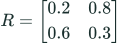 LaTeX:
R=\begin{bmatrix}0.2&0.8\\0.6&0.3\end{bmatrix}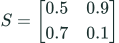 LaTeX:
S=\begin{bmatrix}0.5&0.9\\0.7&0.1\end{bmatrix}To find
Every entry of T.
Formula and why it applies
Pair each row entry with the corresponding column entry; min for a two-link path, max across the possible middle elements. This is not ordinary matrix multiplication.
Solution
Step 1. Cell (1,1): row 1 of R with column 1 of S
 LaTeX:
T_{11}=\max\{\min(0.2,0.5),\min(0.8,0.7)\} LaTeX:
=\max\{0.2,0.7\}=0.7Step 2. Cell (1,2): row 1 of R with column 2 of S
 LaTeX:
T_{12}=\max\{\min(0.2,0.9),\min(0.8,0.1)\} LaTeX:
=\max\{0.2,0.1\}=0.2Step 3. Cell (2,1): row 2 of R with column 1 of S
 LaTeX:
T_{21}=\max\{\min(0.6,0.5),\min(0.3,0.7)\} LaTeX:
=\max\{0.5,0.3\}=0.5Step 4. Cell (2,2): row 2 of R with column 2 of S
 LaTeX:
T_{22}=\max\{\min(0.6,0.9),\min(0.3,0.1)\} LaTeX:
=\max\{0.6,0.1\}=0.6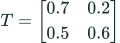 LaTeX:
T=\begin{bmatrix}0.7&0.2\\0.5&0.6\end{bmatrix}.Calculate the max–min composition using LaTeX: T_{ik}=\max_j\min(R_{ij},S_{jk}). [3 marks · Practice]
Given
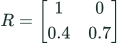 LaTeX:
R=\begin{bmatrix}1&0\\0.4&0.7\end{bmatrix}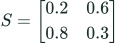 LaTeX:
S=\begin{bmatrix}0.2&0.6\\0.8&0.3\end{bmatrix}To find
Every entry of T.
Formula and why it applies
Pair each row entry with the corresponding column entry; min for a two-link path, max across the possible middle elements. This is not ordinary matrix multiplication.
Solution
Step 1. Cell (1,1): row 1 of R with column 1 of S
 LaTeX:
T_{11}=\max\{\min(1,0.2),\min(0,0.8)\} LaTeX:
=\max\{0.2,0\}=0.2Step 2. Cell (1,2): row 1 of R with column 2 of S
 LaTeX:
T_{12}=\max\{\min(1,0.6),\min(0,0.3)\} LaTeX:
=\max\{0.6,0\}=0.6Step 3. Cell (2,1): row 2 of R with column 1 of S
 LaTeX:
T_{21}=\max\{\min(0.4,0.2),\min(0.7,0.8)\}LaTeX: =\max\{0.2,0.7\}=0.7Step 4. Cell (2,2): row 2 of R with column 2 of S
 LaTeX:
T_{22}=\max\{\min(0.4,0.6),\min(0.7,0.3)\} LaTeX:
=\max\{0.4,0.3\}=0.4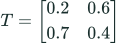 LaTeX:
T=\begin{bmatrix}0.2&0.6\\0.7&0.4\end{bmatrix}.Calculate the max–min composition using LaTeX: T_{ik}=\max_j\min(R_{ij},S_{jk}). [3 marks · Practice]
Given
 LaTeX:
R=\begin{bmatrix}0.3&0.6&0.9\end{bmatrix}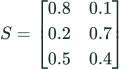 LaTeX:
S=\begin{bmatrix}0.8&0.1\\0.2&0.7\\0.5&0.4\end{bmatrix}To find
Every entry of T.
Formula and why it applies
Pair each row entry with the corresponding column entry; min for a two-link path, max across the possible middle elements. This is not ordinary matrix multiplication.
Solution
Step 1. Cell (1,1): row 1 of R with column 1 of S
 LaTeX:
T_{11}=\max\{\min(0.3,0.8),\min(0.6,0.2),\min(0.9,0.5)\} LaTeX:
=\max\{0.3,0.2,0.5\}=0.5Step 2. Cell (1,2): row 1 of R with column 2 of S
 LaTeX:
T_{12}=\max\{\min(0.3,0.1),\min(0.6,0.7),\min(0.9,0.4)\} LaTeX:
=\max\{0.1,0.6,0.4\}=0.6 LaTeX:
T=\begin{bmatrix}0.5&0.6\end{bmatrix}.Yaad rakho: Har path mein min, phir saare paths mein max. Multiply-and-add nahi.