Intelligent Systems II · TEE · read
ACO formulas: transition probability, city choice and pheromone update
Unit 3 · Ant colony optimization (ACO)
Unit 3 · Ant colony optimization for TSP · asked as a 10-mark numerical in both 2025–26 papers
From city A an ant may choose B or C. Distances are AB=2 and AC=4. Pheromones are both 1 and α=β=1. Find the next-city probabilities. [2 marks · Worked example]
Given
Current city A; allowed next cities B and C. Distances dAB=2 and dAC=4. Pheromones τAB=τAC=1, and exponents α=β=1. Visited cities are excluded.
To find
P(A→B) and P(A→C).
Formula and why it applies
 LaTeX:
\eta_{ij}=1/d_{ij}\qquad P_{ij}=\tau_{ij}\eta_{ij}/\sum_{l\in allowed}\tau_{il}\eta_{il}Shorter distance gives a larger reciprocal. Normalise the desirability weights to probabilities.
Solution
Step 1. Take reciprocal distances
 LaTeX:
\eta_{AB}=1/2=0.5\qquad\eta_{AC}=1/4=0.25Step 2. Multiply by pheromone
 LaTeX:
w_B=1\times0.5=0.5\qquad w_C=1\times0.25=0.25Step 3. Add allowed weights
 LaTeX:
0.5+0.25=0.75Step 4. Divide each weight by their total
 LaTeX:
P_{AB}=0.5/0.75=2/3 LaTeX:
P_{AC}=0.25/0.75=1/3Evaporation ρ=.5 means retain 1−.5=.5 of the old pheromone. A completed tour of length 20 deposits Q/20 on each edge it used; with Q=1 this is .05. An unused edge receives no deposit from that ant. Use complete tour length, not the length of the individual edge, in this denominator.
In one line: an ant picks the next city with probability ∝ pheromone × (1/distance); after all ants finish, pheromone evaporates and each ant adds Q/(its tour length) to every edge it used.
1. Transition probability
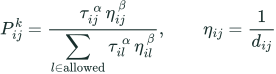
An ant  LaTeX:
k at city  LaTeX:
i moves to an unvisited city  LaTeX:
j with probability
 LaTeX:
P^{k}_{ij}=\frac{\tau_{ij}^{\,\alpha}\,\eta_{ij}^{\,\beta}}{\displaystyle\sum_{l\in\text{allowed}}\tau_{il}^{\,\alpha}\,\eta_{il}^{\,\beta}},\qquad \eta_{ij}=\frac1{d_{ij}} LaTeX:
\tau_{ij}: pheromone on edgeLaTeX: i–LaTeX: j; LaTeX:
\eta_{ij}: visibility (heuristic), the inverse of distance. LaTeX:
\alpha: weight of pheromone; LaTeX:
\beta: weight of distance. In every class example LaTeX:
\alpha=\beta=1.- “allowed” = cities this ant has not visited yet.
With all  LaTeX:
\tau=1 and LaTeX: \alpha=\beta=1, the probabilities are simply proportional to  LaTeX:
1/d.
2. Choosing the city with a random number (cumulative rule)
- List the allowed cities in alphabetical (city) order, not sorted by probability.
- Write their cumulative probabilities.
- Pick the first city whose cumulative value is ≥ the random number
 LaTeX:
r. - When only one city is left, the ant goes there without using a random number, then returns to the start.
3. Pheromone update (after all ants finish)
 LaTeX:
\tau_{ij}\leftarrow(1-\rho)\,\tau_{ij}+\sum_{k=1}^{m}\Delta\tau^{k}_{ij},\qquad \Delta\tau^{k}_{ij}=\begin{cases}Q/L_k&\text{if ant }k\text{ used edge }(i,j)\\0&\text{otherwise}\end{cases} LaTeX:
\rho: evaporation rate (fraction lost). Class examples use LaTeX:
\rho=0.5. LaTeX:
Q: deposit constant, usually 1. LaTeX:
L_k: length of antLaTeX: k's complete tour including the return edge. Shorter tours deposit more.- Edges are undirected: update LaTeX:
\tau_{ij}and LaTeX:
\tau_{ji}together (the matrix stays symmetric). - The update happens once per iteration, after every ant has finished; within an iteration all ants use the same pheromone values.
4. Algorithm (Ant System)
- Initialise parameters: number of ants, α, β, ρ, Q, initial pheromone
 LaTeX:
\tau_0, maximum iterations. - Place each ant on its start city.
- Each ant repeatedly chooses the next city with the transition probability until it has visited all cities, then returns to the start.
- Compute each tour length LaTeX:
L_kand record the best tour. - Update pheromone: evaporation, then deposit
 LaTeX:
Q/L_k. - Repeat steps 2–5 until the iteration limit; output the best tour.
| Parameter | Meaning | Typical value |
|---|---|---|
| m | Number of ants | number of cities (or 20) |
| α | Pheromone importance | 1 |
| β | Distance (visibility) importance | 1 (often 2–5 in practice) |
| ρ | Evaporation rate | 0.5 in class numericals (0.05–0.5 in practice) |
| Q | Deposit constant | 1 (100 in one slide example) |
LaTeX: \tau_0 | Initial pheromone | 1 in exam questions |