Intelligent Systems II · TEE · read
Markov decision process, policies and value functions
Unit 4 · MRP, MDP, policies and Bellman equations
Unit 4 · Markov reward process, Markov decision process, value functions, Bellman equations, applications
| Read this | Meaning | Concrete example |
|---|---|---|
| π(a|s) | Probability the policy chooses action a in state s | In room A: left .3, right .7 |
| P(s′|s,a) | Probability of the environment’s next state after that action | Right action reaches room B with probability .8 |
| vπ(s) | Expected return starting in state s and following policy π | A number scoring the state |
| qπ(s,a) | Expected return if action a is taken first, then policy π is followed | One score for each possible first action |
| π in this chapter | A policy | Unlike π in a Markov-chain stationary distribution; context distinguishes them |
The policy chooses an action; the transition model describes what happens after the action. They are two separate probability distributions. The worked examples use stationary Markov policies, depending on the current state and unchanged over time. More general policies may depend on time or history.
In one line: an MDP is an MRP in which the agent chooses actions; a policy says which action to choose, and value functions score how good a state or a state–action pair is under that policy.
Markov decision process
A Markov decision process (MDP) is a tuple  LaTeX:
\langle\mathcal S,\mathcal A,P,R,\gamma\rangle:
 LaTeX:
\mathcal S: states; LaTeX:
\mathcal A: actions; LaTeX:
P^{a}_{ss'}=P(S_{t+1}=s'\mid S_t=s,A_t=a): transition probabilities, now depending on the action; LaTeX:
R^{a}_{s}=\mathbb E[R_{t+1}\mid S_t=s,A_t=a]: expected reward for taking LaTeX:
ain LaTeX:
s; LaTeX:
\gamma: discount factor.
The Markov property still holds: the next state and reward depend only on the current state and action. An MDP is a common model for RL when the chosen state captures the relevant information; partially observed problems require additional treatment.
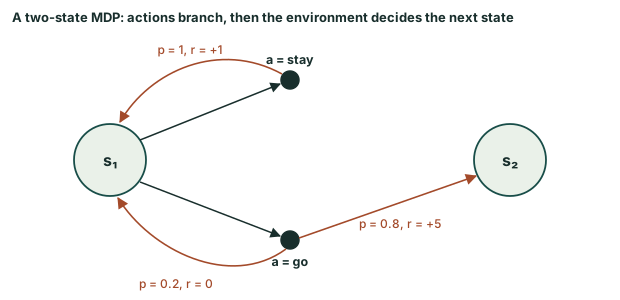
Policy
A policy  LaTeX:
\pi is a distribution over actions given states:
 LaTeX:
\pi(a\mid s)=P(A_t=a\mid S_t=s)- Deterministic policy: one fixed action per state,
 LaTeX:
a=\pi(s). - Stochastic policy: probabilities, e.g.
 LaTeX:
\pi(\text{stay}\mid s_1)=0.5,\;\pi(\text{go}\mid s_1)=0.5.
The policies used in these examples are stationary Markov policies. The term policy more generally also permits time-dependent or history-dependent decision rules.
Value functions
State-value function: expected return from state LaTeX: s when following LaTeX: \pi:
 LaTeX:
v_\pi(s)=\mathbb E_\pi[G_t\mid S_t=s]Action-value function (Q-function): expected return when taking action LaTeX: a in LaTeX: s and following LaTeX: \pi afterwards:
 LaTeX:
q_\pi(s,a)=\mathbb E_\pi[G_t\mid S_t=s,A_t=a]They are linked by averaging over the policy's choices:
 LaTeX:
v_\pi(s)=\sum_{a\in\mathcal A}\pi(a\mid s)\,q_\pi(s,a)Optimal value functions take the best policy:  LaTeX:
v_*(s)=\max_\pi v_\pi(s) and  LaTeX:
q_*(s,a)=\max_\pi q_\pi(s,a). An optimal policy acts greedily on  LaTeX:
q_*:  LaTeX:
\pi_*(s)=\arg\max_a q_*(s,a).
| Markov process | MRP | MDP | |
|---|---|---|---|
| Tuple |  LaTeX: \langle\mathcal S,P\rangle |  LaTeX: \langle\mathcal S,P,R,\gamma\rangle | LaTeX: \langle\mathcal S,\mathcal A,P,R,\gamma\rangle |
| Rewards | No | Yes | Yes |
| Decisions | No | No | Yes (actions) |
| Value | — |  LaTeX: v(s) |  LaTeX: v_\pi(s),\;q_\pi(s,a) |