Natural Language Processing · M2 · formulas
Bigram counts: build the table before multiplying
N-grams & probability
Formulas explained through full worked examples
A bigram probability table uses the previous word as its row and the next word as its column. Divide each cell count by its row's total outgoing count. With one end marker on every sentence, each ordinary training word has a continuation, so its outgoing count equals its token frequency. Do not create a bigram that crosses from one sentence into the next.
 LaTeX:
P(w\mid h)=\frac{C(h,w)}{\sum_{v\in V}C(h,v)}=\frac{C(h,w)}{C(h)}Question. Train a bigram model on “I like tea”, “I like coffee” and “you like tea”. Use one start and one end marker. Find the probability of “I like tea”.
Given
Corpus: <s> I like tea </s>; <s> I like coffee </s>; <s> you like tea </s>. Preserve these tokens.
To find
All nonzero bigram estimates and the test probability.
Formula and why it applies
 LaTeX:
P(w\mid h)=C(h,w)/C(h)Every sentence starts and ends independently. Four probability factors are required for the three test words plus end.
Solution
Step 1. List the training pairs
Sentence 1: (<s>,I), (I,like), (like,tea), (tea,</s>).
Sentence 2: (<s>,I), (I,like), (like,coffee), (coffee,</s>).
Sentence 3: (<s>,you), (you,like), (like,tea), (tea,</s>).
Step 2. Create the nonzero count table
| History → next | Pair count | History count | Probability |
|---|---|---|---|
| <s> → I | 2 | 3 | 2/3 |
| <s> → you | 1 | 3 | 1/3 |
| I → like | 2 | 2 | 1 |
| you → like | 1 | 1 | 1 |
| like → tea | 2 | 3 | 2/3 |
| like → coffee | 1 | 3 | 1/3 |
| tea → </s> | 2 | 2 | 1 |
| coffee → </s> | 1 | 1 | 1 |
Step 3. Write the test path
 LaTeX:
P=P(I\mid\langle s\rangle)P(like\mid I)P(tea\mid like)P(\langle/s\rangle\mid tea)Step 4. Substitute each matching row
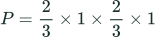 LaTeX:
P=\frac23\times1\times\frac23\times1Step 5. Multiply
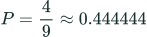 LaTeX:
P=\frac49\approx0.444444Question. Using the same three-sentence corpus given here—“I like tea”, “I like coffee”, “you like tea”—find the bigram probabilities of “you like coffee” and “tea like I”. Include boundaries.
Given
Corpus with one start/end marker per sentence. Counts: start→you=1/3; you→like=1; like→coffee=1/3; coffee→end=1. No training sentence starts with tea.
To find
The two test probabilities.
Formula and why it applies
 LaTeX:
P(\text{sentence})=\prod P(\text{next token}\mid\text{previous token})A model can assign a nonzero probability to a sentence it never saw if all of its local bigrams were seen.
Solution
Step 1. Score you like coffee
 LaTeX:
P=\frac13\times1\times\frac13\times1=\frac19\approx0.111111Step 2. Inspect tea like I
 LaTeX:
P(tea\mid\langle s\rangle)=0/3=0Step 3. Apply the zero factor
The full product is zero, regardless of the remaining factors.
Question. Obtain the unsmoothed bigram probability of “students are from Vellore” from this corpus: “I am from Vellore”; “I am a teacher”; “students are good and are from various cities”; “students from Vellore do engineering”. Use sentence boundaries.
Given
Four training sentences, each padded with one <s> and </s>. Test sequence: <s> students are from Vellore </s>.
To find
The five required conditional probabilities and their product.
Formula and why it applies
LaTeX: P(w\mid h)=C(h,w)/C(h)Count all occurrences in the entire corpus. In particular, are occurs twice inside the third sentence, and Vellore is followed by end once and do once.
Solution
Step 1. Count the histories
| History | Occurrences with continuation |
|---|---|
| <s> | 4 |
| students | 2 |
| are | 2 |
| from | 3 |
| Vellore | 2 |
Step 2. Count the required pairs
| Required pair | Count | Probability |
|---|---|---|
| <s> students | 2 | 2/4 |
| students are | 1 | 1/2 |
| are from | 1 | 1/2 |
| from Vellore | 2 | 2/3 |
| Vellore </s> | 1 | 1/2 |
Step 3. Write the complete product
 LaTeX:
P=\frac24\times\frac12\times\frac12\times\frac23\times\frac12Step 4. Multiply progressively
 LaTeX:
\frac24\times\frac12=\frac14,\quad \frac14\times\frac12=\frac18 LaTeX:
\frac18\times\frac23=\frac1{12},\quad \frac1{12}\times\frac12=\frac1{24}Yaad rakho: Same sentence mein word do baar aaye toh count bhi do.