Natural Language Processing · M2 · formulas
Perplexity: meaning, formula and four complete examples
Smoothing & perplexity
Formulas explained through full worked examples
Intrinsic evaluation evaluates a model directly on a held-out test corpus, for example using perplexity. Extrinsic evaluation places it inside a downstream application, such as a speech recognizer or translation system, and measures the application's performance. Extrinsic testing is closer to actual use but often slower and more expensive. A lower perplexity is not a guarantee of improvement on every downstream task.
Perplexity is the inverse probability of a test sequence, normalized by the number of prediction events. Intuitively, it is the model's effective average number of equally plausible choices. A model that always gives the correct next word probability 1/4 has perplexity 4. Lower is better when the models are tested on the same data, vocabulary, tokenization and boundary convention.
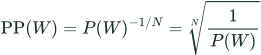 LaTeX:
\operatorname{PP}(W)=P(W)^{-1/N}=\sqrt[N]{\frac1{P(W)}}| Symbol | Meaning |
|---|---|
| W | The complete test sequence. |
| P(W) | Product of the probabilities assigned to the actual next tokens. |
| N | Number of scored prediction events under the stated convention. |
| Exponent −1/N | Take the reciprocal, then the Nth root. |
For calculator entry, use parentheses: P raised to (−1 ÷ N), or (1 ÷ P) raised to (1 ÷ N). Retain several digits in intermediate products. The ordinary start marker is usually given context, not a predicted event; the end marker counts if its probability is included.
Question. A model assigns probability 0.0625 to a test sequence containing four scored tokens. Compute its perplexity.
Given
P(W)=0.0625=1/16; N=4.
To find
PP(W).
Formula and why it applies
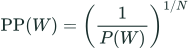 LaTeX:
\operatorname{PP}(W)=\left(\frac1{P(W)}\right)^{1/N}The root removes the effect of sequence length; the reciprocal makes lower surprise correspond to lower perplexity.
Solution
Step 1. Take the reciprocal
 LaTeX:
1/P(W)=1/0.0625=16Step 2. Use the fourth root
 LaTeX:
\operatorname{PP}=16^{1/4}Step 3. Evaluate
 LaTeX:
2^4=16\quad\Rightarrow\quad\operatorname{PP}=2Question. Two language models score the same three-token test sequence. Model A gives next-token probabilities 0.5, 0.5, 0.5. Model B gives 0.5, 0.25, 0.25. Compute their perplexities and select the better intrinsic result.
Given
Same sequence and N=3 for both models. A factors: 0.5,0.5,0.5. B factors: 0.5,0.25,0.25.
To find
Both sequence probabilities and perplexities.
Formula and why it applies
 LaTeX:
P(W)=\prod_i p_i,\qquad\operatorname{PP}=P(W)^{-1/3}A fair comparison uses identical test tokens and scoring conventions.
Solution
Step 1. Calculate A's probability
 LaTeX:
P_A=0.5\times0.5\times0.5=0.125=1/8Step 2. Calculate A's perplexity
 LaTeX:
\operatorname{PP}_A=8^{1/3}=2Step 3. Calculate B's probability
 LaTeX:
P_B=0.5\times0.25\times0.25=0.03125=1/32Step 4. Calculate B's perplexity
 LaTeX:
\operatorname{PP}_B=32^{1/3}\approx3.174802Step 5. Compare
2 is lower than 3.174802; A places more probability on the observed sequence.
Question. The bigram training corpus is “This is a dog”, “This is a cat”, “I love my cat”, “This is my name”. Score “This is my cat”, including an end marker, and compute perplexity using five predicted events.
Given
Each training sentence has one start and end marker. Test predictions: This, is, my, cat, </s>. Thus N=5.
To find
Bigram sentence probability and perplexity.
Formula and why it applies
 LaTeX:
P(w\mid h)=C(h,w)/C(h),\qquad\operatorname{PP}=P(W)^{-1/5}Start is given context. Four words plus the end marker produce five probability factors.
Solution
Step 1. Count the required transitions
| Transition | Pair count / history count |
|---|---|
| <s>→This | 3/4 |
| This→is | 3/3 |
| is→my | 1/3 |
| my→cat | 1/2 |
| cat→</s> | 2/2 |
Step 2. Form the product
 LaTeX:
P=\frac34\times1\times\frac13\times\frac12\times1=\frac18Step 3. Take the reciprocal
 LaTeX:
1/P=8Step 4. Take the fifth root
 LaTeX:
\operatorname{PP}=8^{1/5}\approx1.515717If the question explicitly states N = 6: use that supplied convention and report PP = 81/6 ≈ 1.414214. The class slide counts both boundary markers in N. Write the chosen N beside the formula; do not silently switch between 5 and 6. Also, This occurs three times and is follows it three times, so P(is|This)=3/3, not 3/4.
Question. A uniform model assigns probability 1/10 to each actual next word in a five-token test. Find its perplexity.
Given
Five scored tokens, each with assigned probability 0.1. N=5.
To find
The sentence probability and perplexity.
Formula and why it applies
 LaTeX:
P(W)=(1/10)^5,\qquad \operatorname{PP}=P(W)^{-1/5}Uniform equal probabilities make the effective number of choices especially clear.
Solution
Step 1. Multiply the five factors
 LaTeX:
P(W)=0.1^5=0.00001=10^{-5}Step 2. Invert
 LaTeX:
1/P(W)=10^5Step 3. Take the fifth root
 LaTeX:
\operatorname{PP}=(10^5)^{1/5}=10Yaad rakho: Probability high → surprise low → perplexity low.