Natural Language Processing · M2 · formulas
Laplace smoothing: why both numerator and denominator change
Smoothing & perplexity
Formulas explained through full worked examples
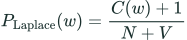
Smoothing reallocates some probability mass to events that received zero or unreliable estimates from finite training data. Laplace, or add-one, smoothing adds one pseudo-count to every possible next outcome. If there are V possible outcomes, the total added count is V, so adding 1 only to the numerator would produce probabilities that do not sum to 1.
 LaTeX:
P_{\mathrm{Laplace}}(w)=\frac{C(w)+1}{N+V} LaTeX:
P_{\mathrm{Laplace}}(w\mid h)=\frac{C(h,w)+1}{C(h)+V}For unigram smoothing, N is the total training token count. For bigram smoothing, C(h) is the count of the particular history. In both cases V is the number of outcomes being predicted, not the number of training sentences and not the number of distinct bigrams. When end is a possible prediction, include it in V; the start marker is usually context only.
Question. A fixed unigram vocabulary is {a,b,c}. The training counts are 3,1,0. Compute unsmoothed and Laplace-smoothed probabilities.
Given
C(a)=3, C(b)=1, C(c)=0; N=4; V=3.
To find
The complete distributions.
Formula and why it applies
 LaTeX:
P(w)=C(w)/N,\qquad P_L(w)=(C(w)+1)/(N+V)The zero-count c is still in the fixed vocabulary, so it must receive one pseudo-count and contribute to V.
Solution
Step 1. Compute unsmoothed values
| Word | Unsmoothed |
|---|---|
| a | 3/4 = 0.75 |
| b | 1/4 = 0.25 |
| c | 0/4 = 0 |
Step 2. Calculate the new denominator
 LaTeX:
N+V=4+3=7Step 3. Add one to each numerator
 LaTeX:
C(a)+1=4,\quad C(b)+1=2,\quad C(c)+1=1Step 4. Divide
| Word | Smoothed |
|---|---|
| a | 4/7 ≈ 0.571429 |
| b | 2/7 ≈ 0.285714 |
| c | 1/7 ≈ 0.142857 |
Step 5. Confirm the total
 LaTeX:
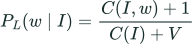
4/7+2/7+1/7=1Question. After history I, a corpus records like three times, study once and sleep zero times. The allowed next vocabulary is {like,study,sleep}. Compute all Laplace-smoothed bigram probabilities.
Given
C(I,like)=3; C(I,study)=1; C(I,sleep)=0. History count C(I)=4. V=3.
To find
P_L(like|I), P_L(study|I), P_L(sleep|I).
Formula and why it applies
 LaTeX:
P_L(w\mid I)=\frac{C(I,w)+1}{C(I)+V}This is smoothing within the I row; use its total 4, not the global corpus token count.
Solution
Step 1. Form the common denominator
 LaTeX:
C(I)+V=4+3=7Step 2. Calculate like
 LaTeX:
P_L(like\mid I)=(3+1)/7=4/7Step 3. Calculate study
 LaTeX:
P_L(study\mid I)=(1+1)/7=2/7Step 4. Calculate sleep
 LaTeX:
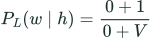
P_L(sleep\mid I)=(0+1)/7=1/7Question. A fixed vocabulary has five possible next tokens. A history h is unseen in training. What is its add-one probability for each next token?
Given
C(h)=0; C(h,w)=0 for each outcome; V=5.
To find
P_L(w|h) for each token.
Formula and why it applies
 LaTeX:
P_L(w\mid h)=\frac{0+1}{0+V}All outcomes receive equal pseudo-counts because the training data gives no preference for this history.
Solution
Step 1. Add the pseudo-count
 LaTeX:
0+1=1Step 2. Form the denominator
 LaTeX:
0+5=5Step 3. Divide and sum
 LaTeX:
P_L(w\mid h)=1/5=0.2,\qquad5(0.2)=1Vocabulary warning. Add-one does not automatically define probabilities for every word in the world. Unknown words require a declared vocabulary/UNK convention. If a question supplies V, use that stated V rather than inventing additional tokens.
Yaad rakho: Add-one: upar +1, neeche +V; bigram mein neeche history ka count.