Natural Language Processing · M2 · formulas
Log probabilities: replace long products with sums
Smoothing & perplexity
Formulas explained through full worked examples
Probabilities are at most 1, so multiplying many of them produces very small numbers. Computers can round extremely small positive products to zero: numerical underflow. Log probabilities convert multiplication into addition and are more stable for long sequences. Natural logs use base e; log₂ uses base 2. Choose one base consistently.
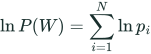 LaTeX:
\ln P(W)=\sum_{i=1}^{N}\ln p_i LaTeX:
P(W)=e^{\ln P(W)},\qquad \operatorname{PP}(W)=\exp\left(-\frac1N\sum_i\ln p_i\right)The log of a probability below 1 is negative. A value closer to zero means a larger probability: ln(0.5) ≈ −0.693 is larger than ln(0.1) ≈ −2.303. A zero probability has log −∞; taking logs does not solve the unseen-event problem. Smoothing handles that separate problem.
Question. The next-word probabilities are 0.5, 0.25 and 0.5. Calculate the natural log probability, ordinary probability and perplexity.
Given
p₁=0.5; p₂=0.25; p₃=0.5; N=3.
To find
ln P(W), P(W), and PP.
Formula and why it applies
 LaTeX:
\ln P=\sum_i\ln p_i,\quad P=e^{\ln P},\quad\operatorname{PP}=e^{-\ln P/N}Logarithms preserve products as sums and the exponent converts the result back.
Solution
Step 1. Compute individual logs
 LaTeX:
\ln0.5\approx-0.693147,\quad\ln0.25\approx-1.386294Step 2. Add all three terms
 LaTeX:
\ln P=-0.693147-1.386294-0.693147\approx-2.772589Step 3. Recover the probability
 LaTeX:
P=e^{-2.772589}\approx0.0625Step 4. Find average negative log probability
 LaTeX:
-\ln P/3\approx2.772589/3=0.924196Step 5. Exponentiate
 LaTeX:
\operatorname{PP}=e^{0.924196}\approx2.519842Question. A model has a total natural log probability −12 over six scored tokens. Calculate its perplexity.
Given
ln P(W)=−12; N=6.
To find
PP without forming the tiny ordinary probability.
Formula and why it applies
 LaTeX:
\operatorname{PP}=\exp(-\ln P(W)/N)The logarithmic formula directly uses the supplied log score.
Solution
Step 1. Negate the log score
 LaTeX:
-\ln P=12Step 2. Divide by token count
 LaTeX:
12/6=2Step 3. Apply exponential
 LaTeX:
\operatorname{PP}=e^2\approx7.389056Question. A language model's average negative log₂ probability is 3 bits per token. Find its perplexity.
Given
Cross-entropy H=3 bits/token. Log base is 2.
To find
PP.
Formula and why it applies
 LaTeX:
\operatorname{PP}=2^HThe inverse operation of log₂ is raising 2 to that power; use e only for natural logs.
Solution
Step 1. Identify the log base
Bits mean base 2.
Step 2. Raise the base to H
 LaTeX:
\operatorname{PP}=2^3=8Yaad rakho: ln use kiya toh e se wapas; log₂ use kiya toh 2 se wapas.