Natural Language Processing · M2 · mocks
Q3 (3 marks)
M2 Mock B · unseen pairs & decoding
M2 · confirmed 2 + 2 + any two of 3 + 3 + 3 · worked practice
Q3
For a fixed vocabulary of five possible continuations, C(very)=7 and C(very bright)=0. Calculate the unsmoothed and Laplace-smoothed probabilities of bright after very. (3 marks)
Given
History count=7; pair count=0; |V|=5.
To findMLE and add-one probabilities.
Formula and why it applies
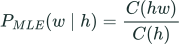 LaTeX:
P_{MLE}(w\mid h)=\frac{C(hw)}{C(h)}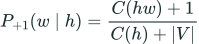 LaTeX:
P_{+1}(w\mid h)=\frac{C(hw)+1}{C(h)+|V|}MLE uses only observations. Laplace reserves probability for all known vocabulary outcomes, including unseen pairs.
Solution
Step 1. Unsmoothed estimate
 LaTeX:
P_{MLE}(\text{bright}\mid\text{very})=\frac07=0Step 2. Add one to the pair count
 LaTeX:
0+1=1Step 3. Add vocabulary size to the history count
 LaTeX:
7+5=12Step 4. Divide
 LaTeX:
P_{+1}(\text{bright}\mid\text{very})=\frac1{12}\approx0.083333MLE=0; Laplace=1/12≈0.083333. The zero count means unseen in this corpus, not impossible language.