Natural Language Processing · TEE · formulas
Estimate transition and emission probabilities from tagged data
HMM & decoding
Formulas explained through full worked examples
 LaTeX:
P(t'\mid t)=\frac{C(t,t')}{C(t)\text{ with a following tag/end event}}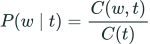 LaTeX:
P(w\mid t)=\frac{C(w,t)}{C(t)}In a transition denominator, count the previous tag's outgoing events. In an emission denominator, count all tokens bearing that tag. With explicit end transitions the totals align conveniently. Keep the two numerator types separate: tag→tag counts are not word→tag counts.
Question. A tagged corpus contains 116454 determiner tags DT, each counted with an outgoing event. DT is followed by NN 56509 times. Estimate P(NN|DT).
Given
C(DT)=116454; C(DT,NN)=56509.
To find
The DT→NN transition probability.
Formula and why it applies
 LaTeX:
P(NN\mid DT)=C(DT,NN)/C(DT)The denominator is the number of previous DT contexts because DT is the condition.
Solution
Step 1. Identify the transition count
DT followed by NN occurs 56509 times.
Step 2. Identify the conditional total
There are 116454 DT contexts.
Step 3. Divide
 LaTeX:
P(NN\mid DT)=\frac{56509}{116454}\approx0.485247Question. The tag VBZ occurs 21627 times, and 10073 of those tokens are the word “is”. Estimate P(is|VBZ).
Given
C(VBZ)=21627; C(is,VBZ)=10073.
To find
The emission probability of is from VBZ.
Formula and why it applies
 LaTeX:
P(is\mid VBZ)=C(is,VBZ)/C(VBZ)The condition is the tag VBZ; we ask which word it emits.
Solution
Step 1. Choose the word-tag count
The required word is is with tag VBZ: count 10073.
Step 2. Choose the tag total
All VBZ-tagged word tokens: count 21627.
Step 3. Divide
 LaTeX:
P(is\mid VBZ)=\frac{10073}{21627}\approx0.465760Question. Use the tagged sentences “dogs/N chase/V cats/N” and “cats/N sleep/V”. Estimate the initial tag probabilities, all nonzero transitions including END, and emissions.
Given
Corpus: START dogs/N chase/V cats/N END; START cats/N sleep/V END.
To find
Initial distribution, transition rows and emission rows.
Formula and why it applies
 LaTeX:
\pi_t=C(START,t)/2,\quad a_{tu}=C(t,u)/C(t),\quad b_t(w)=C(w,t)/C(t)The corpus explicitly tells us the tags, so we can count training frequencies directly.
Solution
Step 1. Count tag tokens
N occurs 3 times: dogs, cats, cats. V occurs 2 times: chase, sleep.
Step 2. Count sentence starts
Both sentences start with N.
 LaTeX:
\pi_N=2/2=1,\quad \pi_V=0/2=0Step 3. Count transitions
| Pair | Count |
|---|---|
| N→V | 2 |
| N→END | 1 |
| V→N | 1 |
| V→END | 1 |
Step 4. Normalize transition rows
| Current | To N | To V | To END |
|---|---|---|---|
| N | 0 | 2/3 | 1/3 |
| V | 1/2 | 0 | 1/2 |
Step 5. Count and normalize emissions
| Tag | dogs | cats | chase | sleep |
|---|---|---|---|---|
| N | 1/3 | 2/3 | 0 | 0 |
| V | 0 | 0 | 1/2 | 1/2 |
Yaad rakho: Tag→tag table aur tag→word table ko mix mat karna.