Natural Language Processing · TEE · formulas
Cosine: products, lengths and division
Representation & similarity
Formulas explained through full worked examples
Cosine similarity compares the direction of two nonzero vectors. Multiply matching coordinates and add to obtain the dot product. To obtain each vector's norm, square its coordinates, add them and take a square root.
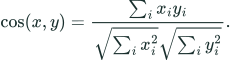 LaTeX:
\cos(x,y)=\frac{\sum_i x_i y_i}{\sqrt{\sum_i x_i^2}\sqrt{\sum_i y_i^2}}.The vectors must use the same coordinate/vocabulary order. For nonnegative BoW or TF–IDF vectors, the result lies from 0 to 1; for general real-valued vectors, it can range from −1 to 1. A zero vector makes this formula undefined.
Question. Find cosine similarity for x=[1,1] and y=[1,0].
Given
Nonzero vectors, matching coordinate order.
To find
Find cosine similarity for x=[1,1] and y=[1,0].
Formula and why it applies
Use  LaTeX:
\cos(x,y)=(x\cdot y)/(\|x\|\|y\|) because direction similarity is required.
Step 1. Multiply matching coordinates
1 × 1 = 1; 1 × 0 = 0.
Step 2. Add products
1 + 0 = 1.
Step 3. Length of x
 LaTeX:
\sqrt{(1)^2+(1)^2}=\sqrt{2}.
Step 4. Length of y
 LaTeX:
\sqrt{(1)^2+(0)^2}=\sqrt{1}.
Step 5. Divide
 LaTeX:
\frac{1}{\sqrt{2}\sqrt{1}}\approx 0.707107.
Answer. Cosine≈0.707107.
Question. Find cosine similarity for x=[1,2] and y=[2,4].
Given
Nonzero vectors, matching coordinate order.
To find
Find cosine similarity for x=[1,2] and y=[2,4].
Formula and why it applies
Use LaTeX: \cos(x,y)=(x\cdot y)/(\|x\|\|y\|) because direction similarity is required.
Step 1. Multiply matching coordinates
1 × 2 = 2; 2 × 4 = 8.
Step 2. Add products
2 + 8 = 10.
Step 3. Length of x
 LaTeX:
\sqrt{(1)^2+(2)^2}=\sqrt{5}.
Step 4. Length of y
 LaTeX:
\sqrt{(2)^2+(4)^2}=\sqrt{20}.
Step 5. Divide
 LaTeX:
\frac{10}{\sqrt{5}\sqrt{20}}\approx 1.000000.
Answer. Cosine≈1.000000.
Question. Find cosine similarity for x=[1,2,0] and y=[0,1,2].
Given
Nonzero vectors, matching coordinate order.
To find
Find cosine similarity for x=[1,2,0] and y=[0,1,2].
Formula and why it applies
Use LaTeX: \cos(x,y)=(x\cdot y)/(\|x\|\|y\|) because direction similarity is required.
Step 1. Multiply matching coordinates
1 × 0 = 0; 2 × 1 = 2; 0 × 2 = 0.
Step 2. Add products
0 + 2 + 0 = 2.
Step 3. Length of x
 LaTeX:
\sqrt{(1)^2+(2)^2+(0)^2}=\sqrt{5}.
Step 4. Length of y
 LaTeX:
\sqrt{(0)^2+(1)^2+(2)^2}=\sqrt{5}.
Step 5. Divide
 LaTeX:
\frac{2}{\sqrt{5}\sqrt{5}}\approx 0.400000.
Answer. Cosine≈0.400000.
Proportional vectors [1,2] and [2,4] have cosine 1 but nonzero Euclidean distance. Direction similarity does not require identical magnitudes.
Cosine: matching products add upar; dono lengths multiply neeche.