Natural Language Processing · TEE · formulas
TEE formula sheet: vectors and applications
TEE · additional formulas
TEE · used together with the M2 formula sheet
These formulas extend the M2 sheet to the complete TEE syllabus. Each coordinate, token-count convention and log base must be defined before calculation. Worked-example chapters follow this sheet.
Type–token ratio
 LaTeX:
TTR=\frac{\#\text{types}}{\#\text{tokens}}Distinct vocabulary types divided by all token occurrences. Often expressed as a percentage.
Normalized term frequency
 LaTeX:
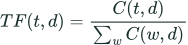
TF(t,d)=\frac{C(t,d)}{\sum_w C(w,d)}The slides use count of the term divided by the document token total after the specified preprocessing.
Inverse document frequency
 LaTeX:
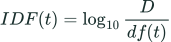
IDF(t)=\log_{10}\frac{D}{df(t)}D is the number of documents; df counts documents containing the term at least once. This is the course slide convention.
TF–IDF
 LaTeX:
TF\!\operatorname{-}\!IDF(t,d)=TF(t,d)IDF(t)Multiply the local frequency weight by the global rarity weight.
Dot product
 LaTeX:
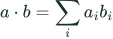
a\cdot b=\sum_i a_ib_iMultiply corresponding coordinates, then add. Vectors need the same coordinate order.
Vector length
 LaTeX:
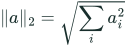
\|a\|_2=\sqrt{\sum_i a_i^2}Square each coordinate, add, then take the square root.
Cosine similarity
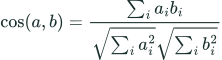 LaTeX:
\cos(a,b)=\frac{\sum_i a_ib_i}{\sqrt{\sum_i a_i^2}\sqrt{\sum_i b_i^2}}Compare direction; undefined for a zero-length vector.
Jaccard similarity
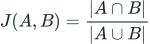 LaTeX:
J(A,B)=\frac{|A\cap B|}{|A\cup B|}Set membership, not repeated word counts. Jaccard distance = 1 − J.
Manhattan distance
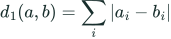 LaTeX:
d_1(a,b)=\sum_i|a_i-b_i|Add coordinate-wise absolute differences.
Euclidean distance
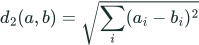 LaTeX:
d_2(a,b)=\sqrt{\sum_i(a_i-b_i)^2}Square differences, add, square root.
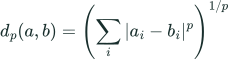
Minkowski distance
 LaTeX:
d_p(a,b)=\left(\sum_i|a_i-b_i|^p\right)^{1/p}p≥1; Manhattan p=1, Euclidean p=2.
Mean sentence embedding
 LaTeX:
v_{sentence}=\frac1n\sum_{i=1}^n v_{w_i}Add word vectors coordinate by coordinate; divide each coordinate by n. This baseline loses word order.
GloVe objective
 LaTeX:
J=\sum_{i,j}f(X_{ij})(w_i^T\widetilde w_j+b_i+\widetilde b_j-\log X_{ij})^2X is a co-occurrence count. Compute the residual, square it and apply the weighting function. Use observed positive counts.
Precision and recall
 LaTeX:
P=\frac{TP}{TP+FP},\qquad R=\frac{TP}{TP+FN}Precision checks predicted positives; recall checks actual positives.
F1 score
 LaTeX:
F_1=\frac{2PR}{P+R}=\frac{2TP}{2TP+FP+FN}Harmonic mean of precision and recall.
Accuracy
 LaTeX:
A=\frac{TP+TN}{TP+TN+FP+FN}All correct predictions divided by all predictions.
Noisy-channel correction
 LaTeX:
\hat w=\arg\max_w P(x\mid w)P(w)Rank intended word w using observed typo x; likelihood × prior.
Unit-cost edit distance
 LaTeX:
D(i,j)=\min\{D(i-1,j)+1,D(i,j-1)+1,D(i-1,j-1)+[a_i\ne b_j]\}Initialise first row/column by insertion/deletion counts; fill all cells using min.