Natural Language Processing · TEE · mocks
Q3B · Co-occurrence matrix and cosine
Timed practice · Solved final paper · December 2025
TEE · actual previous paper · 100 marks · 180 minutes
Target words: teacher, student, board, book.
Context words: wrote, listened, notes, question.
i. Construct a co-occurrence matrix for the target and context words. Take the window size as one whole sentence.
ii. Evaluate the similarity between the vectors of the target words “teacher-student” and “teacher-board” using the cosine similarity.
iii. Plot the target word vectors by considering only two dimensions: “wrote” and “notes”. [10 marks]
Answer
Given
Five sentences, four target rows and four context columns. Treat students and student as the same target lemma, and count each target–context pair once when both occur in a sentence.
To find
The 4 × 4 sentence-window co-occurrence matrix, two cosine similarities and the requested 2-D plot.
Formula: which one and why
 LaTeX:
M_{ij}=\sum_{s=1}^{5}\mathbf{1}[\text{target}_i\text{ and context}_j\text{ occur in sentence }s]The indicator is 1 when both words appear in that sentence and 0 otherwise. Each matrix row is the target word’s vector: its list of four context counts.
 LaTeX:
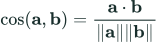
\cos(\mathbf a,\mathbf b)=\frac{\mathbf a\cdot\mathbf b}{\|\mathbf a\|\|\mathbf b\|}The dot product multiplies corresponding coordinates and adds them. The length is the square root of the sum of squared coordinates. Cosine compares directions while allowing different vector lengths.
Solution
Step 1. Record the contribution of each sentence
| Sentence | Targets present | Relevant context | Counts added |
|---|---|---|---|
| 1 | teacher, board | wrote | teacher–wrote +1; board–wrote +1 |
| 2 | student, teacher | listened | student–listened +1; teacher–listened +1 |
| 3 | board | notes | board–notes +1 |
| 4 | student | question | student–question +1 |
| 5 | teacher, book | none | No requested context count |
Step 2. Construct every requested column
| Target | wrote | listened | notes | question |
|---|---|---|---|---|
| teacher | 1 | 1 | 0 | 0 |
| student | 0 | 1 | 0 | 1 |
| board | 1 | 0 | 1 | 0 |
| book | 0 | 0 | 0 | 0 |
Step 3. Calculate teacher–student
 LaTeX:
\mathbf t\cdot\mathbf s=(1)(0)+(1)(1)+(0)(0)+(0)(1)=1 LaTeX:
\|\mathbf t\|=\sqrt{1^2+1^2+0^2+0^2}=\sqrt2 LaTeX:
\|\mathbf s\|=\sqrt{0^2+1^2+0^2+1^2}=\sqrt2 LaTeX:
\cos(\mathbf t,\mathbf s)=\frac1{\sqrt2\sqrt2}=\frac12=0.5Step 4. Calculate teacher–board
 LaTeX:
\mathbf t\cdot\mathbf b=(1)(1)+(1)(0)+(0)(1)+(0)(0)=1 LaTeX:
\|\mathbf b\|=\sqrt{1^2+0^2+1^2+0^2}=\sqrt2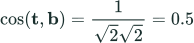 LaTeX:
\cos(\mathbf t,\mathbf b)=\frac1{\sqrt2\sqrt2}=0.5Step 5. Select only the two requested plot coordinates
| Word | x = wrote | y = notes |
|---|---|---|
| teacher | 1 | 0 |
| student | 0 | 0 |
| board | 1 | 1 |
| book | 0 | 0 |
Final answer
Both requested cosine similarities are 0.5. Student and book overlap at the origin of the 2-D projection, but their complete four-dimensional vectors differ. The book row is zero, so a cosine involving book would be undefined without an explicit convention.
Yaad rakho: Har sentence mein target aur context saath? Ek count. Cosine ke liye poori row lo, plot ke liye sirf do columns.