Natural Language Processing · TEE · mocks
Q7B · Corpora and Jaccard similarity
Timed practice · Solved final paper · December 2025
TEE · actual previous paper · 100 marks · 180 minutes
ii. Explain a real-world scenario where the Jaccard Similarity measure is more appropriate than Euclidean or Manhattan distance, and justify why Jaccard is the best choice in that case. [10 marks]
Answer
i. Flat and annotated corpora
A corpus is a collection of language data. A flat text corpus stores text without the linguistic labels needed by a particular task. An annotated corpus adds labels or structure such as POS tags, entity spans, parse trees or sentence sentiment.
| Basis | Flat text corpus | Annotated corpus |
|---|---|---|
| Example | A collection of plain news articles | The same articles with PERSON/ORG spans marked |
| Information | The original text and possibly simple metadata | Text plus explicit task-related linguistic labels |
| Applications | Word frequency, collocations and unsupervised language-model training | Supervised POS tagging, NER or parser training and evaluation |
| Preparation | Relatively inexpensive to gather, but still needs cleaning | Requires annotation guidelines, labour and quality checks |
“Flat” describes the lack of the annotations being discussed, not an absence of all file organization. Both corpus types may still have document boundaries and metadata.
ii. Jaccard in a set-based application
Consider recommending articles using their topic-tag sets. Article A has {AI, NLP, ethics}; article B has {AI, NLP, healthcare}. We care about overlap among present tags, not how many irrelevant tags are absent from both.
Given
A = {AI, NLP, ethics}; B = {AI, NLP, healthcare}.
To find
The fraction of distinct present tags shared by the articles.
Formula and why
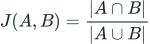 LaTeX:
J(A,B)=\frac{|A\cap B|}{|A\cup B|}The intersection counts common items; the union counts all distinct items present in either set.
Step 1. Find common tags
A ∩ B = {AI, NLP}, so the intersection size is 2.
Step 2. Find all distinct present tags
A ∪ B = {AI, NLP, ethics, healthcare}, so the union size is 4.
Step 3. Divide
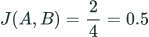 LaTeX:
J(A,B)=\frac24=0.5Jaccard directly measures proportional overlap and ignores joint absences. Euclidean or Manhattan distance on binary tag vectors counts mismatches but does not by itself normalize by the union size. If frequency or magnitude were meaningful, those distance measures could be more appropriate. Here, membership-only tags and sparse sets make Jaccard a suitable choice.
Yaad rakho: Jaccard: common present items / total distinct present items.