Natural Language Processing · TEE · papers
Q3b · Classification and sentiment in industry
2024-12-03 · final · recovered AI paper
Previous examination · complete worked answers
Answer
Text classification assigns a document to one or more predefined categories. Spam detection usually uses two classes; news classification may use several topics. In single-label multiclass classification, choose one of several categories. In multilabel classification, several labels may apply to the same document.
An exam-ready pipeline
| Stage | What you do | Why it matters |
|---|---|---|
| Task definition | Decide what counts as spam or which news topics exist. | Unclear labels create inconsistent training data. |
| Data collection and annotation | Collect representative examples and assign correct labels. | The model learns from these examples. |
| Split data | Separate training, validation and test data. | Test examples must not influence training choices. |
| Preprocess | Tokenize and normalise where suitable; retain meaningful negation. | Reduce irrelevant variation without deleting signal. |
| Represent | Use BoW, TF-IDF or learned embeddings. | Models need numerical features. |
| Train | Fit Naive Bayes, logistic regression or another appropriate model. | Learn how features predict categories. |
| Evaluate | Measure relevant precision, recall and F1 on held-out examples. | Accuracy alone may hide poor minority-class performance. |
| Deploy and monitor | Apply the same preprocessing and monitor changing language. | Incoming data can differ from old examples. |
Naive Bayes is especially useful for hand calculations. With a bag-of-words representation, its class score is the prior multiplied by the conditional probability of each token; repeated tokens repeat the factor. The “naive” assumption is conditional independence of features given the class, not that words are independent in real language.
 LaTeX:
s(c)=P(c)\prod_{w\in V}P(w\mid c)^{C(w,d)}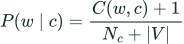 LaTeX:
P(w\mid c)=\frac{C(w,c)+1}{N_c+|V|}C(w,d) counts word w in document d. C(w,c) counts it in training documents belonging to class c. Nc is the total token count for class c. Add-one smoothing adds one to every vocabulary count and therefore adds |V| to the denominator. This is the same arithmetic taught for WSD, with document classes instead of senses.
Worked classification · two-token message
A spam classifier has vocabulary {win, prize, meeting}. Priors are P(spam)=P(ham)=0.5. Spam token counts are [3,2,0]; ham counts are [0,0,5]. With add-one smoothing, classify “win prize”.
|V|=3; N(spam)=5; N(ham)=5; message has win once and prize once.
To findClass scores and predicted label.
Formula and why it applies
 LaTeX:
s(c)=P(c)P(\text{win}\mid c)P(\text{prize}\mid c)LaTeX: P(w\mid c)=\frac{C(w,c)+1}{N_c+|V|}The model is multinomial Naive Bayes; multiply the two token likelihoods and the class prior.
Solution
Step 1. Compute the smoothed denominators
 LaTeX:
5+3=8Step 2. Compute spam likelihoods
 LaTeX:
P(\text{win}\mid S)=\frac{3+1}{8}=\frac12 LaTeX:
P(\text{prize}\mid S)=\frac{2+1}{8}=\frac38Step 3. Compute ham likelihoods
 LaTeX:
P(\text{win}\mid H)=P(\text{prize}\mid H)=\frac{0+1}{8}=\frac18Step 4. Multiply the spam score
 LaTeX:
s(S)=\frac12\times\frac12\times\frac38=\frac{3}{32}=0.09375Step 5. Multiply the ham score
 LaTeX:
s(H)=\frac12\times\frac18\times\frac18=\frac{1}{128}=0.0078125Step 6. Compare
0.09375 > 0.0078125. These are unnormalised scores; the label is chosen by the larger score.
Yaad rakho: Class prior × har word ki class-likelihood; sabse bada score wins.
Sentiment analysis identifies expressed opinion or attitude, often as positive, negative or neutral. Document-level analysis labels a complete text; sentence-level analysis labels a sentence; aspect-level analysis attaches sentiment to a specific feature or entity.
| Review | Useful interpretation |
|---|---|
| “The display is excellent, but the battery is poor.” | Display: positive; battery: negative. One overall label loses this distinction. |
| “The service is not good.” | Negative: negation changes good. Removing not can reverse the intended meaning. |
| “Great, another two-hour delay.” | Likely sarcasm: literal positive word alone is insufficient. |
Approaches
Lexicon based: look up sentiment scores, combine them, and apply stated handling for negation/intensifiers. It is interpretable but fragile with context and sarcasm. Supervised: learn a mapping from labelled text features to sentiment labels. Neural/contextual: learn or use contextual representations to capture word interactions, then fine-tune a sentiment classifier. None guarantees correct interpretation of every review.
A specified lexicon calculation
Use good = +2, excellent = +3 and slow = −2. A “not” immediately before a sentiment word reverses its score. Score “The support was not good but the delivery was excellent and slow.”
Three sentiment words; not modifies good only; sum word scores under the stated rule.
To findTotal sentiment score and label, taking positive totals as positive.
Formula and why it applies
 LaTeX:
S=\sum_i s_iApply the given negation rule before summing. This is a simplified specified model, not a universal linguistic rule.
Solution
Step 1. Identify sentiment words
good, excellent and slow.
Step 2. Apply negation
 LaTeX:
s(\text{not good})=-2Step 3. Add the contributions
 LaTeX:
S=-2+3-2=-1Step 4. Map score to label
The sum is negative.
| Industry | Concrete input and output | Useful decision / limitation |
|---|---|---|
| Retail | Review→topic and sentiment | Route delivery complaints; sarcasm/negation may mislead |
| Banking | Customer message→card/fraud/loan intent | Route to the correct team; a model flag is not proof of fraud |
| Healthcare | Feedback→service-quality topics | Detect recurring appointment issues; protect patient identifiers |
| Media | Article→topic; public responses→sentiment | Organize feeds and monitor reaction; sampling bias prevents treating posts as a census |