Natural Language Processing · TEE · papers
Q4A · Bag of Words and three cosine similarities
Solved re-exam · February 2026
Actual re-examination · 9 February 2026 · 100 marks · 3 hours
Document A: “The dog chased the cat.”
Document B: “The cat chased the mouse.”
Document C: “The dog ran after the cat.”
Using the Bag of Words (BoW) model, represent each document as a vector after removing the stop words {The, by, was}.
i. Construct the term-document matrix.
ii. Compute the cosine similarity between each pair of documents (A–B, A–C, and B–C).
iii. Interpret and comment on the results obtained in terms of document similarity. [10 marks]
Answer
Given
Three documents. Lowercase and remove punctuation. Remove the specified stop words case-insensitively; “the” is removed everywhere. Keep “after” because it is not in the supplied stop list. Use raw word counts.
To find
A common-vocabulary count matrix, three cosine values and their interpretation.
Formula: which one and why
 LaTeX:
\mathrm{BoW}_j(d)=C(v_j,d)vⱼ is vocabulary term j. The coordinate stores its count in document d; order in the sentence is not retained.
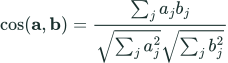 LaTeX:
\cos(\mathbf a,\mathbf b)=\frac{\sum_j a_jb_j}{\sqrt{\sum_j a_j^2}\sqrt{\sum_j b_j^2}}Solution
Step 1. Clean each document
A: dog chased cat.
B: cat chased mouse.
C: dog ran after cat.
Step 2. Fix vocabulary and matrix
Vocabulary: dog, chased, cat, mouse, ran, after.
| Term | A | B | C |
|---|---|---|---|
| dog | 1 | 0 | 1 |
| chased | 1 | 1 | 0 |
| cat | 1 | 1 | 1 |
| mouse | 0 | 1 | 0 |
| ran | 0 | 0 | 1 |
| after | 0 | 0 | 1 |
A = [1,1,1,0,0,0]; B = [0,1,1,1,0,0]; C = [1,0,1,0,1,1].
Step 3. Calculate vector lengths
 LaTeX:
\|A\|=\sqrt{1^2+1^2+1^2}=\sqrt3 LaTeX:
\|B\|=\sqrt{1^2+1^2+1^2}=\sqrt3 LaTeX:
\|C\|=\sqrt{1^2+1^2+1^2+1^2}=2Step 4. Calculate A–B
 LaTeX:
A\cdot B=(1)(0)+(1)(1)+(1)(1)+(0)(1)+(0)(0)+(0)(0)=2 LaTeX:
\cos(A,B)=\frac2{\sqrt3\sqrt3}=\frac23\approx0.666667Step 5. Calculate A–C
 LaTeX:
A\cdot C=(1)(1)+(1)(0)+(1)(1)+(0)(0)+(0)(1)+(0)(1)=2 LaTeX:
\cos(A,C)=\frac2{\sqrt3\cdot2}=\frac1{\sqrt3}\approx0.577350Step 6. Calculate B–C
 LaTeX:
B\cdot C=(0)(1)+(1)(0)+(1)(1)+(1)(0)+(0)(1)+(0)(1)=1 LaTeX:
\cos(B,C)=\frac1{\sqrt3\cdot2}\approx0.288675Final answer
A–B = 0.666667; A–C = 0.577350; B–C = 0.288675. A and B have the highest lexical overlap under this representation. B and C share only cat. BoW similarity reflects token overlap, not full semantic equivalence or word order.
Yaad rakho: Same vocabulary order rakho. Corresponding counts multiply-add; phir dono lengths se divide.