Advertising and Public Relations · M2 · mocks
Paper A · theories, planning and media numbers
Three M2 mock papers · fully solved
10 attempted marks · 45 minutes · all answers below questions
Time: 45 minutes. Maximum attempted marks: 10. Q1(a) and Q1(b) are compulsory. Attempt ANY TWO of Q2, Q3 and Q4. The paper offers 13 marks of questions, but you attempt 10. These are authored practice papers, not predicted or previous exam papers.
Q1(a) · Mock question. State the four stages of AIDA. [2 mock marks]
Answer
The four stages are Attention, Interest, Desire and Action. The message first attracts notice, develops relevant interest, builds a preference or desire, and supplies a way to respond.
Q1(b) · Mock question. Distinguish reach and frequency. [2 mock marks]
Answer
Reach is the number or percentage of distinct target members exposed at least once. Average frequency is the average number of exposures among those reached during the same period.
Q2 · Mock question. Explain mediation of reality in advertising. [3 mock marks]
Answer
The theory views advertising as a constructed representation of reality. Advertisers select scenes, characters and symbols that associate a product with a particular version of life. Viewers may use those representations to form expectations, although the advertisement is not a complete or neutral account of reality.
Q3 · Mock question. Explain the five-step strategic planning process. [3 mock marks]
Answer
- Select an audience consistent with marketing objectives.
- Study how that audience makes the purchase decision.
- Define a relevant and distinctive brand position.
- Develop a message around specified communication effects.
- Select media and scheduling that deliver the message effectively within resources.
Q4 · Mock question. In a four-week campaign, 1,500 people receive 3 exposures each, 1,500 people receive 6 exposures each. The groups are distinct with no overlap. Find gross exposures, unique reach and average frequency. [3 mock marks]
Answer
Given
| Group | Distinct people | Exposures each |
|---|---|---|
| 1 | 1500 | 3 |
| 2 | 1500 | 6 |
To find
Gross exposures, unduplicated reach and average frequency.
Formula and why
 LaTeX:
I=\sum_i n_i f_i,\qquad n=\sum_i n_i,\qquad\bar f=\frac{I}{n}Multiply each group size by its frequency; then add. The reach sum is valid because the question explicitly says the groups do not overlap.
Step-by-step solution
Step 1. Count exposures for group 1
 LaTeX:
1500\times3=4500Step 2. Count exposures for group 2
 LaTeX:
1500\times6=9000Step 3. Add all group exposures
 LaTeX:
4500+9000=13500Step 4. Count distinct people
 LaTeX:
1500+1500=3000Step 5. Divide exposures by people reached
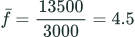 LaTeX:
\bar f=\frac{13500}{3000}=4.5Final answer: Gross exposures = 13,500; reach = 3,000 people; average frequency = 4.5.