Advertising and Public Relations · M2 · mocks
Paper C · media decisions and brand indices
Three M2 mock papers · fully solved
10 attempted marks · 45 minutes · all answers below questions
Time: 45 minutes. Maximum attempted marks: 10. Q1(a) and Q1(b) are compulsory. Attempt ANY TWO of Q2, Q3 and Q4. The paper offers 13 marks of questions, but you attempt 10. These are authored practice papers, not predicted or previous exam papers.
Q1(a) · Mock question. Distinguish flighting and pulsing. [2 mock marks]
Answer
Flighting alternates active advertising periods with gaps. Pulsing maintains a continuing base level with heavier bursts at selected times.
Q1(b) · Mock question. State two functions of media planning. [2 mock marks]
Answer
Media planning identifies suitable channels and vehicles for the target audience, and allocates delivery across budget, timing, reach and frequency requirements. Evaluation then compares delivery with objectives.
Q2 · Mock question. Explain the Ehrenberg model used in this course. [3 mock marks]
Answer
- Awareness makes the brand familiar.
- Trial gives the consumer actual product experience.
- Reinforcement supports a satisfactory experience and existing attitude.
- Nudging keeps the brand salient for later purchases.
Q3 · Mock question. Explain the four stages in developing a media plan. [3 mock marks]
Answer
- Analyse the market and identify the target audience.
- Set measurable media objectives for audience, place, timing and exposure.
- Develop and implement a suitable mix and schedule.
- Evaluate media delivery and its contribution to communication objectives; improve the next plan.
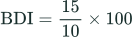
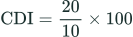
Q4 · Mock question. An area contains 10% of the relevant population, accounts for 15% of total brand sales and 20% of total category sales. Calculate BDI and CDI and interpret them. [3 mock marks]
Answer
Given
| Population share | Brand-sales share | Category-sales share |
|---|---|---|
| 10% | 15% | 20% |
To find
Brand and category development indices.
Formula and why
 LaTeX:
\text{BDI}=\frac{B_{\%}}{P_{\%}}\times100,\qquad\text{CDI}=\frac{C_{\%}}{P_{\%}}\times100The common denominator is population share. Only the numerator changes between brand sales and category sales.
Step-by-step solution
Step 1. Substitute for BDI
 LaTeX:
\text{BDI}=\frac{15}{10}\times100Step 2. Divide and scale BDI
 LaTeX:
1.5\times100=150Step 3. Substitute for CDI
 LaTeX:
\text{CDI}=\frac{20}{10}\times100Step 4. Divide and scale CDI
 LaTeX:
2\times100=200Step 5. Compare each with 100
Both brand and category are over-represented relative to population.
Final answer: BDI = 150; CDI = 200.