Advertising and Public Relations · M2 · papers
Compare print, audio-visual and digital media
M2 solved question bank
Short exam answers with examples
Practice question. Compare print, audio-visual and digital media for advertising. [3 practice marks]
Answer
Definition. A medium’s sensory and technical characteristics determine how a message can be presented and how audiences can respond.
| Medium | Nature | Strength | Limitation | Illustrative use |
|---|---|---|---|---|
| Text and still images; can be retained and reread | Detailed explanation; useful local or specialist targeting | No motion or sound; readership and placement matter | Magazine page explaining a product specification | |
| Audio | Speech, music, sound effects and silence | Voice and sound can create recall; fits listening occasions | No visual demonstration; listeners may miss details | Local radio announcement with a memorable spoken address |
| Audio-visual | Sight, motion and sound | Demonstrates use and combines verbal/nonverbal cues | Production and placement costs; clutter and avoidance | Film showing how a foldable product works |
| Digital | Can combine text, audio, video and interaction | Clickable response, flexible formats and measurable events | Privacy, fraud, clutter, measurement gaps and unequal access | Captioned demo linked to a detailed product page |
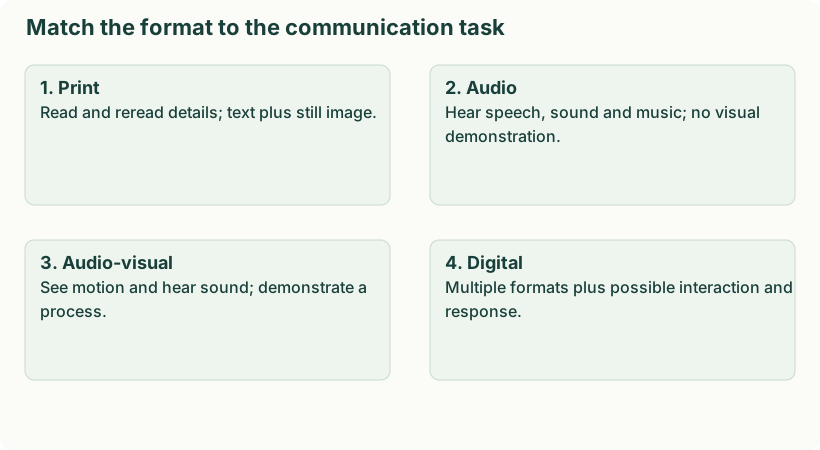
Diagram: Match the format to the communication task. Labels: Match the format to the communication task | Match the format to the communication task | 1. Print | Read and reread details; text plus still image. | 2. Audio | Hear speech, sound and music; no visual | demonstration. | 3. Audio-visual | See motion and hear sound; demonstrate a | process. | 4. Digital | Multiple formats plus possible interaction and | response.
These categories can overlap: a digital video is both digital and audio-visual; a digital newspaper uses print-style text but online distribution. Print is not necessarily published only once a day. Electronic and digital are not exact opposites: radio and television can also use digital transmission.