Advertising and Public Relations · M2 · read
DAGMAR and the ACCA stages
Unit 2 · Advertising models
M2 notes pp6–10 · includes AIDA, DRIP, DAGMAR, Ehrenberg and Maslow
Definition. DAGMAR stands for Defining Advertising Goals for Measured Advertising Results. It turns a communication task into a measurable objective.
In simple words. Bas “sales badhao” nahi: kisko, kitna change, kab tak aur kaise measure?
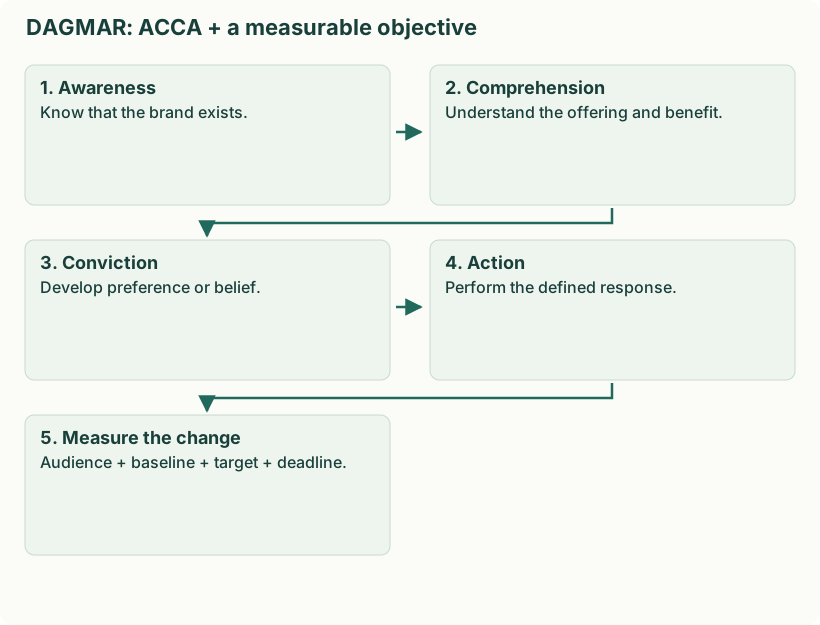
Diagram: DAGMAR: ACCA + a measurable objective. Labels: DAGMAR: ACCA + a measurable objective | DAGMAR: ACCA + a measurable objective | 1. Awareness | Know that the brand exists. | 2. Comprehension | Understand the offering and benefit. | 3. Conviction | Develop preference or belief. | 4. Action | Perform the defined response. | 5. Measure the change | Audience + baseline + target + deadline.
Understand it step by step
- Awareness: the audience knows the brand exists.
- Comprehension: it understands what the offering does and its relevant benefit. Recognition of a name alone is insufficient.
- Conviction: it develops a favourable belief or preference. This is stronger than understanding but not yet completed action.
- Action: the audience performs the defined response. Define whether that means enquiry, trial or purchase.
- A measurable goal: state target audience, present benchmark, required change and time period. Use a comparable evaluation method. Sales depend on distribution, price and competition as well as advertising.
See it in use
Practice question. Explain DAGMAR and state its requirements for an objective. [3 practice marks]
Answer
DAGMAR defines measurable communication goals through Awareness, Comprehension, Conviction and Action. A useful objective identifies the target audience, a concrete measurable task, the current benchmark, the desired change and a deadline. Evaluation compares the result with that specified objective.
Yaad rakho: ACCA: Aware → Clear meaning → Convinced → Act.