Advertising and Public Relations · TEE · mocks
TEE mock 1 · all questions and solutions
Two TEE mock papers · complete answers
100 attempted marks · 3 hours
Time: 3 hours. Maximum attempted marks: 100. Q1 is compulsory. Attempt any FOUR complete questions from Q2–Q7. Q1 has four parts of 5 marks each. Q2–Q6 have two parts of 10 marks each. Q7 is a 20-mark case. Both parts of a selected question must be answered. This is an authored mock aligned with the supplied course policy and archive pattern.
Q1(a) · Mock question. Define communication and explain its importance. [5 mock marks]
Answer
Definition. Communication enables people and organisations to share meaning, coordinate action, build understanding and respond to feedback.
In simple words. Message bhejna enough nahi; shared meaning aur useful response chahiye.
Understand it step by step
- Inform: explain facts, features, conditions and instructions accurately.
- Coordinate: align staff, agencies and partners around the same purpose and promise.
- Persuade: offer reasons for a choice while respecting the audience’s ability to judge.
- Build relationships: listen as well as speak; concerns can reveal a service problem requiring action.
- Evaluate: distinguish sending a message from receiving and understanding it. Feedback closes that gap.
See it in use
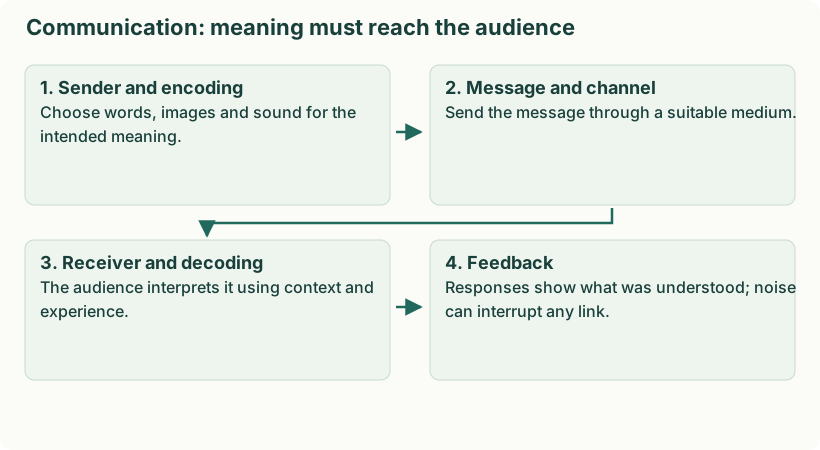
Definition. Communication is the process through which a sender encodes a message, sends it through a channel and receives an interpreted response from an audience.
In simple words. Brand kuch kehna chahta hai; audience uska meaning samajhti hai. Beech ka medium aur noise result badal sakte hain.
Understand it step by step
- Sender: the organisation communicates a purpose, such as introducing a refill bottle. Encoding converts that purpose into words, pictures and sound.
- Message and medium: the message is the meaning; the medium carries it. “Refill to reduce packaging” is a message; a newspaper or video platform is a medium.
- Receiver and decoding: the audience interprets the signs using language, experience and context. A technical word can be understood differently by different groups.
- Noise and feedback: clutter, poor sound, confusing wording or distrust can interrupt meaning. Questions, recall research and responses help the sender assess what was understood.
See it in use
Q1(b) · Mock question. Explain mediation of reality. [5 mock marks]
Answer
Mediation of reality
Definition. Mediation of reality explains how advertising presents selected, constructed representations of life that can influence how audiences interpret their own world.
In simple words. Ad life ka selected version dikhata hai; woh complete reality nahi hoti.
Understand it step by step
- An advertisement chooses a setting, characters, lighting and events. The choice makes some aspects visible and leaves others out.
- The resulting world may look ordinary while being carefully constructed: a family problem is resolved instantly or a lifestyle appears effortless.
- Repeated representations can influence expectations about normal life, success or relationships. Influence varies by audience; exposure does not mechanically control every viewer.
See it in use
Q1(c) · Mock question. Explain the concept of brand equity. [5 mock marks]
Answer
Definition. Brand equity is the additional value or response associated with a brand name and its accumulated awareness, associations, perceived quality and loyalty.
In simple words. Same category mein naam ki wajah se extra preference milna.
Understand it step by step
- Awareness: people can recognise or recall the brand when choosing.
- Associations and perceived quality: relevant, distinctive and credible meanings can reduce uncertainty and build preference.
- Loyalty: satisfactory experience may support repeat choice; it does not imply that every buyer is permanently loyal.
- Consequences: equity may support preference, price tolerance or acceptance of a new offering. It is not identical to sales revenue, a logo or a precise financial valuation.
See it in use
Q1(d) · Mock question. Distinguish advertising and public relations. [5 mock marks]
Answer
| Basis | Public relations | Advertising |
|---|---|---|
| Concept | Managing relationships and understanding with publics | Paid communication from an identified sponsor |
| Definition | A planned relationship and communication function | Sponsor-identified paid messages about an offering, organisation or idea |
| Driven by | Stakeholder relationships and organisational context | A specified communication task within marketing/organisational objectives |
| Type of communication | Emphasises listening and dialogue; some tools are one-way | Traditionally one-to-many; digital ads may allow response |
| Importance | Trust, understanding, cooperation and issue management | Awareness, information, preference and action |
The classroom contrast is “relationship-driven/two-way” versus “communication-driven/one-way”. Treat it as an emphasis, not an absolute: PR can use one-way statements and interactive advertising can receive feedback. PR also costs money and extends beyond earned media.
Why the distinction matters
- In an advertisement, the sponsor buys a defined placement and generally controls the submitted creative. That control does not guarantee audience attention or belief.
- In media relations, an organisation may offer a story or provide information, but a journalist decides independently whether and how to use it. The possibility of third-party credibility comes with limited control.
- PR also uses owned communication and dialogue: an employee meeting or community consultation is PR work even without a news story. Therefore, “PR equals free advertising” is an incorrect definition.
- Advertising effectiveness and PR effectiveness both require objectives and evaluation, but their immediate measures may differ. An ad campaign can seek product awareness while a consultation seeks understanding and resolution of community concerns.
Q2(a) · Mock question. Explain the types of communication and their uses. [10 mock marks]
Answer
Definition. Communication can be classified by form, direction, channel and degree of formality; these classifications answer different questions.
In simple words. Spoken/written kya? Formal/informal kya? One-way/two-way kya?
Understand it step by step
- Verbal: words communicated orally or in writing; oral communication uses speech while written communication leaves a readable record.
- Nonverbal: gesture, expression, posture, tone and space may modify meaning. Verbal and nonverbal signals can reinforce or contradict each other.
- Visual: images, diagrams, symbols, colour and layout convey relationships or information. Visual material still needs interpretation.
- Formal and informal: official structured communication differs from spontaneous conversation. Informal does not automatically mean inaccurate.
- One-way and two-way: a broadcast may mainly deliver information; a dialogue explicitly permits questions and feedback. A platform’s technical interactivity does not guarantee that the organisation actually listens.
See it in use
The five forms named in the faculty notes
| Course heading | Meaning | Advertising / PR example |
|---|---|---|
| Verbal / oral | Spoken words; the notes use verbal mainly in this oral sense. | An account executive explains the campaign proposal in a meeting. |
| Nonverbal | Expression, gesture, posture, tone and other cues that accompany or replace words. | A spokesperson’s attentive posture supports a respectful response. |
| Written | Messages recorded in readable words. | A clear email records the approved brief and deadline. |
| Active listening | Attend to the speaker, clarify uncertainty and summarise the meaning before responding. | The agency repeats the client’s objective in its own words and checks that it is correct. |
| Visual | Images, symbols, charts and layout convey information and relationships. | A storyboard shows how a product demonstration will unfold. |
These are the five headings on M1 pp6–7. In a broader classification, verbal means communication using words and can include writing; the course separates oral and written communication for teaching. Active listening is a receiving skill rather than a separate sensory channel, but retain it when the question asks for the faculty’s list. Formal/informal and one-way/two-way are additional classification bases, not replacements for the five forms.
Definition. Online communication uses internet-connected channels to exchange information synchronously or asynchronously.
In simple words. Live call aur baad mein read hone wala email—dono online, timing different.
Understand it step by step
- Synchronous: live chat or video calls allow immediate exchange but require common availability.
- Asynchronous: email, posts and messages can be read later and provide a record, but delay and missing tone can create misunderstanding.
- Advantages: distribution, multimedia, dialogue and coordination across locations.
- Limitations: access barriers, misinformation, distraction, privacy risks and rapid spread of errors. A deleted message may remain in screenshots.
- Good practice: identify the sender, use a descriptive subject, keep instructions clear, check facts and attachments, respect consent and respond appropriately.
See it in use
The five forms expected in the February 2026 question
| Form | Online example |
|---|---|
| Verbal/oral | Spoken explanation on a video call |
| Nonverbal | Facial expression, gesture and tone during that call |
| Written | A carefully worded email or chat |
| Active listening | Clarifying a customer’s concern and summarising it before responding |
| Visual | A labelled diagram or accessible product demonstration |
This classification concerns the forms and listening skills used online; synchronous/asynchronous instead classifies timing. State which basis you are using.
Six channel forms in M1 notes pp7–8
| Form | How it works | Illustrative use and limitation |
|---|---|---|
| A written message is delivered to addressed recipients and can be read later. | Send an approved brief with a clear subject and attachments. Large unsolicited mailings can damage trust; delivery is not proof of reading. | |
| SMS | A short text is delivered through a mobile messaging service. | A consent-based appointment reminder supplies time and location. Ordinary SMS does not require an internet connection on the recipient’s phone, although an organisation may send it through an online gateway. |
| Instant messaging | A messaging application supports rapid exchanges and may retain messages for later reading. | A project group confirms a revised deadline. Participants need not always be online simultaneously; do not confuse the platform name with guaranteed synchronous use. |
| Online forum | Messages and replies are organised into discussion threads. | A moderated customer forum collects questions about a product. Public answers require accuracy and moderation; individual posts may not represent all customers. |
| Shared whiteboard | Participants view or edit a visual canvas through connected software. | An agency team arranges storyboard scenes during a remote meeting. Permissions, accessibility and a saved record matter. |
| VoIP / video conferencing | Voice over Internet Protocol carries voice using IP networks; a video meeting adds visual communication. | A client briefing allows questions and screen sharing. Connectivity, sound, time zones and participant access can affect the exchange. |
Three communication requirements in the notes
- Clear and concise language: state the main action, define unfamiliar terms and avoid unexplained abbreviations.
- Appropriate tone: consider how words may be interpreted without face-to-face context; humour and sarcasm may not transfer well.
- Complete responses: answer the actual question, clarify missing information and give useful next steps. Completeness does not mean an unnecessarily long message.
Technical access, suitable software, accessibility and privacy arrangements support these three message-quality requirements. The notes mention Google Jamboard as an example; it is historical because the app ended on 31 December 2024. Learn the shared-whiteboard concept rather than relying on that discontinued product. Google’s end-of-life notice.
Q2(b) · Mock question. Explain communication barriers with examples. [10 mock marks]
Answer
Definition. A communication barrier is a condition that prevents or distorts the intended meaning between sender and receiver.
In simple words. Barrier ka naam likhke rukna nahi—meaning kaise bigda aur solution kya?
Understand it step by step
- Semantic: jargon, ambiguous words or language differences distort interpretation. Use audience-appropriate language and define unfamiliar terms.
- Physical or technical: noise, poor audio, tiny text or unreliable connectivity prevents access. Improve the format and offer alternative channels.
- Psychological: distrust, fear, assumptions or selective attention affects reception. Listen, acknowledge concerns and provide credible evidence.
- Organisational: unclear responsibility, hierarchy or inconsistent instructions slows or distorts messages. Clarify ownership and feedback routes.
- Cultural and accessibility: symbols or idioms may mean different things; formats may exclude people. Test with the intended audience and design accessibly.
See it in use
Emotional and attitudinal barriers
An emotional barrier occurs when anxiety, anger or distress makes a message difficult to process; respond calmly, acknowledge concerns and give manageable information. An attitudinal barrier occurs when rigid assumptions, prejudice or unwillingness to listen blocks consideration; use respectful dialogue and relevant evidence. These overlap with psychological barriers but are separate named headings in some schemes.
Explain each barrier through its effect on meaning
A complete explanation identifies the obstacle, shows how it changes or blocks understanding, and gives a relevant example. The following situations are illustrative; they are not reported historical campaigns.
| Barrier | How communication fails | Example and suitable correction |
|---|---|---|
| Semantic / language | Sender and receiver interpret the same words differently, or the receiver does not understand the vocabulary. | A plan advertises “unlimited data” but reduces speed after a threshold. Explain the limit and speed clearly rather than relying on an ambiguous headline. |
| Physical / technical | Noise, distance, poor equipment or a disrupted channel prevents the message from reaching the receiver accurately. | A railway announcement becomes inaudible in crowd noise. Repeat it clearly and provide a readable display with the same information. |
| Psychological | Preconceptions, distrust or selective attention affect interpretation even when the words arrive correctly. | A customer who distrusts the brand dismisses a new quality claim. Provide verifiable evidence and address the concern instead of merely repeating the claim. |
| Organisational | Too many levels, unclear responsibility or selective filtering delays or alters a message. | A sales team learns of an offer after customers have seen the advertisement. Use an approved shared brief and brief the staff before launch. |
| Cultural / accessibility | Symbols, language or formats do not suit the audience’s context or access needs. | A colour-only instruction cannot be distinguished by some viewers. Add words or symbols; translate and test culturally specific expressions with the intended audience. |
| Emotional | Fear, anger or stress interferes with listening and comprehension. | An angry customer cannot process a long explanation during a complaint. Acknowledge the problem, give one clear next step, and then explain the details. |
| Attitudinal | Unwillingness to listen, apathy or a dismissive attitude prevents constructive exchange. | A manager rejects staff feedback without examining it. Invite the specific concern, listen and explain the decision. |
Categories can overlap: emotional and attitudinal factors can also be described as psychological barriers. Keep each example distinct when an answer asks for five barriers. End by relating the remedy to the cause, rather than writing “improve communication” for every point.
Q3(a) · Mock question. Explain AIDA and DRIP with examples. [10 mock marks]
Answer
AIDA: attention → interest → desire → action
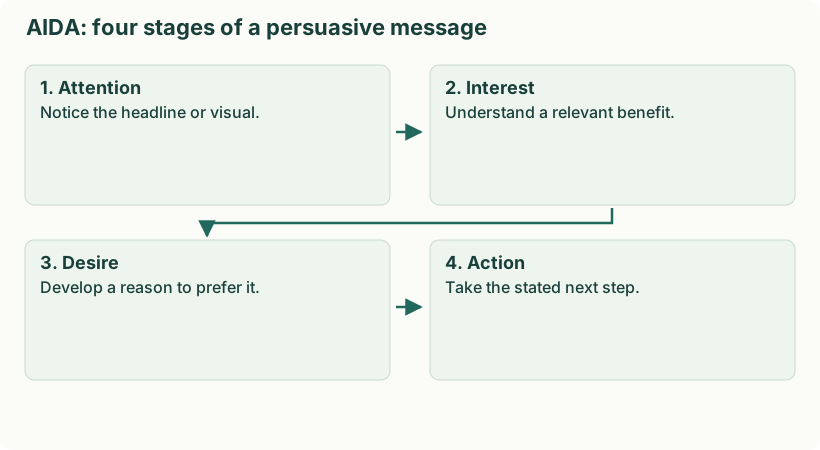
Definition. AIDA is a response-hierarchy model that organises persuasive communication into Attention, Interest, Desire and Action.
In simple words. Pehle notice, phir interest, phir chahiye, phir action.
Understand it step by step
- Attention: earn notice with a relevant headline or visual. The notes also use “Awareness” for this first stage; explain that the message must first be noticed and recognised.
- Interest: offer information that matters to the audience. A striking image without a relevant benefit may stop here.
- Desire: connect the benefit to the person’s need and provide reasons to prefer the offering. Interest is “this is useful”; desire is “I would like this”.
- Action: give a clear next step: visit, enquire, register or purchase. Make access easy and avoid inventing false urgency.
- Limit: AIDA is a planning model, not a guarantee that every buyer follows a strict linear sequence. Habit and repeated experience may produce a different journey.
See it in use
One advertisement explained at all four stages
| Stage | Communication task | Illustrative beginner-workshop advertisement |
|---|---|---|
| Attention | Make the intended audience notice the message. | A readable headline, “Build your first website”, and a clear example page catch the attention of students interested in creating a site. |
| Interest | Give relevant information that makes the audience continue considering the offer. | Explain that the workshop covers page structure, styling and publishing, and state the date and beginner prerequisites. |
| Desire | Turn interest into a personal reason to prefer or want the offering. | Show what a student can realistically complete with guided support and explain why that outcome is useful. Evidence and credible scope support preference. |
| Action | Make the next response clear and practical. | Give the registration link, fee, deadline and contact details. The next action is registration; exposure alone is not action. |
Interest versus desire: “I want to know what is taught” is interest; “this suitable workshop would help me make my own site” is desire. A persuasive message should not skip essential conditions just to attract attention. Buyers may move back and forth or act from habit, so AIDA is a planning framework rather than a universal prediction.
DRIP: four jobs of communication
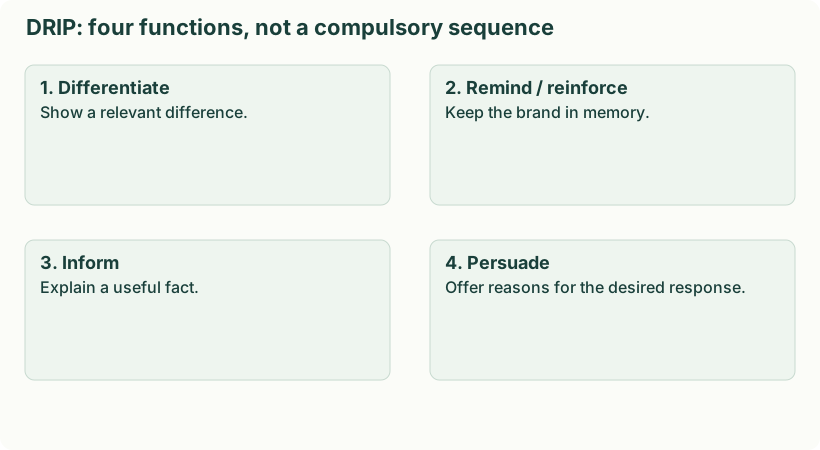
Definition. DRIP groups advertising tasks as Differentiate, Remind, Inform and Persuade.
In simple words. Alag kya hai, yaad rakh, jaan le, choose kar.
Understand it step by step
- Differentiate: explain a meaningful difference from alternatives. It must be relevant and supported, not an empty “best” claim.
- Remind / reinforce: maintain salience and reassure existing users. The notes discuss reinforcement under R; “Remind” is the acronym label used here.
- Inform: communicate features, availability, price or correct use when the audience lacks information.
- Persuade: provide reasons for the desired choice or action. DRIP tasks can overlap; they are not mandatory sequential stages.
See it in use
Q3(b) · Mock question. Explain the need for advertising and its role as a communication tool. [10 mock marks]
Answer
Definition. Advertising is sponsor-identified, paid communication used to inform, persuade or remind a selected audience about an offering, organisation or idea.
In simple words. Paid message ka purpose clear hona chahiye: inform, persuade ya remind.
Understand it step by step
- Inform: introduce a category or offering, explain benefits and clarify correct use.
- Persuade: communicate relevant differentiation and reasons for a choice.
- Remind and reinforce: maintain availability in memory and support previous satisfactory experience.
- Economic role: connect sellers and buyers and support demand; results depend on the wider marketing mix.
- Limitations: clutter, avoidance, credibility problems and measurement difficulties reduce effectiveness. Advertising cannot guarantee demand or excuse a defective product.
See it in use
Why these functions matter in an actual launch
- Reduce an information gap. A new offering cannot be considered if the audience does not know what it is, where it is available or how to use it. An advertisement can introduce these facts at scale. For a refill service, show both the benefit and the location of a refill point.
- Explain a meaningful difference. When alternatives look similar, the message can explain a supported feature and its practical benefit. “Repairable parts” becomes meaningful when the advertisement shows how that affects maintenance; a vague claim of being “best” supplies little useful information.
- Build recognition and retrieval. Consistent names, visual elements and messages help the audience identify the brand later. Amul’s topical archive illustrates how varied creative can retain a recognisable identity. Recognition helps choice but must be supported by satisfactory experience.
- Support intermediaries and availability. Consumer awareness may support retailers carrying an offering, but advertising cannot compensate for a product being unavailable when demanded. The communication team therefore coordinates with distribution and service teams.
- Enable a response and evaluation. A clear enquiry or registration route makes the requested action possible. Compare observed responses with the actual objective; do not assume that every purchase was caused by an ad or that every exposure produced a purchase.
Conclude by connecting advertising to the full marketing mix. Its useful contribution is communication: making an offering known, meaningful and memorable. Price, quality, access, competing messages and customer experience also affect outcomes.
Six need-of-advertising headings in M1 notes pp16–17
| Heading | Reasoned explanation |
|---|---|
| Support sales | Relevant information and persuasion can help demand when the offering, price and availability suit the buyer. Sales are a possible objective, not an automatic result. |
| Inform customers | Explain benefits, availability, correct use and relevant conditions so a buyer can consider the offering. |
| Retain customers | Reminders can reconnect a previous user with a satisfactory experience and a suitable occasion for repeat use. |
| Support employee morale | Credible positive communication can help employees understand and take pride in the offering. It will not compensate for poor working conditions or a false public promise. |
| Differentiate the brand | Communicate meaningful distinctions and maintain recognisable identity, rather than relying on an unsupported claim of superiority. |
| Support customer trust | Familiarity, substantiated information and consistent experience can support confidence. Repetition alone does not prove trustworthiness. |
Q4(a) · Mock question. Explain strategic planning in advertising. [10 mock marks]
Answer
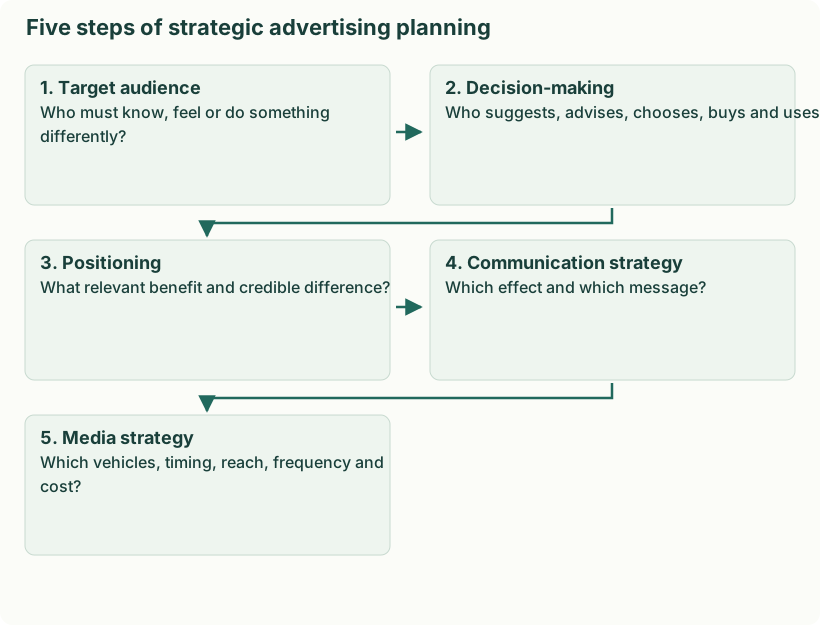
Definition. Strategic advertising planning connects a business objective to a selected audience, relevant position, communication objective and media delivery.
In simple words. Kisko → decision kaise → brand ka place → kya message → kahan dikhana.
Understand it step by step
- 1. Select the target audience: choose the group whose behaviour matters to the marketing objective.
- 2. Understand decision-making: identify roles, perceived risk, motivation and barriers.
- 3. Determine positioning: select the category frame, relevant benefit and reason to believe.
- 4. Develop communication strategy: decide the desired change in category need, awareness, attitude or intention and shape the message.
- 5. Set media strategy: choose vehicles, timing, reach and frequency that enable the intended audience to process the message.
See it in use
Develop the five steps as one connected plan
The marketing-plan review supplies the starting problem, product information, market assessment and business objective. The five steps then turn this brief into communication decisions. Each step produces an output used by the next; choosing a medium before understanding the audience can waste the budget.
Step 1. Select the target audience
Identify whose action is needed: category newcomers, competing-brand users, existing customers or intermediaries. Describe the group using relevant location, behaviour, needs and other evidence. Distinguish a trial objective from repeat purchase: someone who has never used the brand needs a reason to try, while an existing user may need reinforcement or a new usage occasion. The output is a clear audience profile, not “everyone”.
Step 2. Understand how that audience decides
Identify the initiator, influencer, decider, purchaser and user; these roles can overlap. Examine involvement, perceived risk, motivation and obstacles. A costly unfamiliar purchase needs more reassurance than a familiar routine purchase. Ask what information or experience would reduce the relevant barrier. The output is an explanation of how the audience chooses and what prevents the desired action.
Step 3. Determine the best positioning
Specify the category in which the offering competes, the important benefit for the selected audience and a credible reason to believe it. Positioning concerns the intended place in the audience’s mind relative to alternatives. A feature matters when its practical benefit is clear. Avoid choosing an attractive promise that the service cannot deliver. The output is a consistent position that guides the message and customer experience.
Step 4. Develop the communication strategy
Decide whether the immediate task concerns category need, brand awareness, brand attitude or purchase intention. Set an appropriate objective and then choose the main message, supporting evidence, appeal, tone and response requested. Awareness is not the same as sales: people may recognise a name without trusting it or being able to buy. The output is a communication brief that explains what the audience should understand, feel or intend and why.
Step 5. Set the media strategy
Select channels and specific vehicles that reach the target group in a suitable context. Decide timing, scheduling, geographic coverage, reach, frequency and budget. A demonstration needs a format that can show the process; a detailed comparison needs enough reading or viewing time. Repeated exposure may help recognition but cannot guarantee persuasion. The output is a delivery plan with measures related to the communication objective.
Evaluation closes the planning loop
Check delivery, communication effects and business results separately. If many students see the message but still misunderstand the estimate process, improve the explanation. If understanding improves but access is inconvenient, advertising alone will not fix the operational problem. Evaluation is feedback on the five-step plan, not an invented sixth item in the course’s named model.
Why planning matters
- It links creative work to a defined audience and objective.
- It coordinates positioning, message and media.
- It makes resource choices explicit and reduces inconsistent decisions.
- It supplies a basis for evaluating results and improving the next campaign.
Q4(b) · Mock question. Explain the process of media planning. [10 mock marks]
Answer
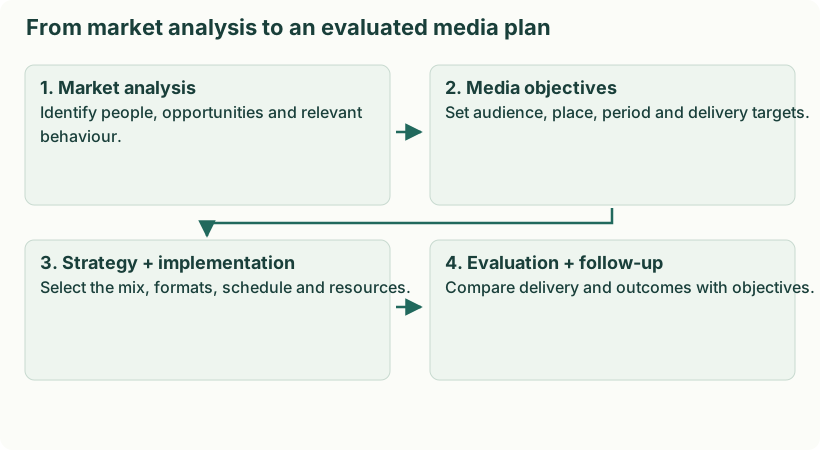
Definition. The media-plan process moves from market analysis to objectives, strategy implementation and evaluation.
In simple words. Pehle data, phir target, phir execution, phir result check.
Understand it step by step
- 1. Analyse the market: identify audience opportunities, competition, geography and the source of business.
- 2. Establish media objectives: specify whom to reach, where, within what period and with what exposure level. Include the budget constraint.
- 3. Develop and implement: select a media mix, vehicles, formats and schedule; arrange creative production and buying.
- 4. Evaluate and follow up: compare actual reach, frequency, cost and quality with planned delivery, and examine contribution to awareness or other communication outcomes.
- Interpretation: a plan can meet its impression target but fail its communication objective if the message is confusing or the audience is wrong.
See it in use
The four stages, with the decision made at each stage
Media planning turns a marketing and communication brief into a delivery plan. Each stage produces information needed by the next. The museum example below is a hypothetical teaching plan; the targets are chosen for explanation, not copied from a past paper.
1. Market analysis and target-market identification
Examine the product or service, the market, competitors and the audience. Identify the people the campaign must reach, their location, needs and media habits. Distinguish the total market from the selected target. The output is a supported audience description and an understanding of the communication problem.
Example: a museum wants nearby college students to know about a weekend programme. Research must establish which colleges can realistically attend, the travel constraints and which channels those students use. Buying nationwide exposure would waste much of a local programme’s budget.
2. Establish media objectives
Specify whom to reach, where, during what period, with what intended reach and repetition, within the available budget. Media objectives describe delivery; marketing objectives concern outcomes such as registrations or sales. Both matter, but exposure is not proof of a sale.
Example: aim to reach 60% of the defined nearby student audience during four weeks, with an appropriate repetition target. Record how reach will be estimated, so results can be evaluated against the same audience and period.
3. Develop and implement the media strategy
Choose a suitable combination of media and specific vehicles, allocate the budget, schedule placements and arrange execution. Consider audience fit, geographic coverage, message format, reach, frequency, timing, flexibility and cost. Coordinate the creative material with placement specifications and check that bookings run as agreed.
Example: combine approved college notices with geographically relevant digital placements. Begin before registration closes, use consistent event details and ensure every booking link reaches the correct information. The choice must follow audience evidence rather than the popularity of a platform.
4. Evaluation and follow-up
Compare actual delivery with the objectives: placements delivered, target reach, repeated exposures, cost and timing. Examine audience understanding and registrations separately to assess contribution to communication and marketing goals. Identify gaps and adjust later activity; do not claim that every registration was caused by one advertisement.
Example: if many impressions reach people outside the local area, refine the placements. If students see the message but misunderstand the date, revise the creative. Evaluation therefore diagnoses the problem rather than treating a large impression total as automatic success.
Q5(a) · Mock question. Explain brand management and its challenges. [10 mock marks]
Answer
Definition. Brand management coordinates product experience, identity and communication to maintain a clear and credible brand over time.
In simple words. Har touchpoint pe promise same aur experience reliable hona chahiye.
Understand it step by step
- Fragmented markets: groups differ in needs and behaviour; one message may not work for all. Variants add complexity and may increase total coordination costs.
- Fragmented media: audiences use different platforms and attention is divided. Adapt the format while keeping the core position recognisable.
- Informed audiences: reviews and comparison tools let buyers challenge claims. Transparency and service response matter.
- Shopper versus user: the person buying may differ from the person using. Packaging, retail availability and point-of-sale messages must support the purchase.
- Extension and consistency: new variants can create growth opportunities but also confusion, cannibalisation or dilution if they fit poorly.
See it in use
Definition. A line extension adds a variant within an existing product category. A brand extension uses an existing brand name in a different product category.
In simple words. Same category ka new version = line; new category = brand extension.
Understand it step by step
- Line extension: a new pack size, flavour or suitable variant within the existing category. State the category before classifying.
- Brand extension: the name moves into another category. Familiarity may help trial if the new offering fits the brand’s credibility.
- Benefits: meet varied needs and use existing recognition. Benefits are possible, not automatic profits.
- Risks: variants may cannibalise sales or confuse buyers; a poorly fitting new category can weaken associations.
See it in use
Q5(b) · Mock question. Explain Reach, Frequency and Weight of advertising with calculations. [10 mock marks]
Answer
Reach, coverage, frequency and effective reach
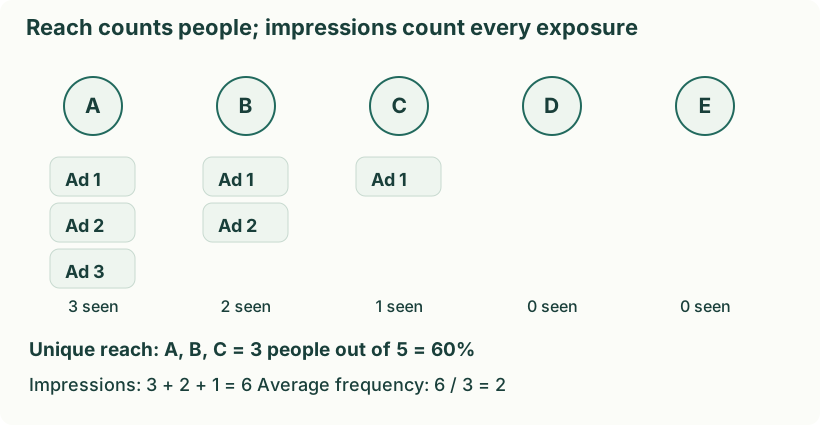
Definition. Reach counts distinct people exposed at least once during a defined period. Frequency measures repeated exposures. Coverage describes the potential audience accessible through a medium or plan.
In simple words. Reach mein banda ek baar count; impressions mein har exposure count.
Understand it step by step
- Universe: first define the entire target audience and period. “60% reach” is meaningless without saying 60% of whom and over what duration.
- Unduplicated reach: a person exposed five times contributes one person to reach, not five. Overlap between media must be removed.
- Average frequency: divide total exposures by the number reached. It is an average among reached people; it need not be an integer.
- Effective reach: the percentage meeting a specified exposure threshold, for example at least three opportunities. The threshold is part of the plan, not a universal law.
- Attention and outcome: an opportunity to see is not proof of noticing, remembering or purchasing. Excess repetition may waste resources or create fatigue.
 LaTeX:
\text{Reach \%}=\frac{\text{unique people reached}}{\text{target population}}\times100 LaTeX:
\bar f=\frac{\text{gross exposures}}{\text{unique people reached}}Continue to three complete reach / overlap examples →
See it in use
Gross impressions, rating and GRP
Definition. Gross impressions count all exposures, including repetitions. A rating expresses an audience as a percentage of a defined universe. Gross rating points sum rating points across insertions or equal reach percentage multiplied by average frequency for the same audience and period.
In simple words. Gross = repeat bhi count. GRP unique logon ka percent nahi hai.
Understand it step by step
- Impressions: if 2,000 people each have three exposures, they create 6,000 gross exposures. They still represent 2,000 unique people.
- Rating: divide the audience of a programme or insertion by its relevant universe and multiply by 100. Check whether the figure refers to people or households.
- GRP: multiply reach expressed as a percentage number, such as 60, by average frequency. 60 × 4 = 240 GRPs; do not use 0.60 in that version of the formula.
- Consistency: the reach-frequency formula requires matched target definition and period. Do not mix household ratings with person-based reach.
- Interpretation: GRP can exceed 100 because it counts repeated opportunities, not a population share. A high total does not prove unique reach or effectiveness.
 LaTeX:
\text{GRP}=R_{\%}\times\bar f LaTeX:
\text{Gross impressions}=\sum_i n_i f_iSee it in use
Worked examples for the requested measures
The original paper supplies no figures. The 16 May 2026 Q4(a) explicitly asks for examples showing calculations; the examples below use the faculty M2 notes pp27–28. State the assumptions and interpret each measure. CPM is not part of this question.
1. Reach: 3,000 distinct people out of 10,000
Given
| Quantity | Value |
|---|---|
| Unique people reached | 3,000 |
| Target population | 10,000 |
| Period | One month |
To find
Percentage of the target reached at least once.
Formula and why
 LaTeX:
R_{\%}=\frac{n}{N}\times100Here n is the distinct people reached and N is the whole target. Divide part by whole, then multiply by 100.
Step-by-step solution
Step 1. Substitute the two counts
 LaTeX:
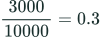
R_{\%}=\frac{3000}{10000}\times100Step 2. Divide to obtain the share
 LaTeX:
\frac{3000}{10000}=0.3Step 3. Convert the share to a percentage
 LaTeX:
0.3\times100=30\%Final answer: 30% reach.
2. Average frequency: two distinct audience groups
Given
| Group | Distinct people | Exposures each |
|---|---|---|
| 1 | 1500 | 3 |
| 2 | 1500 | 6 |
To find
Gross exposures, unduplicated reach and average frequency.
Formula and why
 LaTeX:
I=\sum_i n_i f_i,\qquad n=\sum_i n_i,\qquad\bar f=\frac{I}{n}Multiply each group size by its frequency; then add. The reach sum is valid because the question explicitly says the groups do not overlap.
Step-by-step solution
Step 1. Count exposures for group 1
 LaTeX:
1500\times3=4500Step 2. Count exposures for group 2
 LaTeX:
1500\times6=9000Step 3. Add all group exposures
 LaTeX:
4500+9000=13500Step 4. Count distinct people
 LaTeX:
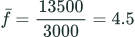
1500+1500=3000Step 5. Divide exposures by people reached
 LaTeX:
\bar f=\frac{13500}{3000}=4.5Final answer: Gross exposures = 13,500; reach = 3,000 people; average frequency = 4.5.
3. Message weight: gross impressions
Given
| Group | Distinct people | Exposures each |
|---|---|---|
| 1 | 6000 | 5 |
| 2 | 6000 | 7 |
| 3 | 3000 | 3 |
To find
Gross exposures, unduplicated reach and average frequency.
Formula and why
LaTeX: I=\sum_i n_i f_i,\qquad n=\sum_i n_i,\qquad\bar f=\frac{I}{n}Multiply each group size by its frequency; then add. The reach sum is valid because the question explicitly says the groups do not overlap.
Step-by-step solution
Step 1. Count exposures for group 1
 LaTeX:
6000\times5=30000Step 2. Count exposures for group 2
 LaTeX:
6000\times7=42000Step 3. Count exposures for group 3
 LaTeX:
3000\times3=9000Step 4. Add all group exposures
 LaTeX:
30000+42000+9000=81000Step 5. Count distinct people
 LaTeX:
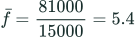
6000+6000+3000=15000Step 6. Divide exposures by people reached
 LaTeX:
\bar f=\frac{81000}{15000}=5.4Final answer: Gross exposures = 81,000; reach = 15,000 people; average frequency = 5.4.
4. Message weight: gross rating points
Given
| Reach | Average frequency | Target |
|---|---|---|
| 75% | 5.4 | 20000 |
To find
GRP, reached people and impressions.
Formula and why
 LaTeX:
\text{GRP}=R_{\%}\bar f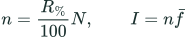 LaTeX:
n=\frac{R_{\%}}{100}N,\qquad I=n\bar fUse the percentage number in GRP. Divide it by 100 when finding a fraction of the population.
Step-by-step solution
Step 1. Calculate GRP
 LaTeX:
75\times5.4=405\text{ GRPs}Step 2. Convert reach to a fraction
 LaTeX:
75\div100=0.75Step 3. Calculate unique people reached
 LaTeX:
0.75\times20000=15000Step 4. Calculate gross impressions
 LaTeX:
15000\times5.4=81000Final answer: 405 GRPs; 15,000 people; 81,000 gross impressions.
Q6(a) · Mock question. Explain the process of public relations. [10 mock marks]
Answer
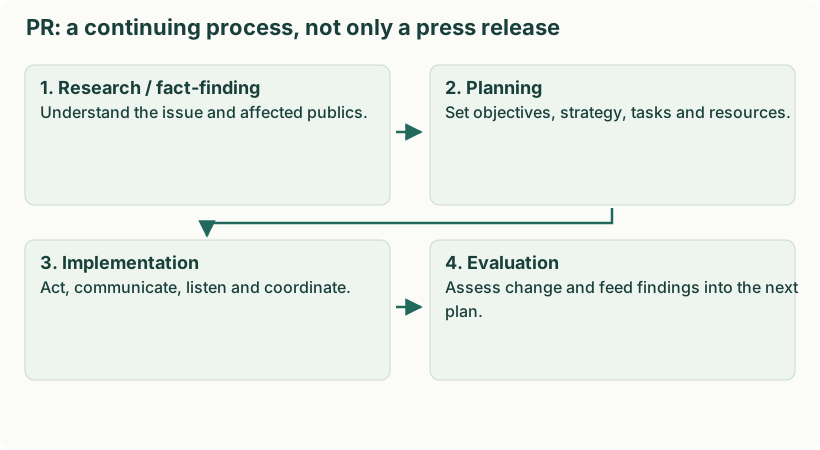
Definition. The PR process uses evidence to identify a relationship problem, plan a response, implement it and evaluate its effects.
In simple words. Pehle problem samjho; press release se seedha start mat karo.
Understand it step by step
- Research: identify the issue, relevant publics, baseline understanding and organisational constraints. Use interviews, surveys, records and listening.
- Planning: set specific objectives, prioritise publics, choose strategy, messages, responsibilities, budget and evaluation measures.
- Implementation: carry out the planned actions and communication; brief spokespeople, coordinate channels and respond to feedback.
- Evaluation: distinguish outputs (what was produced), understanding/attitude effects and outcomes (what changed). Compare with the baseline and objective.
- Iteration: use findings to improve both organisational action and communication. The RACE labels—Research, Action planning, Communication, Evaluation—describe a closely related planning sequence.
See it in use
Definition. Public relations is a planned communication and management activity that develops understanding and relationships between an organisation and groups that affect or are affected by it.
In simple words. Publics matlab sirf customers nahi—employees, community, media sab relevant ho sakte hain.
Understand it step by step
- Identify publics: employees, customers, investors, suppliers, local communities, government and journalists have different interests.
- Listen and advise: research concerns and tell management when organisational behaviour, not merely wording, needs to change.
- Communicate and engage: explain decisions, answer questions and make dialogue possible.
- Build credibility: align statements with action over time. Reputation cannot be repaired sustainably with slogans alone.
- Evaluate: assess understanding, trust, relationship quality and relevant behaviour, rather than only counting media mentions.
See it in use
Course headings for PR objectives
- Identify the target publics and their needs.
- Set clear, measurable objectives for understanding, trust or behaviour.
- Analyse the context and relevant issues.
- Reach the right public through a suitable place and time.
- Adapt relevant content to feedback while maintaining factual consistency.
These headings, used in the December 2025 scheme, are planning requirements supporting PR objectives; an actual objective must still specify the change sought.
Q6(b) · Mock question. Explain tools used in public relations. [10 mock marks]
Answer
Definition. PR tools include media materials, owned channels, events, speaking opportunities, employee communication and programmes that create opportunities for dialogue.
In simple words. Tool ka naam + kya deliver karta + audience ke kaam kaise aata.
Understand it step by step
- Press kit: a release with background, factsheets and approved visual assets.
- Audio release: recorded factual material suitable for audio use; distinguish an editorial resource from a paid audio spot.
- Mat / matte release: prepared feature-style material supplied for publication, often with a useful service angle; sponsorship must not be disguised.
- Website pressroom: a maintained source for current statements, background and media contacts.
- Media tour: coordinated spokesperson meetings with relevant outlets; provide facts and allow questions.
- Newsletter: regular updates for a defined audience, such as employees or members.
- Events and functions: planned opportunities for demonstration, interaction and stakeholder contact.
- Speaking engagements: explain expertise or policy to a relevant audience without unsupported claims.
- Employee interaction: briefings, question sessions and feedback channels build internal understanding.
- CSR-related communication: explain real social or environmental action with evidence. CSR is organisational responsibility, not merely a publicity tactic.
See it in use
Definition. Media-relations tools provide journalists with accurate, usable material while respecting editorial independence.
In simple words. Newsworthy facts do; coverage ka guarantee mat likho.
Understand it step by step
- Press release: a concise announcement with an informative headline, lead, verified facts, approved attributed quote, background and contact.
- Media kit: supporting factsheets, backgrounders, biographies where relevant, verified images with permissions, and a question-and-answer document.
- Press conference / briefing: useful when an important development requires explanation and questions; prepare factual answers and record follow-up needs.
- Interview / statement: a trained spokesperson gives clear, accurate responses. If a fact is unknown, state what is being checked instead of inventing it.
- Media monitoring: track issues, accuracy and audience response; correct factual errors respectfully. Coverage counts alone do not measure relationship quality.
See it in use
Q7 · Mock question. Analyse the case study of Nike “Find Your Greatness” with the campaign idea, communication model, media approach and critical conclusion. [20 mock marks]
Answer
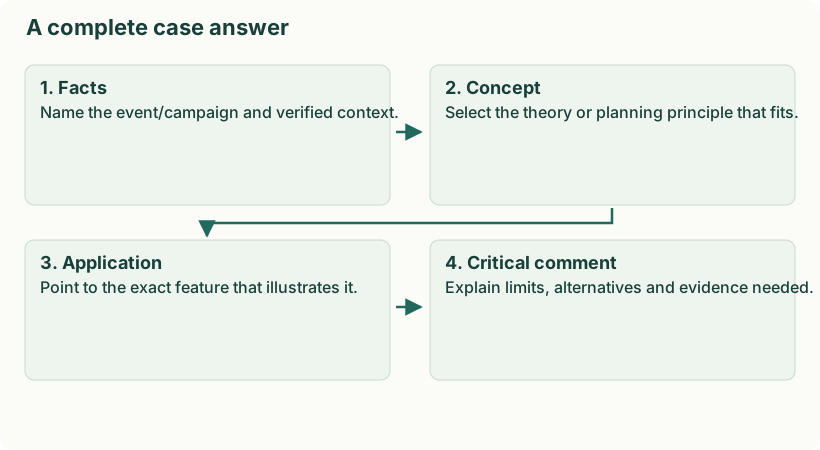
1. Background and communication problem
2. Strategy and application of concepts
- Context and audience: The Olympic period creates attention around exceptional athletic achievement. The creative provides a different point of identification: ordinary people who try. Analyse the intended audience as people interested in participation and self-improvement, not only spectators of elite competition.
- Positioning: The message connects Nike with athletic effort and personal potential. This moves the discussion beyond shoe specifications to the brand’s meaning. The position remains relevant to the sports category, which makes the emotional association understandable.
- Creative idea: Using different Londons creates a coherent device across geographically different scenes. It joins local examples under a global idea. Explain how the repeated device supplies unity, instead of merely listing the countries or people shown.
- Advertising theory: Magic of meaning links sports products and the brand to achievement. Maslow’s self-actualisation category is a useful classroom interpretation of the invitation to develop potential. Because the film features ordinary effort, it can broaden identification rather than relying only on celebrity imitation.
- Message response: The unexpected connection can attract attention; relevant human effort can create interest; identification may build desire to participate. The call is motivational rather than necessarily a direct immediate purchase instruction. Do not force every AIDA stage into a claim the film does not show.
- Integrated identity: The film’s meaning can work with consistent brand presentation across touchpoints. In an exam, explain the role of coherent positioning, rather than claiming a specific media spend or placement schedule that is not supplied.
3. Outcome and what the evidence permits
The verified evidence establishes the creative approach and launch-period message. The supplied question asks about sales and reputation, but neither its scheme nor the reviewed agency account gives a defensible causal sales calculation. Explain how the principles could support brand meaning; do not invent a percentage increase.
4. Critical comments
- The timing invites an association with global sport, but it does not by itself establish official Olympic sponsorship. Do not describe Nike as an official event sponsor on this evidence.
- Emotional engagement is not proof of product preference or sales caused by the film. Evaluation would need exposure, brand-response and business evidence with appropriate comparisons.
- A broad motivational message can be memorable while giving little functional product information. Its suitability therefore depends on the campaign’s brand objective.
5. Conclusion
The case is useful because it connects a defined audience need with a recognisable message and supporting action. A strong exam answer explains those connections and separates observed facts from assumptions about impact.