Advertising and Public Relations · TEE · papers
Q5A · Explain the following models used in advertising: (i) DAGMAR and (ii) Ehrenburg
2022-12-02 · Semester V final
Actual TEE paper · 100 marks · Q1 compulsory + any four complete Q2–Q7
2022-12-02 · Q5A · Previous-paper question. Explain the following models used in advertising: (i) DAGMAR and (ii) Ehrenburg. [10 marks]
Answer
DAGMAR and the ACCA stages
Definition. DAGMAR stands for Defining Advertising Goals for Measured Advertising Results. It turns a communication task into a measurable objective.
In simple words. Bas “sales badhao” nahi: kisko, kitna change, kab tak aur kaise measure?
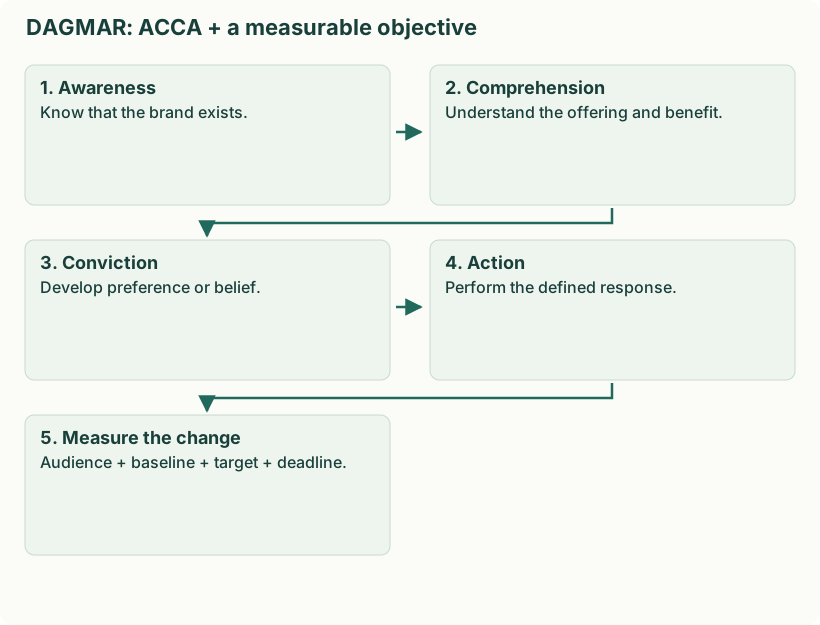
Diagram: DAGMAR: ACCA + a measurable objective. Labels: DAGMAR: ACCA + a measurable objective | DAGMAR: ACCA + a measurable objective | 1. Awareness | Know that the brand exists. | 2. Comprehension | Understand the offering and benefit. | 3. Conviction | Develop preference or belief. | 4. Action | Perform the defined response. | 5. Measure the change | Audience + baseline + target + deadline.
Understand it step by step
- Awareness: the audience knows the brand exists.
- Comprehension: it understands what the offering does and its relevant benefit. Recognition of a name alone is insufficient.
- Conviction: it develops a favourable belief or preference. This is stronger than understanding but not yet completed action.
- Action: the audience performs the defined response. Define whether that means enquiry, trial or purchase.
- A measurable goal: state target audience, present benchmark, required change and time period. Use a comparable evaluation method. Sales depend on distribution, price and competition as well as advertising.
See it in use
Ehrenberg: awareness, trial, reinforcement and nudging
Definition. The course’s Ehrenberg model describes advertising through Awareness, Trial, Reinforcement and Nudging, particularly for established or frequently purchased brands.
In simple words. Naam pata → ek baar try → experience se bharosa → gentle reminder.
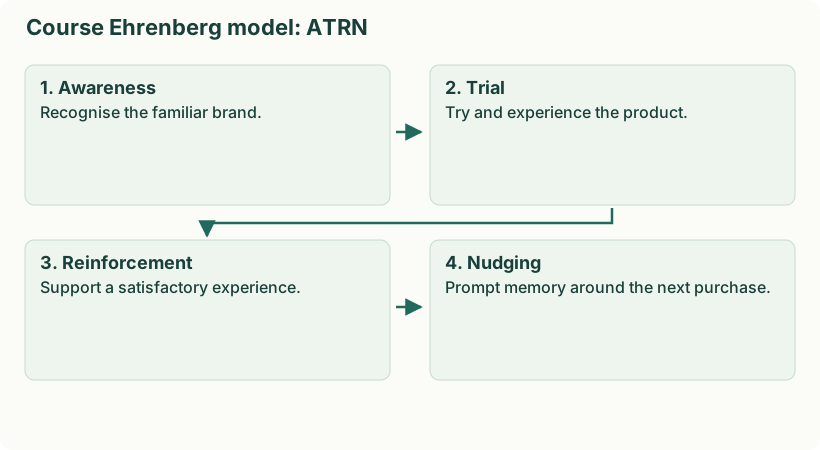
Diagram: Course Ehrenberg model: ATRN. Labels: Course Ehrenberg model: ATRN | Course Ehrenberg model: ATRN | 1. Awareness | Recognise the familiar brand. | 2. Trial | Try and experience the product. | 3. Reinforcement | Support a satisfactory experience. | 4. Nudging | Prompt memory around the next purchase.
Understand it step by step
- Awareness: make the brand available in memory and easy to recognise.
- Trial: encourage an initial purchase or use. The customer learns from experience.
- Reinforcement: remind the user of a satisfactory experience and strengthen the existing choice. Advertising cannot create genuine product satisfaction by assertion alone.
- Nudging: keep the brand easy to recall near another purchase. This is the fourth classroom label in the supplied notes; other accounts often abbreviate the framework to ATR.
- Contrast: strong hierarchy models emphasise persuasive movement in attitudes before action. Ehrenberg’s weaker view gives a substantial role to trial, habit and reinforcement.