Advertising and Public Relations · TEE · papers
Q5A · Explain the following models used in advertising: (i) AIDA and (ii) DRIP
2023-02-08 · Semester V re-exam
Actual TEE paper · 100 marks · Q1 compulsory + any four complete Q2–Q7
2023-02-08 · Q5A · Previous-paper question. Explain the following models used in advertising: (i) AIDA and (ii) DRIP. [10 marks]
Answer
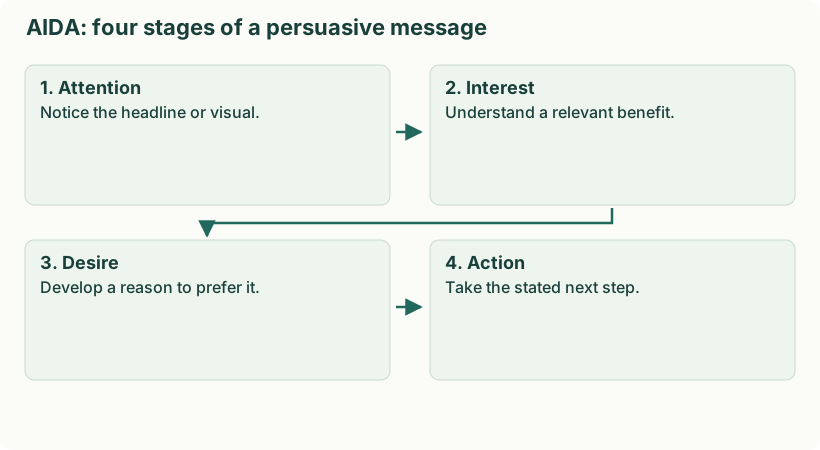
AIDA: attention → interest → desire → action
Definition. AIDA is a response-hierarchy model that organises persuasive communication into Attention, Interest, Desire and Action.
In simple words. Pehle notice, phir interest, phir chahiye, phir action.
Understand it step by step
- Attention: earn notice with a relevant headline or visual. The notes also use “Awareness” for this first stage; explain that the message must first be noticed and recognised.
- Interest: offer information that matters to the audience. A striking image without a relevant benefit may stop here.
- Desire: connect the benefit to the person’s need and provide reasons to prefer the offering. Interest is “this is useful”; desire is “I would like this”.
- Action: give a clear next step: visit, enquire, register or purchase. Make access easy and avoid inventing false urgency.
- Limit: AIDA is a planning model, not a guarantee that every buyer follows a strict linear sequence. Habit and repeated experience may produce a different journey.
See it in use
One advertisement explained at all four stages
| Stage | Communication task | Illustrative beginner-workshop advertisement |
|---|---|---|
| Attention | Make the intended audience notice the message. | A readable headline, “Build your first website”, and a clear example page catch the attention of students interested in creating a site. |
| Interest | Give relevant information that makes the audience continue considering the offer. | Explain that the workshop covers page structure, styling and publishing, and state the date and beginner prerequisites. |
| Desire | Turn interest into a personal reason to prefer or want the offering. | Show what a student can realistically complete with guided support and explain why that outcome is useful. Evidence and credible scope support preference. |
| Action | Make the next response clear and practical. | Give the registration link, fee, deadline and contact details. The next action is registration; exposure alone is not action. |
Interest versus desire: “I want to know what is taught” is interest; “this suitable workshop would help me make my own site” is desire. A persuasive message should not skip essential conditions just to attract attention. Buyers may move back and forth or act from habit, so AIDA is a planning framework rather than a universal prediction.
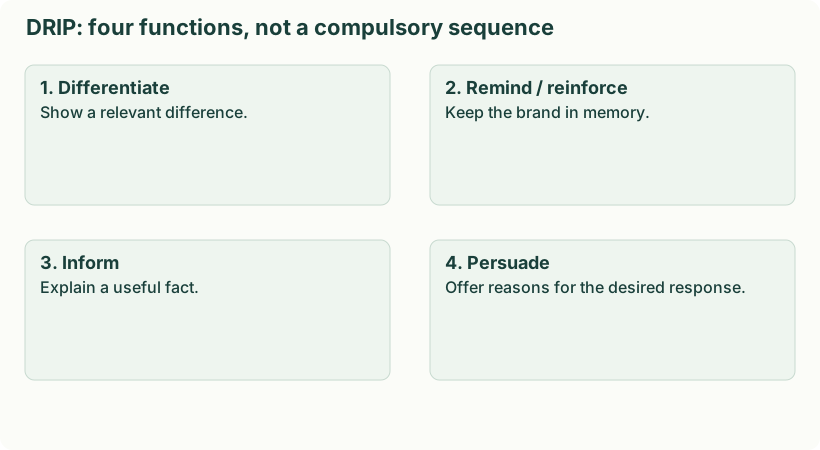
DRIP: four jobs of communication
Definition. DRIP groups advertising tasks as Differentiate, Remind, Inform and Persuade.
In simple words. Alag kya hai, yaad rakh, jaan le, choose kar.
Understand it step by step
- Differentiate: explain a meaningful difference from alternatives. It must be relevant and supported, not an empty “best” claim.
- Remind / reinforce: maintain salience and reassure existing users. The notes discuss reinforcement under R; “Remind” is the acronym label used here.
- Inform: communicate features, availability, price or correct use when the audience lacks information.
- Persuade: provide reasons for the desired choice or action. DRIP tasks can overlap; they are not mandatory sequential stages.