Advertising and Public Relations · TEE · papers
Q7 · Discuss the Case Study of Royal Enfield. Discuss the case study completely, and justify all the important principles which helped to increase the sales and reputation of the brand using public relations instead of advertising, with your comments
2023-07-06 · Semester VI re-exam
Actual TEE paper · 100 marks · Q1 compulsory + any four complete Q2–Q7
2023-07-06 · Q7 · Previous-paper question. Discuss the Case Study of Royal Enfield. Discuss the case study completely, and justify all the important principles which helped to increase the sales and reputation of the brand using public relations instead of advertising, with your comments. [20 marks]
Answer
1. Background and communication problem
2. Strategy and application of concepts
- Publics: Existing riders, enthusiasts, prospective buyers, dealers and relevant media have different relationships with the brand. Community activity particularly involves people who already identify with riding.
- Experience: A ride or gathering provides participation and interaction. The brand is encountered through an activity rather than only through a purchased message. The experience must still be well organised and responsibly managed.
- Identity and belonging: Participants can associate the brand with shared interests and a riding identity. This is a reasoned connection to belonging and symbolic meaning, not proof that every attendee experiences the same emotion.
- Advocacy and attention: Participants may share stories and journalists may cover events. These possibilities can create earned attention, but organisers cannot guarantee favourable independent coverage.
- Product support: A community promise needs reliable products, service, dealer support and responsible event practice. Communication benefits weaken if the customer experience contradicts the identity.
- Evaluation: Useful measures include participant experience, continued engagement, relationship indicators and qualified enquiries. Sales attribution requires additional evidence beyond event attendance.
3. Outcome and what the evidence permits
The documented activities establish a community-based approach. They support analysis of engagement and brand meaning; the sources here do not isolate the share of sales generated by PR.
4. Critical comments
- The older question frames the case as PR “instead of advertising”. Demonstrating strong PR activity does not prove the brand never used paid advertising.
- Event participation may reflect existing loyalty as well as create it; do not automatically reverse cause and effect.
- Avoid treating unsafe riding or exclusionary community behaviour as desirable brand building.
5. Conclusion
The case is useful because it connects a defined audience need with a recognisable message and supporting action. A strong exam answer explains those connections and separates observed facts from assumptions about impact.
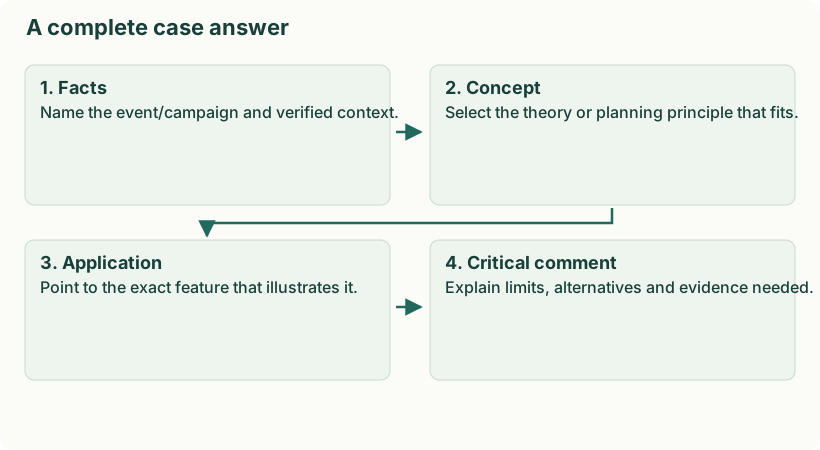
Diagram: A complete case answer. Labels: A complete case answer | A complete case answer | 1. Facts | Name the event/campaign and verified context. | 2. Concept | Select the theory or planning principle that fits. | 3. Application | Point to the exact feature that illustrates it. | 4. Critical comment | Explain limits, alternatives and evidence needed.